

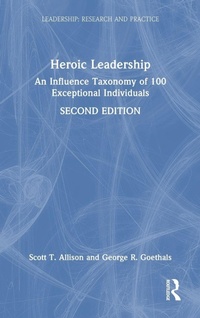
Heroic Leadership
An Influence Taxonomy of 100 Exceptional Individuals
2nd Edition
Published on 30. December 2024
Book
Hardback
248 pages
978-1-032-35807-9 (ISBN)
Description
Heroic Leadership is a celebration of our greatest heroes, from well-known legends to the legions of unsung heroes who transform our world quietly behind the scenes. Now in its second edition, this book offers a compelling conceptual framework for understanding heroism and heroic leadership, drawing from theories of great leadership and heroic action.
With over 50 revised heroic leader profiles, and 30 new profiles of individuals that have transformed the world, the book explores the many counterintuitive ways that heroes lead, shape, and mobilize their followers. The authors offer a definition of heroic leadership that explains how people easily misconstrue both leadership and heroism, and provide an innovative take on why people are drawn to heroic leaders, and why this can be considered a "fatal attraction". Incorporating the latest theory and research, the authors unpack the following ten categories of heroism: trending heroes, transitory heroes, transparent heroes, transitional heroes, tragic heroes, transposed heroes, transitional heroes, traditional heroes, transforming heroes, and transcendent heroes. From within these categories, the authors identify 100 exceptional individuals, describing their lives and how they exemplify the characteristics of the category they have been assigned.
Suggesting that our most cherished heroes make for our most transforming leaders, this is a vital resource for students and scholars of leadership studies, organizational behaviour and social psychology. Presenting valuable insights into the lives of both historical and modern leaders, the book is also a fascinating read for casual readers.
With over 50 revised heroic leader profiles, and 30 new profiles of individuals that have transformed the world, the book explores the many counterintuitive ways that heroes lead, shape, and mobilize their followers. The authors offer a definition of heroic leadership that explains how people easily misconstrue both leadership and heroism, and provide an innovative take on why people are drawn to heroic leaders, and why this can be considered a "fatal attraction". Incorporating the latest theory and research, the authors unpack the following ten categories of heroism: trending heroes, transitory heroes, transparent heroes, transitional heroes, tragic heroes, transposed heroes, transitional heroes, traditional heroes, transforming heroes, and transcendent heroes. From within these categories, the authors identify 100 exceptional individuals, describing their lives and how they exemplify the characteristics of the category they have been assigned.
Suggesting that our most cherished heroes make for our most transforming leaders, this is a vital resource for students and scholars of leadership studies, organizational behaviour and social psychology. Presenting valuable insights into the lives of both historical and modern leaders, the book is also a fascinating read for casual readers.
Reviews / Votes
Praise for the Previous Edition:"A pioneering and insightful examination of the intersection of heroes and leaders by two gifted psychologists. Allison and Goethals' captivating narrative adds a new dimension to current research on leadership."
James MacGregor Burns, author of Leadership and Roosevelt: The Lion and the Fox.
"Allison and Goethals' stimulating and incisive survey of one-hundred influential leaders could not be more cogent or timely. When so many of our leaders seem to have feet of clay and principles that bend with the prevailing breezes,they remind us of those leaders who rose to the occasion and stood firm in their moment of decision. As a result, they and their leadership have stood the test of time. Heroic Leadership offers arefreshingly original and provocativeperspective on what it means to be a great leader. Reading this book not only informs us, it also inspires! My only suggestion would be that we expand their list to 102-adding their names in appreciation of their heroic scholarly labors!"
Roderick M. Kramer, William R. Kimball Professor of Organizational Behavior, Graduate School of Business, Stanford University, USA.
"Scott T. Allison and George R. Goethals are pioneering scholars exploring the psychology of heroism and leadership, and this book outlines their contention that while all heroes are leaders, the converse is not true. They make their case by offering snapshots of 100 characters, some fictional, some collective, and some surprising who instantiate their taxonomy of heroes. For researchers and lay people alike, this book is packed with fascinating insights into the psychology of leadership, heroism, and mere celebrity. It is a book to be enjoyed by everyone who wonders why some people attract public attention, and others, who may deserve it (e.g., parents, soldiers, teachers) do not."
David Messick, Morris and Alice Kaplan Professor of Ethics and Decision in Management Emeritus, Kellogg School of Management, Northwestern University, USA.
"Presenting vivid accounts of distinguishable forms of heroism, this is a welcome contribution to understanding heroic aspects of leader-follower relations. It deserves a place as a text, reference source, and feast of revealing narratives. The accounts chosen capture what individuals' special qualities underlie and activate others' sense of the "heroic," based on five factors affecting a leader's influence. This yields ten types of heroes that are profiled, from "trending" and "transitory" to "transforming" and "transcendent." Among those receiving attention in this cavalcade are the "tragic", and many shown as the "moral". Insightful analyses of individual cases provide an illuminating blend of scientific scrutiny with compelling storytelling."
Edwin P. Hollander, Emeritus, CUNY, Baruch College, and University Graduate Center, USA.
"In this book, Scott T. Allison and George R. Goethals continue their fascinating study of heroes which they began in their earlier book entitled Heroes: What They Do and Why We Need Them."
Jon P. Howell, Professor Emeritus, New Mexico State University, USA.
More details
Series
Edition
2nd edition
Language
English
Place of publication
London
United Kingdom
Publishing group
Taylor & Francis Ltd
Target group
College/higher education
Professional and scholarly
Academic, General, Postgraduate, and Undergraduate Advanced
Illustrations
1 s/w Tabelle, 14 s/w Abbildungen, 14 s/w Photographien bzw. Rasterbilder
1 Tables, black and white; 14 Halftones, black and white; 14 Illustrations, black and white
Dimensions
Height: 235 mm
Width: 157 mm
Thickness: 19 mm
Weight
543 gr
ISBN-13
978-1-032-35807-9 (9781032358079)
Copyright in bibliographic data and cover images is held by Nielsen Book Services Limited or by the publishers or by their respective licensors: all rights reserved.
Schweitzer Classification
Other editions
Additional editions
Scott T. Allison | George R. Goethals
Heroic Leadership
An Influence Taxonomy of 100 Exceptional Individuals
E-Book
12/2024
2nd Edition
Routledge
€63.49
Available for download
Scott T. Allison | George R. Goethals
Heroic Leadership
An Influence Taxonomy of 100 Exceptional Individuals
E-Book
12/2024
2nd Edition
Routledge
€63.49
Available for download
Scott T. Allison | George R. Goethals
Heroic Leadership
An Influence Taxonomy of 100 Exceptional Individuals
Book
12/2024
2nd Edition
Routledge
€69.90
Shipment within 10-20 days
Previous edition
Scott T. Allison | George R. Goethals
Heroic Leadership
An Influence Taxonomy of 100 Exceptional Individuals
Book
03/2013
1st Edition
Routledge
€215.41
Article exhausted; check for reprint
Persons
Scott T. Allison is Professor Emeritus of Psychology at the University of Richmond, USA. He has published extensively on heroism and leadership and numerous books, including Heroes, Heroic Humility, Conceptions of Leadership, The Romance of Heroism, The Hazards of Great Leadership, and the Handbook of Heroism and Heroic Leadership. His work has appeared in USA Today, National Public Radio, The New York Times, The Los Angeles Times, Slate Magazine, MSNBC, CBS, Psychology Today, and the Christian Science Monitor. He has received Richmond's Distinguished Educator Award and the Virginia Council of Higher Education's Outstanding Faculty Award.
George R. Goethals is the E. Claiborne Robins Distinguished Professor in Leadership Studies Emeritus at the University of Richmond, USA. Previously he held academic and administrative appointments at Williams College where he served as the chair of the Department of Psychology, Acting Dean of the Faculty, Provost, and, finally, founder and chair of the Program in Leadership Studies. He taught courses on theories of leadership and presidential leadership. His recent scholarship focuses on presidential leadership, heroism and leader-follower dynamics. He has received the Lifetime Achievement Award from the International Leadership Association and Richmond's Distinguished Scholarship Award.
George R. Goethals is the E. Claiborne Robins Distinguished Professor in Leadership Studies Emeritus at the University of Richmond, USA. Previously he held academic and administrative appointments at Williams College where he served as the chair of the Department of Psychology, Acting Dean of the Faculty, Provost, and, finally, founder and chair of the Program in Leadership Studies. He taught courses on theories of leadership and presidential leadership. His recent scholarship focuses on presidential leadership, heroism and leader-follower dynamics. He has received the Lifetime Achievement Award from the International Leadership Association and Richmond's Distinguished Scholarship Award.
Content
1. Introduction
2. Trending Heroes: Gaining or Losing Heroic Status
3. Transitory Heroes: Hero Today, Gone Tomorrow
4. Transitional Heroes: Those Whom We Outgrow
5. Tragic Heroes: The Self-Destruction of Greatness
6. Transposed Heroes: The Fine Line Between Heroism & Villainy
7. Transparent Heroes: The Unsung Heroes Among Us
8. Traditional-Moral Heroes
9. Traditional-Competent Heroes
10. Traditional-Complete Heroes
11. Transfigured Heroes: The Cognitive Construction of Greatness
12. Transforming Heroes: Those Who Forever Changed Our World
13. Transcendent Heroes: Influence at its Deepest Level
14. Conclusion: Leadership, Heroism, and Heroic Leadership
2. Trending Heroes: Gaining or Losing Heroic Status
3. Transitory Heroes: Hero Today, Gone Tomorrow
4. Transitional Heroes: Those Whom We Outgrow
5. Tragic Heroes: The Self-Destruction of Greatness
6. Transposed Heroes: The Fine Line Between Heroism & Villainy
7. Transparent Heroes: The Unsung Heroes Among Us
8. Traditional-Moral Heroes
9. Traditional-Competent Heroes
10. Traditional-Complete Heroes
11. Transfigured Heroes: The Cognitive Construction of Greatness
12. Transforming Heroes: Those Who Forever Changed Our World
13. Transcendent Heroes: Influence at its Deepest Level
14. Conclusion: Leadership, Heroism, and Heroic Leadership