

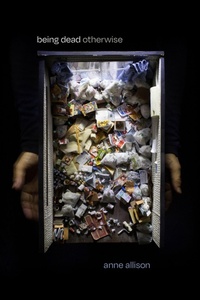
Being Dead Otherwise
Published on 10. March 2023
Book
Hardback
256 pages
978-1-4780-1714-1 (ISBN)
Description
With an aging population, declining marriage and childbirth rates, and a rise in single households, more Japanese are living and dying alone. Many dead are no longer buried in traditional ancestral graves where descendants would tend their spirits, and individuals are increasingly taking on mortuary preparation for themselves. In Being Dead Otherwise Anne Allison examines the emergence of new death practices in Japan as the old customs of mortuary care are coming undone. She outlines the proliferation of new industries, services, initiatives, and businesses that offer alternative means---ranging from automated graves, collective grave sites, and crematoria to one-stop mortuary complexes and robotic priests---for tending to the dead. These new burial and ritual practices provide alternatives to long-standing traditions of burial and commemoration of the dead. In charting this shifting ecology of death, Allison outlines the potential of these solutions to radically reorient sociality in Japan in ways that will impact how we think about the end of life, identity, tradition, and culture in Japan and beyond.
Reviews / Votes
"This is an extraordinary book. . . . Startling stories of mortician contests, robot Buddhist priests, and clean-up crews dealing with the odor of death illustrate change and the crisis of care in a society where good health care has made very old age a common experience, yet family and community have not kept up to provide solatia and death care for the increasing population of those in need. Highly recommended. Advanced undergraduates through faculty; professionals." - M. White (Choice) "As an ethnography of death, these stories are as diverse as the humans they represent . . . Being Dead Otherwise is a highly recommended read not only for those who are interested in Japanese death rituals and concepts of the world beyond the living, but also for those who want to explore what it means when a society is faced with extreme ageing, dissolution of large family structures, urbanization, and potential anonymization." - Marius Palz (Folklore) "Allison's writing is both straightforward and vivid, making her story relatable to those readers not entirely familiar with contemporary Japan; there is also something endearingly warm about her voice, as she considers this book 'the most personal of all my scholarly endeavors' (p. xi)." - Shunsuke Nozawa (American Ethnologist) "For researchers who make developing the cross-cultural model of grief central to their scholarship Being Dead Otherwise should be one of the important books in their library."- Dennis Klass (Omega) "The methods of the book are a lively combination of anthro-journalistic techniques for tracing out leads. . . . Not in the least technical, this book is easily accessible to anyone interested in how contemporary Japan is preparing - or not - for this part of its aging future." - Robert C. Marshall (Anthropology and Aging) "Allison stitches together a fascinating patchwork of scenes from various sites across Japan, revealing the potential of necro-animism to capture both practices of care and of control." - Jason Danely (Journal of Development Studies) "This book will be of interest to scholars and graduate students interested in necro versus biopolitics, relationality and affect, and care work." - Pamela Runestad (Journal of Asian Studies) "Being Dead Otherwise is a seminal ethnographic work on death, and a refreshing counter to the crisis narratives commonly used to describe modern Japan. . . . This is an important work on modern Japan but also for the studies of end-of-life and death more generally, presenting not only other ways of being dead but also other ways of living in anticipation of death." - Natasha Durie (Journal of the Anthropological Society of Oxford) "The strength of the present work lies in Allison's nuanced fieldwork with bereaved families, those anticipating their own death, and representatives of the funeral industry. She has done a brilliant job of describing the fast-changing deathscape here in Japan." - Tom Gill (Journal of Japanese Studies)
More details
Language
English
Place of publication
North Carolina
United States
Target group
Professional and scholarly
Product notice
Cloth over boards
Illustrations
19 illustrations, including 8 in color
Dimensions
Height: 231 mm
Width: 152 mm
Thickness: 10 mm
Weight
522 gr
ISBN-13
978-1-4780-1714-1 (9781478017141)
Copyright in bibliographic data and cover images is held by Nielsen Book Services Limited or by the publishers or by their respective licensors: all rights reserved.
Schweitzer Classification
Person
Anne Allison is Professor of Cultural Anthropology at Duke University and author of Precarious Japan, also published by Duke University Press, Millennial Monsters: Japanese Toys and the Global Imagination, and Nightwork: Sexuality, Pleasure, and Corporate Masculinity in a Tokyo Hostess Club.
Content
Prelude ix
Acknowledgments xi
Introduction 1
Histories
1. Ambiguous Bones: Dead in the Past 25
2. The Popular Industry of Death: From Godzilla to the Ending Business 47
Preparations
3. Caring (Differently) for the Dead 73
4. Preparedness: A Biopolitics of Making Life Out of Death 99
Departures
5. The Smell of Lonely Death and the Work of Cleaning It Up 123
6. De-parting: The Handling of Remaindered Remains 149
Machines
7. Automated Graves: The Precarity and Prosthetics of Caring for the Dead 173
Epilogue 191
Notes 197
Bibliography 215
Index 231
Acknowledgments xi
Introduction 1
Histories
1. Ambiguous Bones: Dead in the Past 25
2. The Popular Industry of Death: From Godzilla to the Ending Business 47
Preparations
3. Caring (Differently) for the Dead 73
4. Preparedness: A Biopolitics of Making Life Out of Death 99
Departures
5. The Smell of Lonely Death and the Work of Cleaning It Up 123
6. De-parting: The Handling of Remaindered Remains 149
Machines
7. Automated Graves: The Precarity and Prosthetics of Caring for the Dead 173
Epilogue 191
Notes 197
Bibliography 215
Index 231