

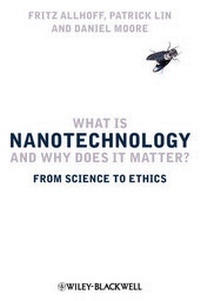
What Is Nanotechnology and Why Does It Matter?
From Science to Ethics
Published on 28. January 2010
Book
Paperback/Softback
304 pages
978-1-4051-7544-9 (ISBN)
Description
Ongoing research in nanotechnology promises both innovations and risks, potentially and profoundly changing the world. This book helps to promote a balanced understanding of this important emerging technology, offering an informed and impartial look at the technology, its science, and its social impact and ethics.
* Nanotechnology is crucial for the next generation of industries, financial markets, research labs, and our everyday lives; this book provides an informed and balanced look at nanotechnology and its social impact
* Offers a comprehensive background discussion on nanotechnology itself, including its history, its science, and its tools, creating a clear understanding of the technology needed to evaluate ethics and social issues
* Authored by a nanoscientist and philosophers, offers an accurate and accessible look at the science while providing an ideal text for ethics and philosophy courses
* Explores the most immediate and urgent areas of social impact of nanotechnology
Reviews / Votes
"This book deserves to be read by anyone interested in why nanotechnology is important and why it matters, and particularly by anyone new to this field. For those already familiar with some (if not all) of the topics that the book covers, there is still some benefit to be gained from reading about some of the latest applications in areas in which they may not have such detailed knowledge. It also permits the reader to take a critical stance on the topics and arguments raised in the book, especially since the book's objective is to prompt the dialogue that is needed to achieve further progress and to continue to broaden the debates." (Nanoethics, 1 October 2014)""However, for the reader looking for general background about nanotechnology and many of its social and ethical issues, the book is worth reading, as long as its arguments are carefully scrutinized and increased understanding of connections among such issues is not expected." (Bioethical Inquiry, 2011)
"I highly recommend this book. It is certain that nanotechnology's advance will continue, affecting many facets of our lives. Fritz Allhof, Patrick Lin, and Daniel Moore have provided the best available overview of the many changes that one can expect to see as a result of nanotechnology's continued advances, and the many ethical implications inherent in this advance. While the authors ask many more questions than they answer, they prepare the intellectual landscape for the ethical debates that are certain to take place over the coming years regarding the often-insidious infusion of various manifestations of nanotechnology into our society." (Journal of Military Ethics, 19 April 2012)
"In their recent publication, What is Nanotechnology and Why Does it Matter: From Science to Ethics, the authors Fritz Allhoff, Patrick Lin, and Daniel Moore search for answers to these two questions-questions which, whether directly addressed or not, underlie all scholarly, political, and consumer protection writings on nanotechnology. In this 260 page, thirteen-chapter book, the authors come impressively close to providing satisfying answers to these questions." (Amber Hottes, Nanotechnology Law & Business, Volume 7, Issue 2)
"As with a number of other such books in print, "What is Nanotechnology and why does it Matter?" brings both scientific knowledge and Ethical/Legal/Societal implications (ELSI) to bear. It heralds the profound changes of nanotechnology while attempting to provide an effective way to deliberate ELSI, as nanotechnology unfolds into full development. In seeking to "tame a riot of speculation" [ix], Allhoff, Lin, and Moore reveal much of the complexity of the ongoing discourse on this matter, leaving quandary on multiple related issues. The tripartite layout of the book demarcates particular areas of expertise represented by the individual authors, in an unusual collaboration that brings distinctive breadth to a relatively well-published area of inquiry." (Rosalyn W. Berne, The Journal of Philosophy, Science & Law, Volume 11, 10 October 2011)
"The book is well-suited to be used either as a coherent text for introductory courses focused specifically on nanotechnology, or used as stand-alone chapters that can be selected to augment and supplement readings in a wide range of courses in fields such as public policy, engineering, sociology, or philosophy of science. The highly interdisciplinary perspective offered in this book should also serve as a model of how scholars can effectively collaborate across fields in ways that break down obstacles and connect findings across disciplines that are all-too-often isolated." (Evan S. Michelson, Science and Public Policy, 2011)
"Overall What is Nanotechnology and Why does it Matter? From Science to Ethics makes an important contribution to the literature as it offers an overview of the nature and implications of nanotechnology. Scientists, researchers, students, industry executives and policymakers will find this volume extremely informative and useful. As advancements in nanotechnology will take place, further dialogues and debates are needed to move nano-products responsibly into the market." (Fabrice Jotterand, International Journal of Applied Philosophy,2010)
"Undoubtedly, reading this book will stimulate a great deal of discussion, which is, perhaps, its chief merit. From this viewpoint the great breadth of coverage is a definite advantage, because it ensures that there is a great variety of food for thought in the content." (Nanotechnology Perceptions, 1 November 2010)
"This book was very carefully constructed. Painstaking internal cross-reference refer the reader to fuller discussions of topics in other chapters. Nearly every chapter, at the start and conclusion, includes a few sentences on scope." (Nanotechnology Law & Business, summer 2010)
More details
Edition
1. Auflage
Language
English
Place of publication
Hoboken
United Kingdom
Publishing group
John Wiley and Sons Ltd
Target group
College/higher education
Professional and scholarly
Product notice
Paperback (trade)
Unsewn / adhesive bound
Dimensions
Height: 229 mm
Width: 152 mm
Thickness: 16 mm
Weight
443 gr
ISBN-13
978-1-4051-7544-9 (9781405175449)
Schweitzer Classification
Other editions
Additional editions

Fritz Allhoff | Patrick Lin | Daniel Moore
What Is Nanotechnology and Why Does It Matter?
From Science to Ethics
Book
01/2010
Wiley-Blackwell
€103.06
Article exhausted; check different version
Fritz Allhoff | Patrick Lin | Daniel Moore
What Is Nanotechnology and Why Does It Matter?
From Science to Ethics
E-Book
11/2009
Wiley-Blackwell
€33.99
Available for download
Persons
Fritz Allhoff is Assistant Professor in the Department of Philosophy at Western Michigan University, where he also holds an affiliation with the Mallinson Institute for Science Education. He has held fellowships at the Center for Philosophy of Science at the University of Pittsburgh and the Centre for Applied Philosophy and Public Ethics at the Australian National University. He has edited more than 20 books, including two on the social and ethical implications of nanotechnology.
Patrick Lin is the director of Ethics + Emerging Sciences Group at California Polytechnic State University, San Luis Obispo, and holds academic appointments at Dartmouth College, US Naval Academy and Western Michigan University. He is also lead author of a recent major report funded by the Department of Navy entitled Autonomous Military Robotics: Risk, Ethics, and Design (2008), as well as other publications in technology ethics, including edited anthologies on nanoethics.
Daniel Moore is a research scientist on nanoscale semiconductor solutions for IBM. He served on the Georgia Institute of Technology's honor committee and has received numerous fellowships, including the Molecular Design Institute Fellowship, the GT Nanoscience and Technology Fellowship, the School of Materials Science and Engineering Advanced Publication Award, the NSF STEP Fellowship, and a Sam Nunn Security Fellowship. His professional experience includes nanoscale research in other leading industry laboratories.
Content
Unit 1: What is Nanotechnology?
1. The Basics of Nanotechnology
2. Tools of the Trade
3. Nanomaterials
4. Applied Nanotechnology
Unit 2: Risk, Regulation, and Fairness
5. Risk and Precaution
6. Regulating Nanotechnology
7. Equity and Access
Unit 3: Ethical and Social Implications
8. Environment
9. Military
10. Privacy
11. Medicine
12. Enhancement
Conclusion