

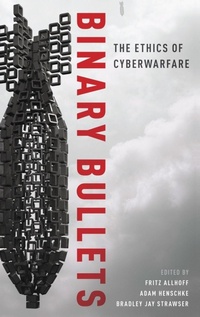
Binary Bullets
The Ethics of Cyberwarfare
Published on 18. February 2016
Book
Hardback
316 pages
978-0-19-022107-2 (ISBN)
Description
Philosophical and ethical discussions of warfare are often tied to emerging technologies and techniques. Today we are presented with what many believe is a radical shift in the nature of war-the realization of conflict in the cyber-realm, the so-called "fifth domain " of warfare. Does an aggressive act in the cyber-realm constitute an act of war? If so, what rules should govern such warfare? Are the standard theories of just war capable of analyzing and assessing this mode of conflict? These changing circumstances present us with a series of questions demanding serious attention. Is there such a thing as cyberwarfare? How do the existing rules of engagement and theories from the just war tradition apply to cyberwarfare? How should we assess a cyber-attack conducted by a state agency against private enterprise and vice versa? Furthermore, how should actors behave in the cyber-realm? Are there ethical norms that can be applied to the cyber-realm? Are the classic just war constraints of non-combatant immunity and proportionality possible in this realm? Especially given the idea that events that are constrained within the cyber-realm do not directly physically harm anyone, what do traditional ethics of war conventions say about this new space? These questions strike at the very center of contemporary intellectual discussion over the ethics of war.
In twelve original essays, plus a foreword from John Arquilla and an introduction, Binary Bullets: The Ethics of Cyberwarfare, engages these questions head on with contributions from the top scholars working in this field today.
In twelve original essays, plus a foreword from John Arquilla and an introduction, Binary Bullets: The Ethics of Cyberwarfare, engages these questions head on with contributions from the top scholars working in this field today.
Reviews / Votes
Binary Bullets is an engaging collection of essays on ethics involved in cyberwarfare. Rather than a shared thesis, divergent voices and opinions advance the debatea valuable frame of reference for ethics perspectives based on the current character of hostile efforts in the cyber realm. * Nicholas Sambaluk, Humanities and Social Sciences Online12/10/2016 * In summary, this volume is philosophically rich, empirically informative, and eminently relevant; it is a must-read for anyone interested in the topic of cyberwarfare or war in general. * Saba Bazargan-Forward, Notre Dame Philosophical Reviews Online * Binary Bullets: The Ethics of Cyberwarfare will prove to be an important book for scholars and practitioners alike. The former will benefit from the volume's probing chapters across a swath of issues integral to a more comprehensive conceptualization of cyberwarfare. The latter will profit from policy implications abstracted from such rigorous reflection. * Paul Lushenko, Journal of Military Ethics *More details
Other editions
Additional editions
Book
02/2016
Oxford University Press Inc
€56.80
Shipment within 15-20 days
E-Book
01/2016
1st Edition
OUP eBook
€19.99
Available for download
E-Book
01/2016
1st Edition
OUP eBook
€25.49
Available for download
Persons
Fritz Allhoff is an Associate Professor in the Department of Philosophy and an Adjunct Community Associate Professor in the Homer Stryker School of Medicine at Western Michigan University.
Adam Henschke is a Research Fellow at the National Research College of Australian National University College of Asia and the Pacific.
Bradley Jay Strawser is an Assistant Professor of Philosophy in the Defense Analysis Department at the Naval Postgraduate School in Monterey, CA.
Adam Henschke is a Research Fellow at the National Research College of Australian National University College of Asia and the Pacific.
Bradley Jay Strawser is an Assistant Professor of Philosophy in the Defense Analysis Department at the Naval Postgraduate School in Monterey, CA.
Editor
Associate Professor of PhilosophyAssociate Professor of Philosophy, Homer Stryker School of Medicine at Western Michigan University
Research FellowResearch Fellow, National Research College of Australian National University College of Asia and the Pacific
Assistant Professor of PhilosophyAssistant Professor of Philosophy, Naval Postgraduate School
Content
Contents ; Notes on Contributors ; Foreword John Arquilla ; Introduction ; I Foundational Norms for Cyberwarfare ; 1. Emerging Norms for Cyberwarfare George R. Lucas, Jr. ; 2. The Emergence of International Legal Norms for Cyber-Conflict Michael N. Schmitt and Liis Vihul ; 3. Distinctive Ethical Issues of Cyberwarfare Randall R. Dipert ; II Cyberwarfare and the Just War Tradition ; 4. Cyber Chevauchees: Cyber War Can Happen David Whetham ; 5. Cyberwarfare as Ideal War Ryan Jenkins ; 6. Post-Cyber: Dealing With The Aftermath of Cyber-Attacks Brian Orend ; III ETHOS OF CYBERWARFARE ; 7. Beyond Tallinn: The Code of the Cyber-Warrior?>" Matthew Beard ; 8. Immune from Cyber-Fire? The Psychological & Physiological Effects of Cyberwarfare Daphna Canetti, Michael L. Gross, & Israel Waismel-Manor ; 9. Beyond Machines: Humans in Cyber Operations, Espionage, and Conflict David Danks and Joseph H. Danks ; IV CYBERWARFARE, DECEPTION, AND PRIVACY ; 10. Cyber Perfidy, Ruse, and Deception Heather M. Roff ; 11. Cyber-attacks and 'Dirty Hands': Cyberwar, Cyber-crimes or Covert Political Action? Seumas Miller ; 12. Moral Concerns with Cyber Espionage: Automated Key-word Searches and Data-Mining Michael Skerker ; Index