

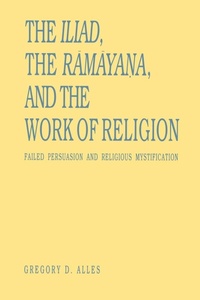
The Iliad, the Ramaya?a, and the Work of Religion
Failed Persuasion and Religious Mystification
Will be published approx. on 15. September 1994
Book
Paperback/Softback
216 pages
978-0-271-01320-6 (ISBN)
Description
One often reads that literature works to construct worlds of meaning. This book argues that the Iliad and the Ramayana did not construct worlds so much as address them. It argues further that the worlds the Iliad and the Ramayana addressed were worlds in which words did not mean so much as persuade. In both ancient Greece and India, persuasion was central to harmonious social interaction. The failure of persuasion marked the limits of the patterns that configured human society; it also threatened social chaos. The work of the Iliad and the Ramayana was to transcend the limits and mystify the threat. In performing this work, the two poems made the configurations of social order fundamentally tenable. They also enabled them to endure up to the present day.
Gregory Alles seeks to bring an awareness of some of the limits of significant ideological practices in the academic study of religions, especially the pursuit known as the history of religions. In the twentieth century, the history of religions has been formulated as a hermeneutical discipline. Its task has been to understand religious meanings, in whatever way the process of understanding meanings has been conceived. This investigation suggests, however, that a hermeneutical history of religions is too narrow. Among other things, it overlooks the religious work that these two poems perform. This study proposes that historians of religions conceive of their task not as hermeneutics but as history, that is, as a principled investigation of events in which religion occurs.
Gregory Alles seeks to bring an awareness of some of the limits of significant ideological practices in the academic study of religions, especially the pursuit known as the history of religions. In the twentieth century, the history of religions has been formulated as a hermeneutical discipline. Its task has been to understand religious meanings, in whatever way the process of understanding meanings has been conceived. This investigation suggests, however, that a hermeneutical history of religions is too narrow. Among other things, it overlooks the religious work that these two poems perform. This study proposes that historians of religions conceive of their task not as hermeneutics but as history, that is, as a principled investigation of events in which religion occurs.
Reviews / Votes
"The aim of this book is to expose and analyze the means by which two classic narratives from two radically different cultures, Valmiki's Ramayana, of ancient India and Homer's Iliad of classical Greece, 'mystify' the social, cultural, and ultimately existential dangers of 'failed persuasion.' The author submits that these narratives 'mystified' the very limits in the patterns of persuasion by which their social orders were arranged, and thereby 'rendered human association tenable and tolerable.' This book unquestionably makes a significant contribution not only to the history of religions but also to religion and literature and comparative literature as well."-Eric Ziolkowski, Lafayette College
More details
Series
Language
English
Place of publication
Pennsylvania
United States
Target group
College/higher education
Professional and scholarly
Product notice
Paperback (trade)
Dimensions
Height: 229 mm
Width: 152 mm
Thickness: 13 mm
Weight
358 gr
ISBN-13
978-0-271-01320-6 (9780271013206)
Copyright in bibliographic data and cover images is held by Nielsen Book Services Limited or by the publishers or by their respective licensors: all rights reserved.
Schweitzer Classification
Person
Gregory D. Alles is Associate Professor of Religious Studies and Coordinator of Cross-Cultural Studies at Western Maryland College.