

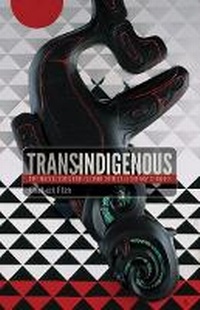
Trans-Indigenous
Methodologies for Global Native Literary Studies
Published on 3. October 2012
Book
Hardback
336 pages
978-0-8166-7818-1 (ISBN)
Description
What might be gained from reading Native literatures from global rather than exclusively local perspectives of Indigenous struggle? In Trans-Indigenous, Chadwick Allen proposes methodologies for a global Native literary studies based on focused comparisons of diverse texts, contexts, and traditions in order to foreground the richness of Indigenous self-representation and the complexity of Indigenous agency.
Through demonstrations of distinct forms of juxtaposition-across historical periods and geographical borders, across tribes and nations, across the Indigenous-settler binary, across genre and media-Allen reclaims aspects of the Indigenous archive from North America, Hawaii, Aotearoa New Zealand, and Australia that have been largely left out of the scholarly conversation. He engages systems of Indigenous aesthetics-such as the pictographic discourse of Plains Indian winter counts, the semiotics of Navajo weaving, and Maori carving traditions, as well as Indigenous technologies like large-scale North American earthworks and Polynesian ocean-voyaging waka-for the interpretation of contemporary Indigenous texts. The result is a provocative reorienting of the call for Native intellectual, artistic, and literary sovereignty that fully prioritizes the global Indigenous.
Through demonstrations of distinct forms of juxtaposition-across historical periods and geographical borders, across tribes and nations, across the Indigenous-settler binary, across genre and media-Allen reclaims aspects of the Indigenous archive from North America, Hawaii, Aotearoa New Zealand, and Australia that have been largely left out of the scholarly conversation. He engages systems of Indigenous aesthetics-such as the pictographic discourse of Plains Indian winter counts, the semiotics of Navajo weaving, and Maori carving traditions, as well as Indigenous technologies like large-scale North American earthworks and Polynesian ocean-voyaging waka-for the interpretation of contemporary Indigenous texts. The result is a provocative reorienting of the call for Native intellectual, artistic, and literary sovereignty that fully prioritizes the global Indigenous.
Reviews / Votes
"Chadwick Allen's articulation of a Trans-Indigenous methodology is clear-minded, robust, and urgent. A committed focus on specific texts is underpinned by deep and genuinely reflective intellectual, ethical, and political commitments. Trans-Indigenous both emphasizes and will be a key player in the configuration of global Indigenous literary studies; yet it is able, through its sheer specificity, to speak provocatively and productively beyond a singular discipline or nation." -Alice Te Punga Somerville, Victoria University of WellingtonMore details
Series
Language
English
Place of publication
Minnesota
United States
Dimensions
Height: 216 mm
Width: 140 mm
Thickness: 28 mm
ISBN-13
978-0-8166-7818-1 (9780816678181)
Copyright in bibliographic data and cover images is held by Nielsen Book Services Limited or by the publishers or by their respective licensors: all rights reserved.
Schweitzer Classification
Person
Chadwick Allen is professor of English and coordinator of American Indian studies at the Ohio State University. He is the author of Blood Narrative: Indigenous Identity in American Indian and Maori Literary and Activist Texts.
Content
Contents
Acknowledgments
Introduction: Ands turn Comparative turn Trans-
Part I. Recovery/Interpretation
1. "Being" Indigenous "Now": Resettling "The Indian Today" within and beyond the U.S. 1960s
2. Unsettling the Spirit of '76: American Indians Anticipate the U.S. Bicentennial
Part II. Interpretation/Recovery
3. Pictographic, Woven, Carved: Engaging N. Scott Momaday's "Carnegie, Oklahoma, 1919" through Multiple Indigenous Aesthetics
4. Indigenous Languaging: Empathy and Translation across Alphabetic, Aural, and Visual Texts
5. Siting Earthworks, Navigating Waka: Patterns of Indigenous Settlement in Allison Hedge Coke's Blood Run and Robert Sullivan's Star Waka
Notes
Bibliography
Index
Acknowledgments
Introduction: Ands turn Comparative turn Trans-
Part I. Recovery/Interpretation
1. "Being" Indigenous "Now": Resettling "The Indian Today" within and beyond the U.S. 1960s
2. Unsettling the Spirit of '76: American Indians Anticipate the U.S. Bicentennial
Part II. Interpretation/Recovery
3. Pictographic, Woven, Carved: Engaging N. Scott Momaday's "Carnegie, Oklahoma, 1919" through Multiple Indigenous Aesthetics
4. Indigenous Languaging: Empathy and Translation across Alphabetic, Aural, and Visual Texts
5. Siting Earthworks, Navigating Waka: Patterns of Indigenous Settlement in Allison Hedge Coke's Blood Run and Robert Sullivan's Star Waka
Notes
Bibliography
Index