

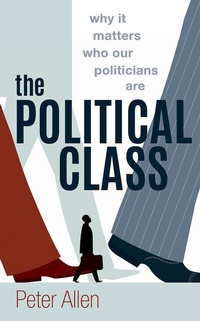
The Political Class
Why It Matters Who Our Politicians Are
Published on 26. April 2018
Book
Hardback
172 pages
978-0-19-879597-1 (ISBN)
Description
Recent years have seen an intensification of discussion on the issue of Britain's political class. The question of who our politicians are is front and centre. Do they represent us? Are all politicians just in it for themselves? Are they disconnected from the lives of normal people? In The Political Class, Peter Allen argues that our current political class are in many important ways unlike the British people as a whole, and this matters a lot.
Our politicians are currently largely drawn from limited sections of society, reflecting patterns of wider social and economic inequality which mean that, for many people, running for political office is almost impossible. This leaves us with a political class that can justifiably be described as uniform in who they are, what they think, and how they behave.
Putting the state of British democracy under the microscope, Allen argues that having a more diverse political class would not only better reflect democratic principles of equality, but would also result in more legitimate political outcomes. We need to radically reshape political institutions so that more citizens have a real chance of becoming involved in making the decisions that affect all of our lives. Only by doing this can the gap between the political class and the public be reduced, and British democracy live up to its name.
Our politicians are currently largely drawn from limited sections of society, reflecting patterns of wider social and economic inequality which mean that, for many people, running for political office is almost impossible. This leaves us with a political class that can justifiably be described as uniform in who they are, what they think, and how they behave.
Putting the state of British democracy under the microscope, Allen argues that having a more diverse political class would not only better reflect democratic principles of equality, but would also result in more legitimate political outcomes. We need to radically reshape political institutions so that more citizens have a real chance of becoming involved in making the decisions that affect all of our lives. Only by doing this can the gap between the political class and the public be reduced, and British democracy live up to its name.
Reviews / Votes
Allen's book, and the current political quagmire, make a convincing case that wholesale electoral reform - a phrase that has rarely quickened a newsroom pulse - should be higher up the agenda. * Daniel Clarke, Times Literary Supplement * A valuable intervention which will provoke many to think about how we can and should make politics 'something that happens here with us and not there with them'. * Lawrence McKay, LSE Review of Books * The balanced case for why educating future leaders in a few elite institutions is such a very bad idea. * Danny Dorling, author Do We Need Economic Inequality? * The Political Class should become a key point of reference for those concerned about why parliament fails to reflect the make-up of the society it governs, and what exactly we can and should do about it. * Michael Kenny, Professor of Public Policy, University of Cambridge *More details
Language
English
Place of publication
Oxford
United Kingdom
Target group
College/higher education
Professional and scholarly
Product notice
sewn/stitched
Cloth over boards
Dimensions
Height: 223 mm
Width: 141 mm
Thickness: 25 mm
Weight
298 gr
ISBN-13
978-0-19-879597-1 (9780198795971)
Copyright in bibliographic data and cover images is held by Nielsen Book Services Limited or by the publishers or by their respective licensors: all rights reserved.
Schweitzer Classification
Other editions
Additional editions
E-Book
04/2018
1st Edition
OUP eBook
€14.99
Available for download
E-Book
04/2018
1st Edition
OUP eBook
€14.99
Available for download
Person
Peter Allen is Reader in Comparative Politics at the University of Bath. His research on representation, political behaviour, and gender and politics has been published in a number of academic journals. He is currently an ESRC Future Research Leader and a 2016-7 Kluge Fellow at the Library of Congress in Washington D.C. Further information can be found at his website, www.peter-allen.co.uk. This is his first book.
Content
Introduction
1: Who or What is the Political Class?
2: The Case for the Defence
3: The Case for the Prosecution
4: How to Make the Political Class More Diverse
Conclusion
Notes
Index
1: Who or What is the Political Class?
2: The Case for the Defence
3: The Case for the Prosecution
4: How to Make the Political Class More Diverse
Conclusion
Notes
Index