

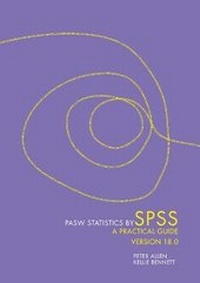
PASW Statistics by SPSS
A Practical Guide: Version 18.0
Will be published approx. on 27. April 2010
Book
Paperback/Softback
304 pages
978-0-17-018855-5 (ISBN)
Description
This practical, reader-friendly text will help you conduct statistical analyses using PASW Statistics by SPSS (version 18.0). Drawing on relevant examples from a range of disciplines, it introduces and then visually guides you through a range of common SPSS/PASW Statistics procedures.
For each procedure it illustrates the full data analytic process: from setting up the data file, through assumption and hypothesis testing, to interpreting and reporting of results.
New to this edition! a decision tree helps you find the right research procedure. Handily located inside the front cover, it's an easy reference for any research project.
For each procedure it illustrates the full data analytic process: from setting up the data file, through assumption and hypothesis testing, to interpreting and reporting of results.
New to this edition! a decision tree helps you find the right research procedure. Handily located inside the front cover, it's an easy reference for any research project.
Reviews / Votes
Preface 1. Getting started with PASW statistics 2. Working with data 3. Summarising and displaying data 4. One sample t test 5. Independent samples t test 6. Paired samples t test 7. One-way between groups ANOVA 8. Factorial between groups ANOVA 9. One-way repeated measures ANOVA 10. One-way analysis of covariance (ANCOVA) 11. Multivariate analysis of variance (MANOVA) 12. Correlation 13. Multiple regression 14. Factor analysis 15. Reliability analysis 16. Non-parametric procedures 17. Working with syntax References IndexMore details
Language
English
Place of publication
United Kingdom
Publishing group
Cengage Learning EMEA
Target group
College/higher education
Dimensions
Height: 297 mm
Width: 230 mm
Thickness: 28 mm
Weight
804 gr
ISBN-13
978-0-17-018855-5 (9780170188555)
Copyright in bibliographic data and cover images is held by Nielsen Book Services Limited or by the publishers or by their respective licensors: all rights reserved.
Schweitzer Classification
Persons
Peter Allen was Lecturer in the School of Experimental Psychology at the University of Bristol in the United Kingdom. He was formerly a lecturer at Curtin University where he taught research methods and statistics to undergraduate students, working with them to solve problems and answer practical questions using IBM SPSS Statistics. Peter's main areas of research interest are online behaviour, online research methods, and research methods pedagogy. Dr Kellie Bennett is an Associate Professor in the School of Medicine at the University of Western Australia. Kellie teaches in the medical and dental programmes, supervises postgraduate students and has provided statistical advice for a number of large research projects. Kellie's main research interests include psychological aspects of mental health, medical communication, developmental consequences of substance use, and related statistical analysis and research methodology.
Content
Preface
1. Getting started with PASW statistics
2. Working with data
3. Summarising and displaying data
4. One sample t test
5. Independent samples t test
6. Paired samples t test
7. One-way between groups ANOVA
8. Factorial between groups ANOVA
9. One-way repeated measures ANOVA
10. One-way analysis of covariance (ANCOVA)
11. Multivariate analysis of variance (MANOVA)
12. Correlation
13. Multiple regression
14. Factor analysis
15. Reliability analysis
16. Non-parametric procedures
17. Working with syntax
References
Index
1. Getting started with PASW statistics
2. Working with data
3. Summarising and displaying data
4. One sample t test
5. Independent samples t test
6. Paired samples t test
7. One-way between groups ANOVA
8. Factorial between groups ANOVA
9. One-way repeated measures ANOVA
10. One-way analysis of covariance (ANCOVA)
11. Multivariate analysis of variance (MANOVA)
12. Correlation
13. Multiple regression
14. Factor analysis
15. Reliability analysis
16. Non-parametric procedures
17. Working with syntax
References
Index