

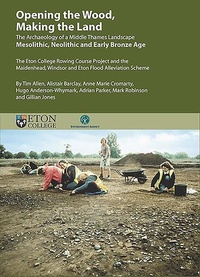
Opening the Wood, Making the Land
The Archaeology of a Middle Thames Landscape Mesolithic, Neolithic and Early Bronze Age. the Eton College Rowing Course Project and the Maidenhead, Windsor and Eton Flood Alleviation Scheme
Published on 26. November 2013
Book
Paperback/Softback
600 pages
978-1-905905-31-7 (ISBN)
Description
Excavations at the Eton Rowing Course and along the Maidenhead, Windsor and Eton Flood Alleviation Channel revealed extensive evidence for occupation in an evolving landscape of floodplains and gravel terraces set amidst the shifting channels of the Thames.
The most significant evidence was a series of early Neolithic midden deposits, preserved in hollows left by infilled palaeochannels. These deposits contained dense concentrations of pottery, worked flint, animal bone and other finds, and are put into context by other artefact scatters from the floodplain, pits on the gravel terrace and waterlogged environmental deposits from palaeochannels. Early Mesolithic lakeside occupation, later Mesolithic flint scatters along a former channel of the Thames, pits from the middle and late Neolithic and activity areas of the Beaker and Early Bronze Age, demonstrate longer term changes in patterns of occupation.
The excavations also revealed early, middle and late Neolithic human remains in palaeochannels, middle Neolithic crouched inhumation burials and early Neolithic cremated remains. An oval barrow may have first been cut in the early Neolithic. Other ring ditches date from the late Neolithic/early Bronze Age; one contained a central cremation burial in a Collared Urn together with pyre material and the remains of a bier.
The most significant evidence was a series of early Neolithic midden deposits, preserved in hollows left by infilled palaeochannels. These deposits contained dense concentrations of pottery, worked flint, animal bone and other finds, and are put into context by other artefact scatters from the floodplain, pits on the gravel terrace and waterlogged environmental deposits from palaeochannels. Early Mesolithic lakeside occupation, later Mesolithic flint scatters along a former channel of the Thames, pits from the middle and late Neolithic and activity areas of the Beaker and Early Bronze Age, demonstrate longer term changes in patterns of occupation.
The excavations also revealed early, middle and late Neolithic human remains in palaeochannels, middle Neolithic crouched inhumation burials and early Neolithic cremated remains. An oval barrow may have first been cut in the early Neolithic. Other ring ditches date from the late Neolithic/early Bronze Age; one contained a central cremation burial in a Collared Urn together with pyre material and the remains of a bier.
More details
Series
Language
English
Place of publication
Oxford
United Kingdom
Product notice
Paperback (trade)
Unsewn / adhesive bound
Dimensions
Height: 212 mm
Width: 296 mm
Thickness: 29 mm
Weight
2225 gr
ISBN-13
978-1-905905-31-7 (9781905905317)
Copyright in bibliographic data and cover images is held by Nielsen Book Services Limited or by the publishers or by their respective licensors: all rights reserved.
Schweitzer Classification
Persons
Alistair Barclay current works as Principal Post-Excavation Manager for Cotswold Archaeology and has been involved in publication for nearly 30 years in which time he has contributed to more than a dozen monographs as co-author/editor, he has also written and edited numerous articles. He was co-editor of NSG 4: Pathways and Ceremonies: the cursus monuments of Britain and Ireland. Hugo Anderson-Whymark is a Researcher at the University of York, based in Stromness, Orkney. He is a prehistorian specialising in flint and stone artefacts.