

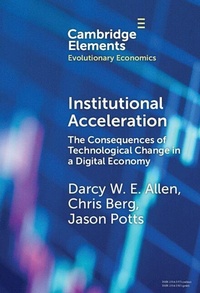
Institutional Acceleration
The Consequences of Technological Change in a Digital Economy
Published on 29. May 2025
Book
Hardback
88 pages
978-1-009-63863-0 (ISBN)
Description
This Element develops a theory of institutional acceleration to explain the transformation to a digital economy through a cluster of frontier technologies: artificial intelligence, blockchain, quantum computing, cryptography, and low-earth orbit infrastructure. Unlike previous technological revolutions, these technologies transform not how we organise things, but how we coordinate economic activity. The authors' supertransition thesis explains why these digital technologies shouldn't be understood in isolation, but rather should be understood in how they combine to create new institutional possibilities, leading to more open, complex, and global economic systems. Drawing on evolutionary economics and institutional theory, this Element shows how this evolutionary process is reshaping our institutional economic architecture. Ultimately, institutional acceleration drives greater computation and knowledge into our economic systems.
More details
Series
Language
English
Place of publication
Cambridge
United Kingdom
Illustrations
Worked examples or Exercises
Dimensions
Height: 235 mm
Width: 157 mm
Thickness: 10 mm
Weight
294 gr
ISBN-13
978-1-009-63863-0 (9781009638630)
Copyright in bibliographic data and cover images is held by Nielsen Book Services Limited or by the publishers or by their respective licensors: all rights reserved.
Schweitzer Classification
Other editions
Additional editions
Darcy W. E. Allen | Chris Berg | Jason Potts
Institutional Acceleration
The Consequences of Technological Change in a Digital Economy
Book
05/2025
Cambridge University Press
€26.80
Shipment within 15-20 days
Persons
Content
Introduction; 1. The supertransition thesis; 2. Vectors of technological change; 3. Combinatorial innovation and the supertransition; 4. Institutional acceleration; 5. An economy of digital institutions; 6. Adaptation and agency in the supertransition; References.