

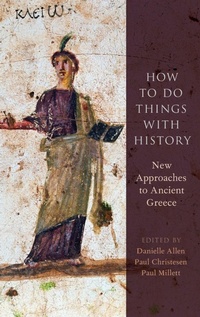
How to Do Things with History
New Approaches to Ancient Greece
Published on 27. September 2018
Book
Hardback
424 pages
978-0-19-064989-0 (ISBN)
Description
How to Do Things with History is a collection of essays that explores current and future approaches to the study of ancient Greek cultural history. Rather than focus directly on methodology, the essays in this volume demonstrate how some of the most productive and significant methodologies for studying ancient Greece can be employed to illuminate a range of different kinds of subject matter. These essays, which bring together the work of some of the most talented scholars in the field, are based upon papers delivered at a conference held at Cambridge University in September of 2014 in honor of Paul Cartledge's retirement from the post of A. G. Leventis Professor of Ancient Greek Culture.
For the better part of four decades, Paul Cartledge has spearheaded intellectual developments in the field of Greek culture in both scholarly and public contexts. His work has combined insightful historical accounts of particular places, periods, and thinkers with a willingness to explore comparative approaches and a keen focus on methodology. Cartledge has throughout his career emphasized the analysis of practice - the study not, for instance, of the history of thought but of thinking in action and through action.
The assembled essays trace the broad horizons charted by Cartledge's work: from studies of political thinking to accounts of legal and cultural practices to politically astute approaches to historiography. The contributors to this volume all take the parameters and contours of Cartledge's work, which has profoundly influenced an entire generation of scholars, as starting points for their own historical and historiographical explorations. Those parameters and contours provide a common thread that runs through and connects all of the essays while also offering sufficient freedom for individual contributors to demonstrate an array of rich and varied approaches to the study of the past.
For the better part of four decades, Paul Cartledge has spearheaded intellectual developments in the field of Greek culture in both scholarly and public contexts. His work has combined insightful historical accounts of particular places, periods, and thinkers with a willingness to explore comparative approaches and a keen focus on methodology. Cartledge has throughout his career emphasized the analysis of practice - the study not, for instance, of the history of thought but of thinking in action and through action.
The assembled essays trace the broad horizons charted by Cartledge's work: from studies of political thinking to accounts of legal and cultural practices to politically astute approaches to historiography. The contributors to this volume all take the parameters and contours of Cartledge's work, which has profoundly influenced an entire generation of scholars, as starting points for their own historical and historiographical explorations. Those parameters and contours provide a common thread that runs through and connects all of the essays while also offering sufficient freedom for individual contributors to demonstrate an array of rich and varied approaches to the study of the past.
Reviews / Votes
This remarkable collection of essays is both inspired by the work of, and dedicated to, Paul Cartledge.... All essays are very elegantly written and retain the immediacy of the occasion when they were originally delivered. They entertain the reader by approaching their respective topics from unusual perspectives. This collection of essays is a must in the library of everyone interested in ancient Greece and, more generally, in classics and in intellectual history. * Bryn Mawr Classical Review * How to Do Things with History is a very interesting and well-designed book, featuring a multiplicity of approaches and methodologies. It provides many insights to all students of ancient history. * Classical Journal-Online * As a tribute to a foremost ancient historian who did many things with history, the volume is a success. * The Journal for Ancient Greek and Roman Political Thought * An Oxford volume, but for a Cambridge stalwart-Paul Cartledge, the inaugural Leventis Professor of Greek culture. The book began in a conference to mark his retirement in 2014, and the stellar cast-list is itself testimony to Cartledge's influence and esteem; these have been matched by his immense energy in communicating with a broader public, not least through his engagement with Friends of Classics and Classics for All. Paul deserves a tribute of the highest quality, and he gets one here. * Classics for All * Big questions are recurrently put, new ways are found to look for answers, ancient and modern worlds intertwine, and simple models illuminate but also fall short of the rich messiness of life. And Paul Cartledge will welcome all those ideas with the infectious enthusiasm that he has shown about so much for so long. * Christopher Pelling, Classics for All * Recommended. * CHOICE *More details
Language
English
Place of publication
New York
United States
Target group
Professional and scholarly
Dimensions
Height: 240 mm
Width: 161 mm
Thickness: 27 mm
Weight
798 gr
ISBN-13
978-0-19-064989-0 (9780190649890)
Copyright in bibliographic data and cover images is held by Nielsen Book Services Limited or by the publishers or by their respective licensors: all rights reserved.
Schweitzer Classification
Other editions
Additional editions
Danielle Allen | Paul Christesen | Paul Millett
How to Do Things with History
New Approaches to Ancient Greece
E-Book
07/2018
OUP eBook
€47.99
Available for download
Danielle Allen | Paul Christesen | Paul Millett
How to Do Things with History
New Approaches to Ancient Greece
E-Book
07/2018
OUP eBook
€61.99
Available for download
Persons
Paul Christesen is William R. Kenan Professor of Ancient Greek History in the Department of Classics at Dartmouth College. He is the author of Olympic Victor Lists and Ancient Greek History and Sport and Democracy in the Ancient and Modern Worlds. He is also co-editor, with Donald Kyle, of The Wiley-Blackwell Companion to Sport and Spectacle in Greek and Roman Antiquity, and author of more than 30 articles. He is currently working with Paul Cartledge of Cambridge University on the Oxford History of the Archaic Greek World. He regularly speaks about these topics to scholarly and general audiences in the United States and Europe. He holds a B.A. from Dartmouth, and a Ph.D. from Columbia University.
Content
Introduction
Chapter 1: The "Great Leap" in Early Greek Politics and Political Thought: A Comparative Perspective, Kurt A. Raaflaub
Chapter 2: Pericles' Utopia - Reading of Thucydides and Plato, Emily Greenwood
Chapter 3: How to Turn History into Scenario: Plato's Republic Book 8 on the Role of Political Office in Constitutional Change, Melissa Lane
Chapter 4: "Cyrus appeared both great and good": Xenophon and the Performativity of Kingship, Carol Atack
Chapter 5: Jurors and Serial Killers: Loneliness, Deliberation, and Community in Ancient Athens, Alastair J. L. Blanshard
Chapter 6: The Sparta Game: Violence, Proportionality, Austerity, Collapse, Josiah Ober and Barry R. Weingast
Chapter 7: Marx and Antiquity, Wilfried Nippel
Chapter 8: Marxism and Ancient History, Kostas Vlassopoulos
Chapter 9: Building for the State: A World-Historical Perspective, Walter Scheidel
Chapter 10: Picturing History: The Ethics and Aesthetics of Tyrannicide in the Art of Classical Athens and Early Imperial China, Jeremy Tanner
Chapter 11: Imaginary Intercourse: an Illustrated History of Greek Pederasty, Robin Osborne
Chapter 12: The Boys from Cydathenaeum: Aristophanes versus Cleon Again, Edith Hall
Chapter 13: How to Write Anti-Roman History, Tim Whitmarsh
Afterward, Paul Cartledge
Chapter 1: The "Great Leap" in Early Greek Politics and Political Thought: A Comparative Perspective, Kurt A. Raaflaub
Chapter 2: Pericles' Utopia - Reading of Thucydides and Plato, Emily Greenwood
Chapter 3: How to Turn History into Scenario: Plato's Republic Book 8 on the Role of Political Office in Constitutional Change, Melissa Lane
Chapter 4: "Cyrus appeared both great and good": Xenophon and the Performativity of Kingship, Carol Atack
Chapter 5: Jurors and Serial Killers: Loneliness, Deliberation, and Community in Ancient Athens, Alastair J. L. Blanshard
Chapter 6: The Sparta Game: Violence, Proportionality, Austerity, Collapse, Josiah Ober and Barry R. Weingast
Chapter 7: Marx and Antiquity, Wilfried Nippel
Chapter 8: Marxism and Ancient History, Kostas Vlassopoulos
Chapter 9: Building for the State: A World-Historical Perspective, Walter Scheidel
Chapter 10: Picturing History: The Ethics and Aesthetics of Tyrannicide in the Art of Classical Athens and Early Imperial China, Jeremy Tanner
Chapter 11: Imaginary Intercourse: an Illustrated History of Greek Pederasty, Robin Osborne
Chapter 12: The Boys from Cydathenaeum: Aristophanes versus Cleon Again, Edith Hall
Chapter 13: How to Write Anti-Roman History, Tim Whitmarsh
Afterward, Paul Cartledge