

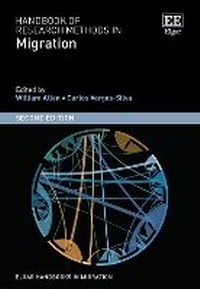
Handbook of Research Methods in Migration
Second Edition
2nd Edition
Published on 15. October 2024
Book
Hardback
394 pages
978-1-80037-802-5 (ISBN)
Description
In this thoroughly revised and updated second edition, William Allen and Carlos Vargas-Silva bring together a diverse range of experts to explore the latest research methods in migration studies, taking stock of major changes that have been salient for migration research-as well as the social sciences more broadly-in the last decade. Spanning a variety of different methodologies, this second edition of the Handbook of Research Methods in Migration provides practical guidance on designing, completing, and communicating migration research, considering diverse audiences including migrants themselves.
Chapter authors reflect on and engage with trends of migration research, with seventeen new chapters covering developments in data sources, techniques, and practical issues impacting migration researchers. They assess quantitative methods, including surveys, conjoint analysis and satellite data, as well as qualitative methods such as archival research, language patterns and the use of social media. Ultimately, they consider the use of these methods in specific case studies, before focusing on how to address practical and ethical issues that can arise during the process of migration research.
Expertly developing the ideas discussed in the first edition, this Handbook is a crucial resource for students and scholars of development studies, human geography and social science research methods. It also appeals to researchers working on migration in all its forms, as well as ethnicity, discrimination and demographic change.
Chapter authors reflect on and engage with trends of migration research, with seventeen new chapters covering developments in data sources, techniques, and practical issues impacting migration researchers. They assess quantitative methods, including surveys, conjoint analysis and satellite data, as well as qualitative methods such as archival research, language patterns and the use of social media. Ultimately, they consider the use of these methods in specific case studies, before focusing on how to address practical and ethical issues that can arise during the process of migration research.
Expertly developing the ideas discussed in the first edition, this Handbook is a crucial resource for students and scholars of development studies, human geography and social science research methods. It also appeals to researchers working on migration in all its forms, as well as ethnicity, discrimination and demographic change.
Reviews / Votes
'In the rapidly expanding field of migration studies, the editors and contributors have done a fantastic job in creating this treasure trove of information, guidance and insight into both the methods and practice of migration research that will be an invaluable resource for migration researchers.' -- Andrew Geddes, European University Institute, ItalyMore details
Series
Edition
2nd edition
Language
English
Place of publication
Cheltenham
United Kingdom
Target group
Professional and scholarly
Dimensions
Height: 244 mm
Width: 169 mm
ISBN-13
978-1-80037-802-5 (9781800378025)
Copyright in bibliographic data and cover images is held by Nielsen Book Services Limited or by the publishers or by their respective licensors: all rights reserved.
Schweitzer Classification
Other editions
Previous edition
Carlos Vargas-Silva
Handbook of Research Methods in Migration
Book
03/2012
Edward Elgar Publishing
€326.83
Article exhausted; check for reprint
Persons
Edited by William L. Allen, Lecturer in Political Science, Department of Politics and International Relations (PAIR), University of Southampton and Carlos Vargas-Silva, Professor of Migration Studies, Centre on Migration, Policy and Society (COMPAS) and Oxford Department of International Development, University of Oxford, UK
Content
Contents
1 Methods for migration studies: data, techniques, questions 1
William L. Allen and Carlos Vargas-Silva
PART I QUANTITATIVE APPROACHES
2 Conceptualizing, planning, and administering migration surveys 10
Stefanie Barratt, Sonja Fransen and Craig Loschmann
3 Survey experiments in migration research 31
Maria Sobolewska and Laurence Lessard-Phillips
4 Field and natural experiments in migration 48
David McKenzie and Dean Yang
5 Emerging big data sources for studying migration 83
Tuba Bircan and Albert Ali Salah
6 Using satellite maps to build sampling frames in migration surveys 104
Jessica Hagen-Zanker
PART II QUALITATIVE APPROACHES
7 Analysing archives to write migration histories 116
Uttara Shahani
8 Critical discourse studies and migration 136
Gavin Brookes and David Wright
9 Visual methods for migration research: approaches, strategies, and
challenges 153
Kevin Smets
10 Making sense of digital traces in migration contexts 172
Helena Dedecek Gertz, Earvin Cabalquinto and Koen Leurs
11 Digital ethnography as an inter-ethnic reckoning method 193
Ka-Kin Cheuk
12 Participatory mapping as a research tool in migration studies 204
Luis Sanchez-Ayala
13 Implementing collaborative qualitative data collection 213
Marta Bivand Erdal
PART III CASE STUDIES
14 Beyond the surveillance data set: blending qualitative and quantitative
approaches to visualizing forced migration 228
Roopika Risam
15 Using qualitative mixed methods in migration studies: a case study of asylum
seekers fleeing gender-based persecution 245
Connie Oxford
16 A mobile methodology for the study of environmental change and human
mobility 258
Ingrid Boas
17 Mixed methods and the study of American franchises 266
Jennifer Parker
PART IV PRACTICE, POLICY, PARTICIPATION
18 Migration statistics in times of large-scale mobility data: ethical concerns
and concerns with ethics 280
Linnet Taylor and Fran Meissner
19 Data visualisation in migration research: the case of circular migration plots 296
Nikola Sander and Andreas Genoni
20 Engaging refugees as researchers: ethics, challenges, successes 312
Evan Easton-Calabria
21 Influencing migration policy and public debate through targeted
communications: lessons for researchers and practitioners as to what, who,
how, and when to engage 324
Helen Dempster
22 Beyond dissemination: knowledge exchange, impact and the active researcher 343
Jacqueline Broadhead
Index 359
1 Methods for migration studies: data, techniques, questions 1
William L. Allen and Carlos Vargas-Silva
PART I QUANTITATIVE APPROACHES
2 Conceptualizing, planning, and administering migration surveys 10
Stefanie Barratt, Sonja Fransen and Craig Loschmann
3 Survey experiments in migration research 31
Maria Sobolewska and Laurence Lessard-Phillips
4 Field and natural experiments in migration 48
David McKenzie and Dean Yang
5 Emerging big data sources for studying migration 83
Tuba Bircan and Albert Ali Salah
6 Using satellite maps to build sampling frames in migration surveys 104
Jessica Hagen-Zanker
PART II QUALITATIVE APPROACHES
7 Analysing archives to write migration histories 116
Uttara Shahani
8 Critical discourse studies and migration 136
Gavin Brookes and David Wright
9 Visual methods for migration research: approaches, strategies, and
challenges 153
Kevin Smets
10 Making sense of digital traces in migration contexts 172
Helena Dedecek Gertz, Earvin Cabalquinto and Koen Leurs
11 Digital ethnography as an inter-ethnic reckoning method 193
Ka-Kin Cheuk
12 Participatory mapping as a research tool in migration studies 204
Luis Sanchez-Ayala
13 Implementing collaborative qualitative data collection 213
Marta Bivand Erdal
PART III CASE STUDIES
14 Beyond the surveillance data set: blending qualitative and quantitative
approaches to visualizing forced migration 228
Roopika Risam
15 Using qualitative mixed methods in migration studies: a case study of asylum
seekers fleeing gender-based persecution 245
Connie Oxford
16 A mobile methodology for the study of environmental change and human
mobility 258
Ingrid Boas
17 Mixed methods and the study of American franchises 266
Jennifer Parker
PART IV PRACTICE, POLICY, PARTICIPATION
18 Migration statistics in times of large-scale mobility data: ethical concerns
and concerns with ethics 280
Linnet Taylor and Fran Meissner
19 Data visualisation in migration research: the case of circular migration plots 296
Nikola Sander and Andreas Genoni
20 Engaging refugees as researchers: ethics, challenges, successes 312
Evan Easton-Calabria
21 Influencing migration policy and public debate through targeted
communications: lessons for researchers and practitioners as to what, who,
how, and when to engage 324
Helen Dempster
22 Beyond dissemination: knowledge exchange, impact and the active researcher 343
Jacqueline Broadhead
Index 359