

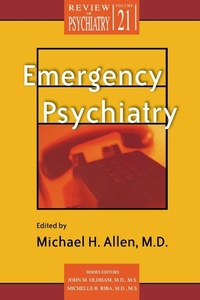
Emergency Psychiatry
Published on 30. April 2002
Book
Paperback/Softback
216 pages
978-1-58562-070-8 (ISBN)
Description
The field of emergency mental health care is evolving rapidly. In addition to continued widespread use of the traditional consultation model, in which psychiatrists provide on-call assistance to emergency department physicians, specialized psychiatric emergency services (PESs) are available in many cities, and newer models of integrated community psychiatric emergency care are being developed and implemented. With the spread of AIDS, the aging of the population, and the popularity of recreational substances of abuse, the scope and complexity of the field have increased as well. Emergency Psychiatry provides a snapshot of the current state of the art of this fast-paced discipline.
Readers of this volume will find ; Survey of the major service models used in emergency psychiatry: the consultation model, the specialized PES model, and newer community models (crisis hospitalization, mobile teams, crisis residences); Principles of triage of patients presenting to an emergency department with psychiatric problems, including a discussion of instruments used to assess psychosocial and cognitive functioning; Guidelines for assessing risk of suicide or violence; Standards for behavioral management of agitation and aggression aimed at reestablishing inner and outer controls for the patient in the least coercive manner; Discussion of legal and regulatory issues affecting emergency room practice; Guidance on application of psychotherapeutic technique to interviewing patients in crises so as to communicate concern, elicit cooperation and essential information about the patient's state, and foster an alliance that facilitates appropriate treatment
Psychiatric emergencies can occur at any time and in any setting; for this reason, every mental health clinician should be familiar with the principles of crisis management and the cutting-edge issues surrounding the provision of emergency psychiatric care. Intended for psychiatrists, psychiatric and emergency medicine residents, and all mental health practitioners, this book offers an accessible guide to current practice and thought in this exciting field.
Readers of this volume will find ; Survey of the major service models used in emergency psychiatry: the consultation model, the specialized PES model, and newer community models (crisis hospitalization, mobile teams, crisis residences); Principles of triage of patients presenting to an emergency department with psychiatric problems, including a discussion of instruments used to assess psychosocial and cognitive functioning; Guidelines for assessing risk of suicide or violence; Standards for behavioral management of agitation and aggression aimed at reestablishing inner and outer controls for the patient in the least coercive manner; Discussion of legal and regulatory issues affecting emergency room practice; Guidance on application of psychotherapeutic technique to interviewing patients in crises so as to communicate concern, elicit cooperation and essential information about the patient's state, and foster an alliance that facilitates appropriate treatment
Psychiatric emergencies can occur at any time and in any setting; for this reason, every mental health clinician should be familiar with the principles of crisis management and the cutting-edge issues surrounding the provision of emergency psychiatric care. Intended for psychiatrists, psychiatric and emergency medicine residents, and all mental health practitioners, this book offers an accessible guide to current practice and thought in this exciting field.
Reviews / Votes
The book is recommended to mental health workers, and especially to students and especially to those new to psychiatric emergency work. It would be a useful resource in libraries for students of health and medical studies.As a practicing acute psychiatrist, there was much I found useful. The overview of models of psychiatric emergency service delivery was particularly interesting, given the tendency to myopic views from within one's own institution.
This book is a must-have primer for all clinicians at every level of training. It serves as an introduction to the literature for novices and review of the literature for the more seasoned clinician. All disciplines would benefit from this book; it is a quick way to get up to speed on the key issues in the growing field of emergency psychiatry.
This small volume is an excellent resource for clinicians, teachers, students, and administrators interested in mental health crisis intervention and emergency psychiatry.... It is vital, resourceful, and timely -- the same attributes one would expect to find in all goof psychiatric emergency services.
More details
Language
English
Place of publication
VA
United States
Target group
College/higher education
Professional and scholarly
US School Grade: College Graduate Student and over
Product notice
Paperback (trade)
Dimensions
Height: 229 mm
Width: 162 mm
Thickness: 14 mm
Weight
358 gr
ISBN-13
978-1-58562-070-8 (9781585620708)
Copyright in bibliographic data and cover images is held by Nielsen Book Services Limited or by the publishers or by their respective licensors: all rights reserved.
Schweitzer Classification
Other editions
Additional editions
Michael H. Allen
Emergency Psychiatry
E-Book
12/2002
1st Edition
American Psychiatric Publishing
€101.49
Available for download
Persons
Michael H. Allen, M.D., is Director of Inpatient Psychiatry at Colorado Psychiatric Health and Assistant Professor of Psychiatry at the University of Colorado School of Medicine in Denver, Colorado.
Content
PrefaceChapter 1. Structure and function of psychiatric emergency servicesChapter 2. Medical, psychiatric, and cognitive assessment in the psychiatric emergency serviceChapter 3. Assessment and treatment of suicidal patients in an emergency settingChapter 4. Emergency treatment of agitation and aggressionChapter 5. Psychosocial interventions in the psychiatric emergency service: a skills approachIndex