

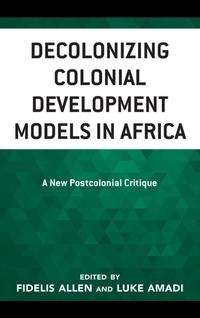
Decolonizing Colonial Development Models in Africa
A New Postcolonial Critique
Published on 17. January 2022
Book
Hardback
344 pages
978-1-6669-0124-5 (ISBN)
Description
Decolonizing Colonial Development Models in Africa: A New Postcolonial Critique confronts colonial development models to decolonize methodologies, epistemologies, and the history and practice of development in postcolonial African societies and advocates for Afrocentric alternatives. By taking a critical approach and drawing on postcolonial, postmodern, post-developmental, and post-structural theories, the contributors identify and analyze the effects of global inequality, racism, white supremacy, crisis, climate change, increasing environmental insecurity, underdevelopment, chronic diseases, and the vulnerability of the postcolonial societies of the global South. Together, the collection calls for and theorizes a new direction of development that incorporates indigenous-Afrocentric alternatives.
Reviews / Votes
This collection of case studies calls for decolonizing the social sciences and for a new configuration of development unbound from its colonial legacies. It brings together studies from multiple disciplines, including education, sociology, literature, history, and political science. The majority of the contributors teach at African universities. While some chapters are manifestos for new approaches to development or literature reviews, other contributions feature new research. This study certainly offers a clear perspective on African critiques of development. Recommended. Advanced undergraduates through faculty. * Choice Reviews * This is a careful balance of older and newer voices on Africa's search for development, moving effortlessly from city planning to national projects, and then to continental ideologies and crises. Knowledge is powerful! The book's mission of rethinking extant ideas to move the continent forward is laudable, thus bringing academic issues that are translatable to practical projects to the table of policy makers. -- Toyin Falola, University of Texas at Austin, USA This book is a timely contribution to the critical turn in the study of Africa and its developmental travails and aspirations in that it revisits the very idea of development, probing its problematic underpinnings and rescuing it from coloniality of power that continues to haunt it. A combination of conceptual critique and case analysis makes this an excellent read for scholars, students, and general readers alike. I highly recommend this collection for those looking for fresh and diverse insights on how to realize Africa's age-old development, the Africa we want. -- Siphamandla Zondi, University of Johannesburg Allen and Amadi have assembled an amazing coterie of African scholarly voices and intellectuals to offer a much-needed tour de force for anyone contemplating myriad pathways for decolonizing, deconstructing, and demolishing entrenched legacies of African colonial development. -- M.K. Dorsey, Club of Rome Decolonizing Colonial Development Models in Africa: A New Postcolonial Critique is a thoroughly researched book which provides critical insights into the dynamics and contributions of colonialism in defining development in Africa. Fidelis Allen and Luke Amadi have done a tour de force by interrogating the thoughts of a cross section of African scholars on the destructive impacts of colonialism on indigenous knowledge, social structures, politics, and development in Africa. It also examines Africanist scholars' views on postcolonial identity, postcolonial nationalism, and postcolonial development, and highlights the implications for development in the continent. The book provides recommendations on how to address the challenges to development thrown up by colonialism. These suggestions pertain mainly on how to reverse or redefine the ideology of colonial development, postcolonial development patterns, and development models in Africa. This book situates in a single volume issues addressing the contemporary challenges of politics, development, and security in Africa. It is a must-read and is subsequently recommended to scholars, researchers, students, government functionaries, development partners, and practitioners. -- Ibaba Samuel Ibaba, Niger Delta UniversityMore details
Language
English
Place of publication
United States
Publishing group
Bloomsbury Publishing Plc
Target group
Professional and scholarly
Illustrations
2 b/w illustrations;
Dimensions
Height: 235 mm
Width: 157 mm
Thickness: 25 mm
Weight
713 gr
ISBN-13
978-1-6669-0124-5 (9781666901245)
Copyright in bibliographic data and cover images is held by Nielsen Book Services Limited or by the publishers or by their respective licensors: all rights reserved.
Schweitzer Classification
Other editions
Additional editions
Decolonizing Colonial Development Models in Africa
A New Postcolonial Critique
E-Book
01/2022
1st Edition
Lexington Books
€36.99
Available for download
Persons
Fidelis Allen is professor of development studies in the Department of Political and Administrative Studies at the University of Port Harcourt.
Luke Amadi received his Ph.D. in development studies from the University of Port Harcourt and is currently guest editor at Cambridge Scholars Publishing, UK.
Luke Amadi received his Ph.D. in development studies from the University of Port Harcourt and is currently guest editor at Cambridge Scholars Publishing, UK.
Content
Introduction
Fidelis Allen and Luke Amadi
Chapter 1: Development Paradigms and the Framing of Postcolonial Identity: Urbanization, Waterfront Development, and the Eko o ni baje Ethos/Slogan in Lagos
Adebisi Alade
Chapter 2. Nationalism in Postcolonial Studies: A Case for Hybridity
Nick T. C. Lu
Chapter 3: Maintaining Law and Order or Maintaining Conditions Ideal for the Exploitation of
Africa? A Post-Colonial Critique of Colonial Development Assumptions
Biko Agozino
Chapter 4. Postcolonial Development and Nailiyat Dance of Algeria: An Unorthodox Approach
Fouad Mami
Chapter 5: Colonialism and the Destruction of Indigenous Knowledge Systems: Daring to Push
the Epistemological Frontiers for African Re-Development Paradigms
Nathan Moyo and Jairos Gonye
Chapter 6: Deconstructing Colonial Development Models: Rethinking Africa's Moral Economy and Social Entrepreneurship for Sustainable Rural Development in Post-Colonial Africa
Mike Odey
Chapter 7: Decolonization and Deconstruction
Fidelis Allen and Luke Amadi
Chapter 1: Development Paradigms and the Framing of Postcolonial Identity: Urbanization, Waterfront Development, and the Eko o ni baje Ethos/Slogan in Lagos
Adebisi Alade
Chapter 2. Nationalism in Postcolonial Studies: A Case for Hybridity
Nick T. C. Lu
Chapter 3: Maintaining Law and Order or Maintaining Conditions Ideal for the Exploitation of
Africa? A Post-Colonial Critique of Colonial Development Assumptions
Biko Agozino
Chapter 4. Postcolonial Development and Nailiyat Dance of Algeria: An Unorthodox Approach
Fouad Mami
Chapter 5: Colonialism and the Destruction of Indigenous Knowledge Systems: Daring to Push
the Epistemological Frontiers for African Re-Development Paradigms
Nathan Moyo and Jairos Gonye
Chapter 6: Deconstructing Colonial Development Models: Rethinking Africa's Moral Economy and Social Entrepreneurship for Sustainable Rural Development in Post-Colonial Africa
Mike Odey
Chapter 7: Decolonization and Deconstruction