

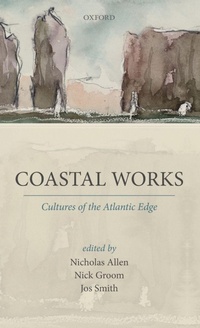
Coastal Works
Cultures of the Atlantic Edge
Published on 6. July 2017
Book
Hardback
320 pages
978-0-19-879515-5 (ISBN)
Description
In all the complex cultural history of the islands of Britain and Ireland the idea of the coast as a significant representative space is critical. For many important artists coastal space has figured as a site from which to braid ideas of empire, nation, region, and archipelago. They have been drawn to the coast as a zone of geographical uncertainty in which the self-definitions of the nation founder; they have been drawn to it as a peripheral space of vestigial wildness, of island retreats and experimental living; as a network of diverse localities richly endowed with distinctive forms of cultural heritage; and as a dynamically interconnected ecosystem, which is at the same time the historic site of significant developments in fieldwork and natural science.
This collection situates these cultures of the Atlantic edge in a series of essays that create new contexts for coastal study in literary history and criticism. The contributors frame their research in response to emerging conversations in archipelagic criticism, the blue humanities, and island studies, the essays challenging the reader to reconsider ideas of margin, periphery and exchange. These twelve case studies establish the coast as a crucial location in the imaginative history of Britain, Ireland and the north Atlantic edge. Coastal Works will appeal to readers of literature and history with an interest in the sea, the environment, and the archipelago from the 18th century to the present. Accessible, innovative and provocative, Coastal Works establishes the important role that the coast plays in our cultural imaginary and suggests a range of methodologies to represent relationships between land, sea, and cultural work.
This collection situates these cultures of the Atlantic edge in a series of essays that create new contexts for coastal study in literary history and criticism. The contributors frame their research in response to emerging conversations in archipelagic criticism, the blue humanities, and island studies, the essays challenging the reader to reconsider ideas of margin, periphery and exchange. These twelve case studies establish the coast as a crucial location in the imaginative history of Britain, Ireland and the north Atlantic edge. Coastal Works will appeal to readers of literature and history with an interest in the sea, the environment, and the archipelago from the 18th century to the present. Accessible, innovative and provocative, Coastal Works establishes the important role that the coast plays in our cultural imaginary and suggests a range of methodologies to represent relationships between land, sea, and cultural work.
Reviews / Votes
Coastal Works gives a new turn to archipelagic studies. It musters an extraordinary range of scholarly disciplines - including literary criticism, cultural history, field studies, marine biology, thalassology and ethnography - to capture the meeting of water and land through its lived history, ecology, literary writings and visual art. * Pamela Clemit, The Times Literary Supplement * Coastal Works is a skillfully crafted collection of essays that converses intricately with the study of islands. In many anthologies, it is often difficult to really maintain a shared intellectual horizon throughout the book, but these authors succeed. The essays mirror each other. They deserve to be read by anyone who feels or remembers feeling in a particular mood when they walk along the coast. * Martin Ledstrup, Island Studies Journal *More details
Language
English
Place of publication
Oxford
United Kingdom
Target group
College/higher education
Professional and scholarly
Illustrations
Includes over 25 black and white illustrations
Dimensions
Height: 222 mm
Width: 145 mm
Thickness: 20 mm
Weight
523 gr
ISBN-13
978-0-19-879515-5 (9780198795155)
Copyright in bibliographic data and cover images is held by Nielsen Book Services Limited or by the publishers or by their respective licensors: all rights reserved.
Schweitzer Classification
Other editions
Additional editions
E-Book
07/2017
1st Edition
OUP eBook
€47.99
Available for download
E-Book
06/2017
1st Edition
OUP eBook
€47.99
Available for download
Persons
Nicholas Allen's work is located at the intersection between literature, history, and visual culture. His interests include the study of modernism, empire, and increasingly, writing about ocean and archipelago. He has taught previously at the University of North Carolina at Chapel Hill and the National University of Ireland, Galway, where he was academic director of the Moore Institute. His books include Broken Landscapes: Selected letters on Ernie O'Malley (Dublin, 2011), Modernism, Ireland and Civil War (CUP, 2009), That Other Island (2007), The Proper Word (2007), George Russell and the New Ireland (2003), and The Cities of Belfast (2003).
Nick Groom is an academic and writer. He is professor in English at the University of Exeter and has written widely on literature, music, and contemporary art. He is the author of a dozen books and editions, including The Forger's Shadow (2002), The Union Jack (2006), and, most recently, The Gothic (2012).
Jos Smith is an author and researcher with a specialist interest in the intersection of literature and cultural geography. In particular his work explores 'vibrant localism', that is, cultural activity driven by environmental concern that transforms attitudes to place. This is a subject central to his recent book on 'The New Nature Writing' and to his current research project exploring a cultural history of the arts and environmental charity Common Ground.
Nick Groom is an academic and writer. He is professor in English at the University of Exeter and has written widely on literature, music, and contemporary art. He is the author of a dozen books and editions, including The Forger's Shadow (2002), The Union Jack (2006), and, most recently, The Gothic (2012).
Jos Smith is an author and researcher with a specialist interest in the intersection of literature and cultural geography. In particular his work explores 'vibrant localism', that is, cultural activity driven by environmental concern that transforms attitudes to place. This is a subject central to his recent book on 'The New Nature Writing' and to his current research project exploring a cultural history of the arts and environmental charity Common Ground.
Content
1: Nicholas Allen, Nick Groom, and Jos Smith.: Introduction 2: Nick Groom: Draining the Irish Channel: Identity, Sustainability, and the Politics of Water 3: Fiona Stafford: The Roar of the Solway 4: Nicholas Allen: Ireland, Literature, and the Coastal Imaginary 5: Andrew Gibson: 'At the Dying Atlantic's Edge': Norman Nicholson and the Cumbrian Coast 6: John Brannigan: 'Felt Routes': Louis MacNeice and the North East Atlantic Archipelago 7: Daniel Brayton: The Riddle of the Sands: Erskine Childers Between the Tides 8: Damian Walford Davies: Ronald Lockley and the Archipelagic Imagination 9: Nessa Cronin: Maude Delap's Domestic Science: Island Spaces and Gendered Fieldwork in Irish Natural History 10: Kyriaki Hadjiafxendi and John Plunkett: Science at the Seaside: Pleasure Hunts in Victorian Devon 11: Margaret Cohen: Seeing Through Water: The Paintings of Zarh Pritchard 12: Andrew McNeillie: In the Labyrinth: Annotating Aran 13: Jos Smith: Fugitive Allegiances: the Good Ship Archipelago and the Atlantic Edge 14: John R. Gillis: Afterword