

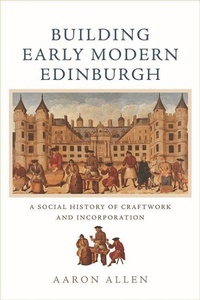
Building Early Modern Edinburgh
A Social History of Craftwork and Incorporation
Published on 21. September 2018
Book
Hardback
304 pages
978-1-4744-4238-1 (ISBN)
Description
Much like in the present day, building a house in the sixteenth century involved masons, carpenters and glaziers, among others, and in many cities such trades had separate companies to govern their own affairs. In Edinburgh, however, they banded together in a single body - the Edinburgh Incorporation of Mary's Chapel.
Building Early Modern Edinburgh traces the history of the organisation, which sought to control the capital's building trades and defend their privileges. By utilising a range of previously missing charters and archival documents, the author offers a new perspective on the prestigious and important craft guild in its 543 years of existence. Developing a crucial theme of 'composite corporatism', and using the concepts of 'family' and 'household' to approach an urban institution, this book is a valuable resource of comparative material for the study of craft guilds and urban history in a global context.
Building Early Modern Edinburgh traces the history of the organisation, which sought to control the capital's building trades and defend their privileges. By utilising a range of previously missing charters and archival documents, the author offers a new perspective on the prestigious and important craft guild in its 543 years of existence. Developing a crucial theme of 'composite corporatism', and using the concepts of 'family' and 'household' to approach an urban institution, this book is a valuable resource of comparative material for the study of craft guilds and urban history in a global context.
Reviews / Votes
The scholarship and exhaustive research that underpins this fine book is impressive and adds considerably to our understanding of all early modern Scottish cities and Edinburgh in particular, moving the focus in an existing extensive literature away from elites and politics with a big 'p' to the politics and preoccupations of the skilled working man and woman. The book comes alive when we learn more about these individuals and their work and circumstances. -- Stana Nenadic, University of Edinburgh * Journal of Scottish Historical Studies * Allen skillfully plots a path through the extraordinarily complex history of early modern Edinburgh, and one of the great strengths of the book is his focus on the original archival material... a major contribution to the institutional history of the city, as well as the context for architectural historians to do further work on how buildings actually came to be constructed. -- John Lowrey, University of Edinburgh * Renaissance Quarterly * Building Early Modern Edinburgh is an important book. It takes a certain elan to approach sources of this nature when other scholars will actively ignore them due to their complexity. In so doing, Allen has paved a way for scholars in the future to further explore Scotland's social history, while also reflecting on the ways in which religious Reformation had deep and lasting impacts on Scotland's social fabric. -- Chris R. Langley, Newman University, Birmingham * Scottish Church History * The author is to be congratulated for producing a readable and interesting work on a united yet divided group of craftsmen, and for his careful exploration of the things that brought unity and those that brought division. One of its most significant achievements is in showing that it is possible to write a full-length academic study of a single incorporated trade, in spite of the sometimes difficult source base. Finally, the present-day Incorporation of Mary's Chapel is to be commended for supporting the extensive research that lay behind this book. May such a significant gesture of commitment to scholarly research into what remains a remarkably under-studied aspect of Scottish urban history serve as an inspiration to other similar bodies, in Edinburgh and other historic burghs, so that the contribution of the incorporated trades to the social, economic and cultural development of urban Scotland continues to be explored and brought to light. -- Alan R. Macdonald, University of Dundee * Scottish Historical Review * A book such as this is a torchlight for all to show what can be done. The author is Dr Aaron Allen of Edinburgh University, whose passion and knowledge of the city's trades shines through in the text so much that there appears to be more room for his insights and demonstrations of craft skills than the three hundred pages can contain. -- Anthon Lewis, Glasgow Life * The Innes Review * This deeply researched book has a great deal to commend it, above all is its emphasis on the importance of corporatism. The author weaves the concept of corporatism through each chapter as he examines its social, political, religious and economic ramifications, and the result is a book that will most certainly find an important place in the growing field of the early modern history of work. -- James R. Farr, Purdue University Edinburgh's history, long dominated by the story of its merchant elite and professions, is given extensive, new insights. The ten 'arts' in the 'House' of St Mary's Incorporation, centred around the masons and wrights, were largely responsible for building the Old Town. A ground-breaking and definitive work of new research. -- Michael Lynch, Emeritus Professor, University of EdinburghMore details
Language
English
Place of publication
Edinburgh
United Kingdom
Target group
Professional and scholarly
Product notice
sewn/stitched
Cloth over boards
Illustrations
11 black and white illustrations, 8 colour illustrations
Dimensions
Height: 236 mm
Width: 157 mm
Thickness: 23 mm
Weight
612 gr
ISBN-13
978-1-4744-4238-1 (9781474442381)
Copyright in bibliographic data and cover images is held by Nielsen Book Services Limited or by the publishers or by their respective licensors: all rights reserved.
Schweitzer Classification
Other editions
Additional editions
E-Book
08/2018
1st Edition
Edinburgh University Press
€31.49
Available for download
Person
Aaron Allen is currently a Teaching Fellow at the University of Edinburgh. He is the author of The Locksmith Craft in Early Modern Edinburgh (2007) and co-editor, with Cathryn Spence, of Edinburgh Housemails Taxation Book, 1634-1636 (2014).
Content
List of Tables; List of Figures & Plates; List of Abbreviations; Foreword; PrefaceIntroduction: Incorporation and the Corporate Framework1. Headship and Inclusion2. Family, Household and Obligation3. Craft and Kirk: Security, Status and Shelter4. Craft and Burgh: Conflict or Partnership?Conclusions: The Decline of Corporatism and the Rise of the UnfreeAppendices; Glossary; Bibliography; Index