

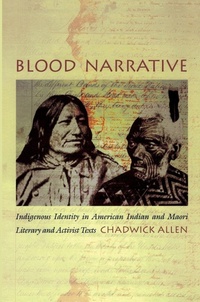
Blood Narrative
Indigenous Identity in American Indian and Maori Literary and Activist Texts
Published on 6. August 2002
Book
Paperback/Softback
320 pages
978-0-8223-2947-3 (ISBN)
Description
Blood Narrative is a comparative literary and cultural study of post-World War II literary and activist texts by New Zealand Maori and American Indians-groups who share much in their responses to European settler colonialism. Chadwick Allen reveals the complex narrative tactics employed by writers and activists in these societies that enabled them to realize unprecedented practical power in making both their voices and their own sense of indigeneity heard.
Allen shows how both Maori and Native Americans resisted the assimilationist tide rising out of World War II and how, in the 1960s and 1970s, they each experienced a renaissance of political and cultural activism and literary production that culminated in the formation of the first general assembly of the World Council of Indigenous Peoples. He focuses his comparison on two fronts: first, the blood/land/memory complex that refers to these groups' struggles to define indigeneity and to be freed from the definitions of authenticity imposed by dominant settler cultures. Allen's second focus is on the discourse of treaties between American Indians and the U.S. government and between Maori and Great Britain, which he contends offers strong legal and moral bases from which these indigenous minorities can argue land and resource rights as well as cultural and identity politics.
With its implicit critique of multiculturalism and of postcolonial studies that have tended to neglect the colonized status of indigenous First World minorities, Blood Narrative will appeal to students and scholars of literature, American and European history, multiculturalism, postcolonialism, and comparative cultural studies.
Allen shows how both Maori and Native Americans resisted the assimilationist tide rising out of World War II and how, in the 1960s and 1970s, they each experienced a renaissance of political and cultural activism and literary production that culminated in the formation of the first general assembly of the World Council of Indigenous Peoples. He focuses his comparison on two fronts: first, the blood/land/memory complex that refers to these groups' struggles to define indigeneity and to be freed from the definitions of authenticity imposed by dominant settler cultures. Allen's second focus is on the discourse of treaties between American Indians and the U.S. government and between Maori and Great Britain, which he contends offers strong legal and moral bases from which these indigenous minorities can argue land and resource rights as well as cultural and identity politics.
With its implicit critique of multiculturalism and of postcolonial studies that have tended to neglect the colonized status of indigenous First World minorities, Blood Narrative will appeal to students and scholars of literature, American and European history, multiculturalism, postcolonialism, and comparative cultural studies.
Reviews / Votes
"Chadwick Allen traces the 'inseparable triad' of blood, land, and memory in two cultures and distinct generations of indigenous writers and activists. Blood Narrative is an original, persuasive consideration of Native American Indian and New Zealand Maori tropes of indigenous identity. Natives and the Maori created viable identities in 'dominant discourses' during the Second World War, but the pride of national service was not a practicable source of indigenous identities in the simulations of postwar modernity. A generation later identities were constructed by political resistance, literary subversion, and cultural activism. Many writers have asserted 'blood memory' as a strategy of contemporary indigenous identity and survivance. Allen provides a cogent, astute critique of these memorable triads and complex turns of identity."-Gerald Vizenor, University of California, Berkeley "I cannot think of a more provocative or evocative title for a book that addresses the narrative tactics and activism of indigenous writings. Allen draws upon the tactical differences deployed by American Indian and New Zealand Maori writers to provide insights into the ways that indigenous minority writing has defined an enduring identity of indigeneity. Blood Narrative is elegantly written, provocative in some of its arguments, rich in examples and well worth reading."-Linda Tuhiwai Smith, The University of AucklandMore details
Series
Language
English
Place of publication
North Carolina
United States
Target group
Professional and scholarly
Product notice
Paperback (trade)
Dimensions
Height: 235 mm
Width: 156 mm
Thickness: 17 mm
Weight
490 gr
ISBN-13
978-0-8223-2947-3 (9780822329473)
Copyright in bibliographic data and cover images is held by Nielsen Book Services Limited or by the publishers or by their respective licensors: all rights reserved.
Schweitzer Classification
Other editions
Additional editions
Chadwick Allen | Donald E. Pease
Blood Narrative
Indigenous Identity in American Indian and Maori Literary and Activist Texts
E-Book
08/2002
1st Edition
De Gruyter
€208.99
Available for download
Person
Chadwick Allen is Assistant Professor of English at Ohio State University and Associate Editor of the journal Studies in American Indian Literatures.
Content
Acknowledgments
Introduction: Marking the Indigenous in Indigenous Minority Texts
Part I. A Directed Self-Determination
1. A Marae on Paper: Writing a New Maori World in Te Ao Hou
2. Indian Truth: Debating Indigenous Identity after Indians in the War
Part II. An Indigenous Renaissance
3. Rebuilding the Ancestor: Constructing Self and Community in the Maori Renaissance
4. Blood/Land/Memory: Narrating Indigenous Identity in the American Indian Renaissance
Conclusion: Declaring a Fourth World
Appendix: Integrated Time Line, World War II to 1980
Notes
Bibliography
Index
Introduction: Marking the Indigenous in Indigenous Minority Texts
Part I. A Directed Self-Determination
1. A Marae on Paper: Writing a New Maori World in Te Ao Hou
2. Indian Truth: Debating Indigenous Identity after Indians in the War
Part II. An Indigenous Renaissance
3. Rebuilding the Ancestor: Constructing Self and Community in the Maori Renaissance
4. Blood/Land/Memory: Narrating Indigenous Identity in the American Indian Renaissance
Conclusion: Declaring a Fourth World
Appendix: Integrated Time Line, World War II to 1980
Notes
Bibliography
Index