

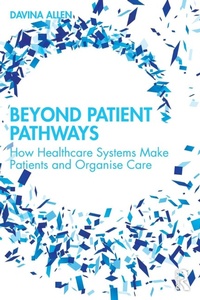
Beyond Patient Pathways
How Healthcare Systems Make Patients and Organise Care
1st Edition
Published on 23. January 2026
Book
Paperback/Softback
318 pages
978-1-032-75652-3 (ISBN)
Description
How is care coordinated when the course is uncertain, the work distributed, and the patient constantly redefined? In this detailed ethnographic study of the hip fracture trajectory, Beyond Patient Pathways challenges the dominant rational-linear logic of care pathways to reveal the complex, evolving assemblages that underpin everyday service delivery.
The book traces how coordination is accomplished within and across diverse settings - from the control centre and ambulance services, through the emergency department, hospital ward, and operating theatres, to community-based care. The first ever study to examine the organisation of end-to-end processes in real time, it offers unique insights into the changing shape of patient trajectories. Anchored in classic sociological ideas on patient trajectories and informed by Translation Mobilisation Theory, Beyond Patient Pathways reframes patient-centred care not as a fixed ideal, but as something enacted through shifting concerns, technologies, and institutional arrangements. It brings to light the diversity of ways in which care is organised, including the often-invisible work that sustains coordination across time and settings. In doing so, it offers not only a powerful conceptual lens but also a methodological foundation for studying care trajectories in ways that are sensitive to the relational intricacies and dynamic configurations of care work.
The complexity of care systems is increasingly acknowledged, but they are difficult to study systematically. This book provides both the empirical grounding and the theoretical tools needed to do so - making it an essential resource for a wide readership of researchers, medical sociologists, service managers, improvement scientists, and healthcare professionals with an interest in health services management, quality improvement, person-centred care, care planning and interprofessional education.
The book traces how coordination is accomplished within and across diverse settings - from the control centre and ambulance services, through the emergency department, hospital ward, and operating theatres, to community-based care. The first ever study to examine the organisation of end-to-end processes in real time, it offers unique insights into the changing shape of patient trajectories. Anchored in classic sociological ideas on patient trajectories and informed by Translation Mobilisation Theory, Beyond Patient Pathways reframes patient-centred care not as a fixed ideal, but as something enacted through shifting concerns, technologies, and institutional arrangements. It brings to light the diversity of ways in which care is organised, including the often-invisible work that sustains coordination across time and settings. In doing so, it offers not only a powerful conceptual lens but also a methodological foundation for studying care trajectories in ways that are sensitive to the relational intricacies and dynamic configurations of care work.
The complexity of care systems is increasingly acknowledged, but they are difficult to study systematically. This book provides both the empirical grounding and the theoretical tools needed to do so - making it an essential resource for a wide readership of researchers, medical sociologists, service managers, improvement scientists, and healthcare professionals with an interest in health services management, quality improvement, person-centred care, care planning and interprofessional education.
More details
Language
English
Place of publication
London
United Kingdom
Publishing group
Taylor & Francis Ltd
Target group
College/higher education
Professional and scholarly
Postgraduate and Professional Practice & Development
Illustrations
1 s/w Tabelle, 12 s/w Abbildungen, 12 s/w Zeichnungen
1 Tables, black and white; 12 Line drawings, black and white; 12 Illustrations, black and white
Dimensions
Height: 234 mm
Width: 156 mm
Thickness: 18 mm
Weight
515 gr
ISBN-13
978-1-032-75652-3 (9781032756523)
Copyright in bibliographic data and cover images is held by Nielsen Book Services Limited or by the publishers or by their respective licensors: all rights reserved.
Schweitzer Classification
Other editions
Additional editions
E-Book
01/2026
Routledge
€55.49
Available for download
E-Book
01/2026
Routledge
€55.49
Available for download
Book
01/2026
1st Edition
Routledge
€212.00
Shipment within 10-20 days
Person
Davina Allen is a professor of Health Service Organisation and Delivery at Cardiff University. A nurse and a sociologist, her work spans foundational ethnographic studies, applied research, and theory development. A Fellow of the Academy of Social Sciences, the Learned Society of Wales, and the Health Foundation, she has a longstanding commitment to the value of sociological inquiry to illuminate and address the practical challenges of contemporary healthcare systems.
Content
Part 1: Reframing Coordination, Introduction to Part 1, 1: The Trouble with Coordination: Organisational Challenges and the Seductions of Pathways, 2: Reimagining Coordination: Sociological Perspectives, 3: Studying Coordination in the Wild: Case, Methods, and Theoretical Framework, Part 2: The Provisional Patient - The Unscheduled Care Assemblage.Introduction to Part 2, 4: Calls, Codes, Dispatch: Emergency Medical Services Control Centre Work, 5: Between Crisis and Care: Emergency Medical Services Responder Work, 6: From Arrival to Admission: Emergency Department Work, 7: Evolving Objects: Unscheduled Care Transitions, Summary of Part 2, Part 3: The Definitive Patient - The Acute Care Assemblage, Introduction to Part 3, 8: Assessment and Alignment: Preoperative Orthogeriatric Work, 9: Bodies and Materials: Operating Department Work, 10: Conscripted Objects: Acute Care Transitions, Summary of Part 3, Part 4: The Distributed Patient - The Recovery Care Assemblage, Introduction to Part 4, 11: Recovery and Discharge Planning: Postoperative Orthogeriatric Work, 12: Enablement and Infrastructures: Community Resource Team Work, 13: Unstable Objects: Recovery Care Transitions, Summary of Part 4, Conclusion: Trajectory Assemblage Synthesis and Implications for Service Improvement and Research, 14: Beyond Pathways: Making Coordination Work