

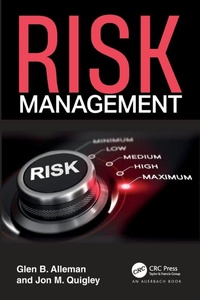
Risk Management
Managing Tomorrow's Threats
1st Edition
Published on 15. March 2024
Book
Paperback/Softback
312 pages
978-1-032-54564-6 (ISBN)
Description
Project success is an elusive goal in every business or technical domain. Project failure usually results from unhandled risks to the technical, cost, and schedule aspects of the project. There are four primary root causes of project failure.
Unrealistic performance expectation, with missing Measures of Effectiveness
Unrealistic cost and schedule estimates based on inadequate risk adjusted growth models
Inadequate assessment of risk and unmitigated exposure to these risks without proper handling strategies
Unanticipated technical issues with alternative plans and solutions to maintain the effectiveness of the project processes and its deliverables
Risk Management provides a comprehensive overview of the people, principles, processes, and practices as the fundamental base upon which an effective risk management system resides. However, this does not guarantee effective risk management and successful projects and businesses. The first half of the book describes risk management processes, as well as a delineation between risk and hazards and how these are connected. The second half of the book provides industry examples of the approach to risk management in specific context and with specific approaches and artifacts where applicable.
The book focuses on risks created by uncertainty, their identification, and the corrective and preventive actions needed to address these risks to increase the probability of project success. The book's goal is to provide a context-driven framework, developing a foundation for a rational approach to risk management that makes adaptation to circumstances as easy as possible.
Unrealistic performance expectation, with missing Measures of Effectiveness
Unrealistic cost and schedule estimates based on inadequate risk adjusted growth models
Inadequate assessment of risk and unmitigated exposure to these risks without proper handling strategies
Unanticipated technical issues with alternative plans and solutions to maintain the effectiveness of the project processes and its deliverables
Risk Management provides a comprehensive overview of the people, principles, processes, and practices as the fundamental base upon which an effective risk management system resides. However, this does not guarantee effective risk management and successful projects and businesses. The first half of the book describes risk management processes, as well as a delineation between risk and hazards and how these are connected. The second half of the book provides industry examples of the approach to risk management in specific context and with specific approaches and artifacts where applicable.
The book focuses on risks created by uncertainty, their identification, and the corrective and preventive actions needed to address these risks to increase the probability of project success. The book's goal is to provide a context-driven framework, developing a foundation for a rational approach to risk management that makes adaptation to circumstances as easy as possible.
More details
Language
English
Place of publication
London
United Kingdom
Publishing group
Taylor & Francis Ltd
Target group
Professional and scholarly
Professional Practice & Development
Illustrations
19 s/w Tabellen, 52 s/w Zeichnungen, 52 s/w Abbildungen
19 Tables, black and white; 52 Line drawings, black and white; 52 Illustrations, black and white
Dimensions
Height: 234 mm
Width: 156 mm
Thickness: 18 mm
Weight
506 gr
ISBN-13
978-1-032-54564-6 (9781032545646)
Copyright in bibliographic data and cover images is held by Nielsen Book Services Limited or by the publishers or by their respective licensors: all rights reserved.
Schweitzer Classification
Other editions
Additional editions
E-Book
03/2024
1st Edition
Taylor & Francis
€72.49
Available for download
E-Book
03/2024
1st Edition
Taylor & Francis
€72.49
Available for download
Book
03/2024
1st Edition
Auerbach
€206.20
Shipment within 10-20 days
Persons
Glen B. Alleman has over the past 25 years led program management offices, software product development organizations, and ERP deployment projects. His current interests include Integrated Product Team (IPT) deployments of Microsoft Project Server, integration of schedules and costs on enterprise programs and probabilistic risk assessment integration. As well Glen consults in the system architecture, business process improvement, and program management office deployment fields. Prior to these activities, Glen was VP Program Management, Rocky Flats Environmental Technology Site (www.rfets.gov) where he directed the programmatic controls aspects of the IT closure activities through the deployment of DCMA compliant Earned Value Management Systems controlling agile software development processes.
Jon M. Quigley consults, coaches and teaches on business and project management topics (including agile and scrum) within embedded systems engineering, specifically product development, with more than 30 years of experience much of which is automotive with some industrial control systems. He has done work for PPG, Owens Corning, as well as GM, Plymouth, Harley Davidson, Chrysler, Mack, Volvo and PACCAR. He has ceded 7 US patent to the companies at which he has worked. He has co-authored more than 11 books and contributed to many others, as well as scores of magazine articles, and he is a frequent speaker at technical and project management events.
Jon M. Quigley consults, coaches and teaches on business and project management topics (including agile and scrum) within embedded systems engineering, specifically product development, with more than 30 years of experience much of which is automotive with some industrial control systems. He has done work for PPG, Owens Corning, as well as GM, Plymouth, Harley Davidson, Chrysler, Mack, Volvo and PACCAR. He has ceded 7 US patent to the companies at which he has worked. He has co-authored more than 11 books and contributed to many others, as well as scores of magazine articles, and he is a frequent speaker at technical and project management events.
Content
1. Introduction to Risk Management 2. Risk Identification 3. Risk Analysis 4. Risk-Handling Plan 5. Risk Tracking 6. Communication and Risk 7. Advanced Topics in Risk Management 8. The Practices of Risk Management