

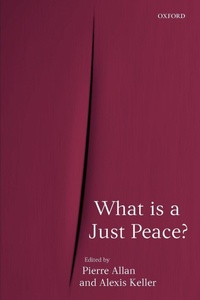
What is a Just Peace?
Published on 17. July 2008
Book
Paperback/Softback
256 pages
978-0-19-954571-1 (ISBN)
Description
Just war has attracted considerable attention. The words peace and justice are often used together. Surprisingly, however, little conceptual thinking has gone into what constitutes a just peace. This book, which includes some of the world's leading scholars, debates and develops the concept of just peace.
The problem with the idea of a just peace is that striving for justice may imply a just war. In other words, peace and justice clash at times. Therefore, one often starts from a given view of what constitutes justice, but this a priori approach leads - especially when imposed from the outside - straight into discord. This book presents conflicting viewpoints on this question from political, historical, and legal perspectives as well as from a policy perspective.
This book also argues that a just peace is a mediated peace. It is just, because it is based on conventions that are negotiated and recognized by the parties. Mutual recognition is central: parties recognize each other as agents that have an identity. Consent is necessary, too: all parties need to approve a solution; therefore, each party needs to understand what allows the other to remain "self." And renouncement: concessions are necessary, some symbols and positions need to be sacrificed. In this sense, the Geneva Initiative - the first comprehensive Israeli-Palestinian peace plan - is a mediated peace.
Thus the book challenges a liberal view of peace founded on norms claiming universal scope. This liberal conception has difficulty in solving conflicts such as civil wars characterized typically by fundamental disagreements between different communities. Cultures make demands that are identity-defining, and some of these defy the "cultural neutrality" that is one of the foundations of liberalism. Thus, the concept of just peace cannot be solved within liberalism - nor for that matter within communitarianism.
The problem with the idea of a just peace is that striving for justice may imply a just war. In other words, peace and justice clash at times. Therefore, one often starts from a given view of what constitutes justice, but this a priori approach leads - especially when imposed from the outside - straight into discord. This book presents conflicting viewpoints on this question from political, historical, and legal perspectives as well as from a policy perspective.
This book also argues that a just peace is a mediated peace. It is just, because it is based on conventions that are negotiated and recognized by the parties. Mutual recognition is central: parties recognize each other as agents that have an identity. Consent is necessary, too: all parties need to approve a solution; therefore, each party needs to understand what allows the other to remain "self." And renouncement: concessions are necessary, some symbols and positions need to be sacrificed. In this sense, the Geneva Initiative - the first comprehensive Israeli-Palestinian peace plan - is a mediated peace.
Thus the book challenges a liberal view of peace founded on norms claiming universal scope. This liberal conception has difficulty in solving conflicts such as civil wars characterized typically by fundamental disagreements between different communities. Cultures make demands that are identity-defining, and some of these defy the "cultural neutrality" that is one of the foundations of liberalism. Thus, the concept of just peace cannot be solved within liberalism - nor for that matter within communitarianism.
More details
Language
English
Place of publication
Oxford
United Kingdom
Target group
College/higher education
Dimensions
Height: 234 mm
Width: 156 mm
Thickness: 14 mm
Weight
389 gr
ISBN-13
978-0-19-954571-1 (9780199545711)
Copyright in bibliographic data and cover images is held by Nielsen Book Services Limited or by the publishers or by their respective licensors: all rights reserved.
Schweitzer Classification
Other editions
Additional editions
Alexis Keller | Pierre Allan
What is a Just Peace?
Book
01/2006
Oxford University Press
€70.10
Shipment within 15-20 days
Persons
Pierre Allan has been Professor of Political Science at the University of Geneva since 1984 and Dean of the Faculty of Social and Economic Sciences since 2001. Graduated in economic sciences in 1974 (prize "La Suisse") of the Ecole des hautes etudes commerciales (HEC) of the University of Lausanne ane, in 1975, graduated in Sociology of the Ecole des ssciences sociales et politiques of the University of Lausanne. In 1980, he obtained his PhD in Political Sciences at the Institut universitaires de hautes etudes internationales (IUHEI) of the University of Geneva.
Alexis Keller is professor at the Faculty of Law, University of Geneva. He is a former fellow of the Carr Centre for Human Rights Policy at the Kennedy School of Government, Harvard University. From 2002 to 2004, Dr. Keller participated actively in negotiations between Israelis and Palestinians that led to the Geneva Accord. In April 2003, he was appointed by the Swiss Foreign Minister to serve as special representative for the Middle East peace process. He held this post until January 2004.
Alexis Keller is professor at the Faculty of Law, University of Geneva. He is a former fellow of the Carr Centre for Human Rights Policy at the Kennedy School of Government, Harvard University. From 2002 to 2004, Dr. Keller participated actively in negotiations between Israelis and Palestinians that led to the Geneva Accord. In April 2003, he was appointed by the Swiss Foreign Minister to serve as special representative for the Middle East peace process. He held this post until January 2004.
Content
1. Introduction ; 2. Between the Eradication of Humanity and Paradise: Just Peace Within a Conceptual Scale ; 3. Peace and Justice in Political Thought ; 4. Just Peace: A Cause Worth Fighting For? ; 5. Peace and Justice ; 6. Peace, Justice, and Religion ; 7. Just Peace: An Unnecessary Concept ; 8. A Just Peace ; 9. Chapter 9 Just Peace: From Peace to Justice or From Justice to Peace?