

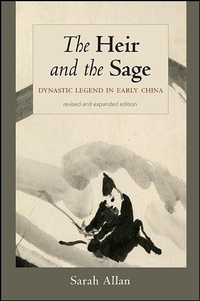
The Heir and the Sage
Dynastic Legend in Early China
2nd Edition
Published on 1. October 2016
Book
Hardback
218 pages
978-1-4384-6225-7 (ISBN)
Description
A comprehensive analysis of the transformations of ancient history in early Chinese texts.
This book presents a comprehensive analysis of the accounts of change of rule in Chinese texts from 600 to 100 BC, including the core philosophical works of the Chinese tradition attributed to Confucius, Mozi, Mencius, Xunzi, Hanfeizi, and Zhuangzi. Drawing from the early structuralism of Claude Levi-Strauss, Sarah Allan demonstrates that similar motifs repeat in every period, and argues that they serve, like myth, to mediate the inherent social conflict between kinship relations and that of the larger community. This conflict is embodied in the idea of a dynastic cycle, founded by a virtuous sage king and passed down hereditarily until a last evil ruler is again replaced, and played out at regular intervals in legends of kings and ministers, heirs and sages, ministers and recluses, regents and rebels. Each philosophical text transforms the legends in a systematic manner to reflect its own understanding of the patterns of history that inform the present.
In this revised and expanded edition, Allan has added translations and original Chinese texts, as well as a new introduction further analyzing structuralism and discussing how the book remains relevant to ongoing sinological arguments. An earlier article by Allan, with supporting evidence for this book's thesis, is included as an appendix.
This book presents a comprehensive analysis of the accounts of change of rule in Chinese texts from 600 to 100 BC, including the core philosophical works of the Chinese tradition attributed to Confucius, Mozi, Mencius, Xunzi, Hanfeizi, and Zhuangzi. Drawing from the early structuralism of Claude Levi-Strauss, Sarah Allan demonstrates that similar motifs repeat in every period, and argues that they serve, like myth, to mediate the inherent social conflict between kinship relations and that of the larger community. This conflict is embodied in the idea of a dynastic cycle, founded by a virtuous sage king and passed down hereditarily until a last evil ruler is again replaced, and played out at regular intervals in legends of kings and ministers, heirs and sages, ministers and recluses, regents and rebels. Each philosophical text transforms the legends in a systematic manner to reflect its own understanding of the patterns of history that inform the present.
In this revised and expanded edition, Allan has added translations and original Chinese texts, as well as a new introduction further analyzing structuralism and discussing how the book remains relevant to ongoing sinological arguments. An earlier article by Allan, with supporting evidence for this book's thesis, is included as an appendix.
More details
Series
Edition
Revised and Expanded Edition
Language
English
Place of publication
Albany, NY
United States
Target group
College/higher education
Professional and scholarly
US School Grade: College Graduate Student and over
Edition type
Revised edition
Product notice
sewn/stitched
Cloth over boards
Illustrations
5 Tables, black and white
Dimensions
Height: 231 mm
Width: 155 mm
Thickness: 20 mm
Weight
454 gr
ISBN-13
978-1-4384-6225-7 (9781438462257)
Copyright in bibliographic data and cover images is held by Nielsen Book Services Limited or by the publishers or by their respective licensors: all rights reserved.
Schweitzer Classification
Other editions
Additional editions
E-Book
09/2016
1st Edition
De Gruyter
from
€84.99
Available for download
Person
Sarah Allan is Burlington Northern Foundation Professor of Asian Studies in Honor of Richard M. Bressler at Dartmouth College. She is the author of Buried Ideas: Legends of Abdication and Ideal Government in Early Chinese Bamboo-Slip Manuscripts; The Way of Water and Sprouts of Virtue; and The Shape of the Turtle: Myth, Art, and Cosmos in Early China, all published by SUNY Press.
Content
Preface To The Revised and Expanded Edition
Acknowledgments
Preface to the Original Edition
Introduction
1. Problem and Theory
2. Legend Set 1: Tang Yao to Yu Shun
3. Legend Sets 2 and 3: Yu Shun to Xia Yu and the Foundation of the Xia Dynasty
4. Legend Set 4: The Foundation of the Shang Dynasty
5. Legend Set 5: The Foundation of the Zhou Dynasty
6. The Philosophers
7. Conclusion
Appendix 1
Charts
Appendix 2
The Identities of Taigong Wang in Zhou and Han Literature
Bibliography
Index of Chinese Names, Places, and Important Terms
Acknowledgments
Preface to the Original Edition
Introduction
1. Problem and Theory
2. Legend Set 1: Tang Yao to Yu Shun
3. Legend Sets 2 and 3: Yu Shun to Xia Yu and the Foundation of the Xia Dynasty
4. Legend Set 4: The Foundation of the Shang Dynasty
5. Legend Set 5: The Foundation of the Zhou Dynasty
6. The Philosophers
7. Conclusion
Appendix 1
Charts
Appendix 2
The Identities of Taigong Wang in Zhou and Han Literature
Bibliography
Index of Chinese Names, Places, and Important Terms