

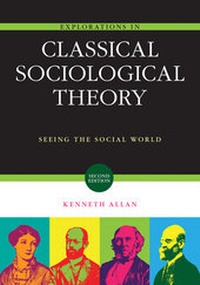
Explorations in Classical Sociological Theory
Seeing the Social World
2nd Edition
Published on 1. October 2009
Book
Paperback/Softback
472 pages
978-1-4129-7812-5 (ISBN)
Description
"Explorations in Classical Sociological Theory: Seeing the Social World, Second Edition" is an undergraduate sociological theory textbook that introduces the student to the major classical theorists, including Marx, Spencer, Durkheim, Weber, Simmel, Mead, Schutz, Gilman, and Du Bois. The theorists were chosen for the diversity of their perspectives as well as their ability to introduce the student to contemporary theory. Kenneth Allan uses a lively informative writing style to engage the students in the eras of social change that spawned the major sociological theories and then applies them to the current era, which also is experiencing major social change. The book includes a glossary of terms. Each of the theorist's important concepts are highlighted in the text and clear definitions provided in the glossary. This feature is particularly important because theory is made up of terms and concepts and without the use of a glossary, it is very easy for the undergraduate theory student to lose track of the terms and meanings.
While the book is organized primarily around the individual theorist's perspective, a categorical scheme is also provided so the student can roughly situate the theorists and decide for themselves some of sociology's big questions. The scheme provided in the book is not the one usually used by textbooks. The more commonly used scheme (conflict, functional, interaction) hides some really important questions that the student needs to consider (for example, is society an object or does it exist only through interpretations?). The book provides an appendix with complete definitions of most of sociology's major 'perspectives' (e.g., critical theory (including feminism, race, and queer theory, postmodernism, and so on), exchange theory, rational choice theory, dramaturgy, ethnomethodology, structuration, network theory, ecological theory, social phenomenology, and so on). The book introduces the power and poetry of theory by extensive use of original source material from the theorists writings.
While the book is organized primarily around the individual theorist's perspective, a categorical scheme is also provided so the student can roughly situate the theorists and decide for themselves some of sociology's big questions. The scheme provided in the book is not the one usually used by textbooks. The more commonly used scheme (conflict, functional, interaction) hides some really important questions that the student needs to consider (for example, is society an object or does it exist only through interpretations?). The book provides an appendix with complete definitions of most of sociology's major 'perspectives' (e.g., critical theory (including feminism, race, and queer theory, postmodernism, and so on), exchange theory, rational choice theory, dramaturgy, ethnomethodology, structuration, network theory, ecological theory, social phenomenology, and so on). The book introduces the power and poetry of theory by extensive use of original source material from the theorists writings.
More details
Edition
2nd Revised edition
Language
English
Place of publication
Thousand Oaks
United States
Publishing group
SAGE Publications Inc
Target group
College/higher education
Edition type
Revised edition
Illustrations
Illustrations
Dimensions
Height: 254 mm
Width: 178 mm
ISBN-13
978-1-4129-7812-5 (9781412978125)
Copyright in bibliographic data and cover images is held by Nielsen Book Services Limited or by the publishers or by their respective licensors: all rights reserved.
Schweitzer Classification
Other editions
New editions
Book
06/2012
3rd Edition
SAGE Publications Inc
€123.50
Article exhausted; check for reprint
Person
Kenneth Allan is Associate Professor (Ph.D., University of California at Riverside, 1995). Most recent teaching is in the areas of: Sociological Theory, Social Psychology, and Sociology of Culture. He has published numerous articles in theory, and a book in 1998, The Meaning of Culture, explicating cultural theory. He also contributed to Turner's last two editions of The Structure of Sociological Theory. Over the past eight years he has taught well over 30 courses in social theory.
Content
1. Imagining Society 2. Organic Evolution-Herbert Spencer (British, 1820--1903) 3. Engines of Change-Karl Marx (German, 1818--1883) 4. Cultural Consensus- Emile Durkheim (French, 1885--1917) 5. Authority and Rationality-Max Weber (German, 1864--1920) 6. Society and the Individual-Georg Simmel (German, 1858--1918) 7. Self-Consciousness-George Herbert Mead (American, 1863--1931) 8. A Society of Difference-Harriet Martineau, Charlotte Perkins Gilman, and W.E.B. Du Bois 9. The Problem of Meaning and Reality-Alfred Schutz (Austrian, 1899--1959) 10. The Social System- Talcott Parsons (American, 1902--1979) 11: Theorizing Society