

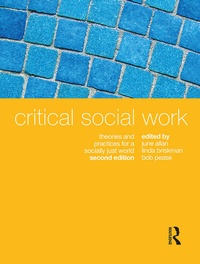
Critical Social Work
Theories and practices for a socially just world
2nd Edition
Published on 31. March 2021
Book
Hardback
368 pages
978-0-367-71785-8 (ISBN)
Description
'Another important contribution to the growing literature on critical social work. It is on the cutting edge of thinking about social work and its goal of social change.' - Kate van Heugten, Social Work Review
Critical Social Work starts from the premise that a central goal of social work practice is social change to redress social inequality. Taking a critical theoretical approach, the authors explore the links between personal and social change. They confront the challenges for critical social work in the context of pressures to separate the personal from the political and in responding to the impact of changes in the socio-political, statutory and global contexts of practice.
Critical Social Work has been thoroughly revised to take into account recent social, economic and political developments. Coverage of theoretical frameworks has been substantially expanded and reflects current concerns such as evidence based practice and human rights. The causes of people's marginalisation and oppression are examined in relation to class, race, ethnicity, gender and other forms of social inequality.Case study chapters in the earlier edition on working with immigrants, Indigenous people, women, men, families, people with psychiatric disabilities and those experiencing loss and grief have been updated and revised. The second edition includes new case study chapters on disability, older people, children, rurality, and violence and abuse.
Critical Social Work is an essential resource to inform progressive social work practice.
Critical Social Work starts from the premise that a central goal of social work practice is social change to redress social inequality. Taking a critical theoretical approach, the authors explore the links between personal and social change. They confront the challenges for critical social work in the context of pressures to separate the personal from the political and in responding to the impact of changes in the socio-political, statutory and global contexts of practice.
Critical Social Work has been thoroughly revised to take into account recent social, economic and political developments. Coverage of theoretical frameworks has been substantially expanded and reflects current concerns such as evidence based practice and human rights. The causes of people's marginalisation and oppression are examined in relation to class, race, ethnicity, gender and other forms of social inequality.Case study chapters in the earlier edition on working with immigrants, Indigenous people, women, men, families, people with psychiatric disabilities and those experiencing loss and grief have been updated and revised. The second edition includes new case study chapters on disability, older people, children, rurality, and violence and abuse.
Critical Social Work is an essential resource to inform progressive social work practice.
More details
Edition
2nd edition
Language
English
Place of publication
London
United Kingdom
Publishing group
Taylor & Francis Ltd
Target group
College/higher education
Dimensions
Height: 230 mm
Width: 176 mm
Weight
1120 gr
ISBN-13
978-0-367-71785-8 (9780367717858)
Copyright in bibliographic data and cover images is held by Nielsen Book Services Limited or by the publishers or by their respective licensors: all rights reserved.
Schweitzer Classification
Other editions
Additional editions
E-Book
07/2020
2nd Edition
Routledge
€52.49
Available for download
E-Book
07/2020
2nd Edition
Routledge
€52.49
Available for download
Book
08/2009
2nd Edition
Allen & Unwin
€69.51
Shipment within 3-4 weeks
Persons
June Allan is Senior Lecturer in Social Work at RMIT University.
Linda Briskman holds the Dr Haruhisa Handa Chair in Human Rights Education at Curtin University.
Bob Pease is Chair of Social Work at Deakin University.
Linda Briskman holds the Dr Haruhisa Handa Chair in Human Rights Education at Curtin University.
Bob Pease is Chair of Social Work at Deakin University.
Content
Preface
List of ContributorsPart I: Introduction
1 Introducing critical theories for social work in a neo-liberal context
Part II: Developing conceptual frameworks for critical social work
2 Tracing the origins of critical social work practice
3 Theorising new developments in critical social work
4 From evidence-based practice to critical knowledge in post-positivist social work
5 Promoting a human rights perspective on critical social work
6 Doing critical social work
Part III: Resisting domination and oppression
7 Towards anti-racist and culturally affirming practices
8 Reversing colonial practices with Indigenous peoples
9 Reconstructing social work practices with families
10 Examining the meaning of childhood in critical social work practice
11 Using critical reflection to improve feminist practice
12 Challenges and directions for profeminist practice with men
13 Empower
List of ContributorsPart I: Introduction
1 Introducing critical theories for social work in a neo-liberal context
Part II: Developing conceptual frameworks for critical social work
2 Tracing the origins of critical social work practice
3 Theorising new developments in critical social work
4 From evidence-based practice to critical knowledge in post-positivist social work
5 Promoting a human rights perspective on critical social work
6 Doing critical social work
Part III: Resisting domination and oppression
7 Towards anti-racist and culturally affirming practices
8 Reversing colonial practices with Indigenous peoples
9 Reconstructing social work practices with families
10 Examining the meaning of childhood in critical social work practice
11 Using critical reflection to improve feminist practice
12 Challenges and directions for profeminist practice with men
13 Empower