

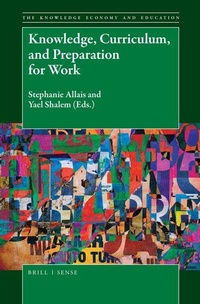
Knowledge, Curriculum, and Preparation for Work
Published on 29. March 2018
Book
Hardback
278 pages
978-90-04-36538-4 (ISBN)
Description
In Knowledge, Curriculum, and Preparation for Work, the editors offer a timely collection of chapters approaching debates on economic and social change and employment within different types of economies. Considering questions of knowledge and curriculum, these works interrogate ways of thinking about relationships between different forms of work and education. The focus is both on the curriculum - the ways in which different types of knowledge affect the quality and organization of curricula that are intended to prepare for work - and the factors influencing and constraining what education can do to prepare for work, as well as how these factors shape and limit the role of educational preparation for work.
More details
Series
Language
English
Place of publication
Leiden
Netherlands
Target group
Professional and scholarly
Product notice
sewn/stitched
Cloth over boards
Dimensions
Height: 239 mm
Width: 160 mm
Thickness: 23 mm
Weight
318 gr
ISBN-13
978-90-04-36538-4 (9789004365384)
Copyright in bibliographic data and cover images is held by Nielsen Book Services Limited or by the publishers or by their respective licensors: all rights reserved.
Schweitzer Classification
Other editions
Additional editions
Stephanie Allais | Yael Shalem
Knowledge, Curriculum, and Preparation for Work
Book
04/2018
Brill
€58.00
Shipment within 10-20 days
Persons
Stephanie Allais is the Research Chair for Skills Development at the Centre for Researching Education and Labour, University of the Witwatersrand. She is the author of Selling Out Education: National Qualifications Frameworks and the Neglect of Knowledge (Sense, 2014).
Yael Shalem is Associate Professor of Education at the University of the Witwatersrand. She co-edited Retrieving Teaching: Critical Issues in Curriculum Pedagogy and Learning (Juta, 2010), in memory of Professor Wally Morrow, the founder of educational theory in South Africa.
Yael Shalem is Associate Professor of Education at the University of the Witwatersrand. She co-edited Retrieving Teaching: Critical Issues in Curriculum Pedagogy and Learning (Juta, 2010), in memory of Professor Wally Morrow, the founder of educational theory in South Africa.
Content
Acknowledgements vii
Notes on Contributors ix
Introduction 1
Stephanie Allais and Yael Shalem
1 When Is Vocational Education Educationally Valuable? 13
Yael Shalem and Stephanie Allais
2 From Labour Market to Labour Process
Finding a Basis for Curriculum in TVET 30
Jeanne Gamble
3 Applied Theoretical Knowledge and Professional and Vocational Education
Informed Know-How in a Non-Intellectualist Framework 51
Christopher Winch
4 Recontextualisation and the Education-Work Relation 68
Jim Hordern
5 Current Trajectories of the South African Economy and Labour Market 89
Sam Ashman
6 The Idealisation of Apprenticeship 104
Volker Wedekind
7 What should Vocational Qualifications Look Like if the Links between Qualifications and Jobs Are So Weak? 127
Leesa Wheelahan and Gavin Moodie
8 The Radical Realism of Creative Policy Hybridity
How Skill Formation Systems Can Improve Low-Income Country Employment 147
Andrew Lawrence
9 The Unbearable 'Applied-Ness' of Engineering Knowledge 167
Renee Smit
10 Theory and Practice in the 21st Century Engineering Workplace 182
Karin Wolff
11 Conversion or Diversion?
Curriculum and Non-Cognate Master's Degrees in Applied Disciplinary Fields 206
Lynn Hewlett
12 Understanding Transitions between Work and Formal Qualifications
The Case of RPL 228
Linda Cooper, Judy Harris and Alan Ralphs
Afterword: The Challenge of Bringing Different Worlds Together 249
Michael Young
Index 261
Notes on Contributors ix
Introduction 1
Stephanie Allais and Yael Shalem
1 When Is Vocational Education Educationally Valuable? 13
Yael Shalem and Stephanie Allais
2 From Labour Market to Labour Process
Finding a Basis for Curriculum in TVET 30
Jeanne Gamble
3 Applied Theoretical Knowledge and Professional and Vocational Education
Informed Know-How in a Non-Intellectualist Framework 51
Christopher Winch
4 Recontextualisation and the Education-Work Relation 68
Jim Hordern
5 Current Trajectories of the South African Economy and Labour Market 89
Sam Ashman
6 The Idealisation of Apprenticeship 104
Volker Wedekind
7 What should Vocational Qualifications Look Like if the Links between Qualifications and Jobs Are So Weak? 127
Leesa Wheelahan and Gavin Moodie
8 The Radical Realism of Creative Policy Hybridity
How Skill Formation Systems Can Improve Low-Income Country Employment 147
Andrew Lawrence
9 The Unbearable 'Applied-Ness' of Engineering Knowledge 167
Renee Smit
10 Theory and Practice in the 21st Century Engineering Workplace 182
Karin Wolff
11 Conversion or Diversion?
Curriculum and Non-Cognate Master's Degrees in Applied Disciplinary Fields 206
Lynn Hewlett
12 Understanding Transitions between Work and Formal Qualifications
The Case of RPL 228
Linda Cooper, Judy Harris and Alan Ralphs
Afterword: The Challenge of Bringing Different Worlds Together 249
Michael Young
Index 261