

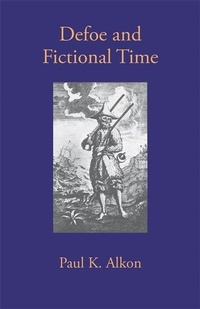
Defoe and Fictional Time
Published on 1. August 2010
Book
Paperback/Softback
290 pages
978-0-8203-3771-5 (ISBN)
Description
Defoe and Fictional Time shows Defoe's relevance to issues now central to criticism of the novel; relationships between narrative time and clock time, the influence of time concepts shared by writers and their audience, and above all the questions of how fiction shapes the phenomenal time of reading. Paul K. Alkon offers first a study of time in Defoe's fiction, with glances at Richardson, Fielding, and Sterne; and second a theoretical discussion of time in fiction. Arguing that eighteenth-century views of history account for the strange chronologies in Captain Singleton, Colonel Jack, Moll Flanders, and Roxana, Alkon explores Defoe's innovative use of narrative sequences, frequency, spatial form, chronology, settings, tempo, and the reader's cumulative memories of a text. Defoe's Journal of the Plague Year is the first portrayal of a public duration-passing time shared by an entire population during a crisis-ranking Defoe among the most creative writers who have explored the way in which fictional time may influence reading time.
Reviews / Votes
Alkon's method produces shrewd observations about the texts at hand as well as about the critical ideas they generate. His account of the puzzling conclusion of Moll Flanders is the best I know. And his comparisons of timeschemes in different novels often open whole new perspectives. -- <i>Modern Language Review</i> Alkon is able to illuminate Defoe's narrative techniques and to read the fictions with subtlety and originality. . . . Alkon has shown how thoroughly Defoe grasped a major aspect of narrative subject matter and technique, and for this everyone interested in Defoe and the novel is in his debt. -- <i>Eighteenth Century Studies</i> Alkon's study helps one to understand the relationship of time to Defoe's novels and to the genre as a whole; it suggests several avenues for future research; and its chapters on the reader's memory and on tempo make an important contribution to time studies. Defoe and Fictional Time is a book that should be read by everyone who is interested in the novel. -- <i>Modern Philology</i>More details
Language
English
Place of publication
Georgia
United States
Target group
Professional and scholarly
Product notice
Paperback (trade)
Dimensions
Height: 216 mm
Width: 140 mm
Thickness: 17 mm
Weight
372 gr
ISBN-13
978-0-8203-3771-5 (9780820337715)
Copyright in bibliographic data and cover images is held by Nielsen Book Services Limited or by the publishers or by their respective licensors: all rights reserved.
Schweitzer Classification
Person
PAUL K. ALKON is Leo S. Bing Professor Emeritus of English and American Literature, University of Southern California, Los Angeles. He is the author of five books including Defoe and Fictional Time (Georgia), Science Fiction before 1900, and Winston Churchill's Imagination.