

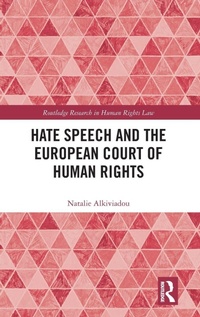
Hate Speech and the European Court of Human Rights
1st Edition
Published on 30. June 2025
Book
Hardback
266 pages
978-1-032-90924-0 (ISBN)
Description
This book argues that the European Court of Human Rights (ECtHR) should reconsider its approach to hate speech cases and develop a robust protection of freedom of expression as set out in the benchmark case of Handyside v the United Kingdom. In that case, the ECtHR determined that Article 10 of the European Convention on Human Rights (ECHR), safeguarding the right to freedom of expression, extends protection not only to opinions which are well received but also to those deemed offensive, shocking, or disturbing. However, subsequent rulings by the Court have generated a significant amount of contradictory case law. Against this backdrop, this book provides an analysis of hate speech case law before the ECtHR and the now-obsolete European Commission on Human Rights. Through a jurisprudential analysis, it is argued that these institutions have adopted an overly restrictive approach to hate speech, which fails to provide adequate protection of the right to freedom of expression. It also demonstrates that there are stark inconsistencies when it comes to the treatment of some forms of 'hate speech' versus others. The study further contends that, in reaching its decisions on hate speech cases, the Court disregards empirical evidence on matters related to free speech restrictions. Viewing the ECHR as a 'living instrument,' the book places this analysis within the current state of affairs vis-a-vis the handling of hate speech, particularly online, by European countries, the European Union itself and social media platforms, actions which the author argues are contributing to a free speech demise. The book will be a valuable resource for academics, researchers and policymakers working in the area of law, political science, European studies and sociology.
Reviews / Votes
"In the coming years, important regulations for major online platforms will likely arise from Council of Europe member states. European Court of Human Rights rulings will shape a complex global jurisprudence on online speech. Natalie Alkiviadou deserves praise for pioneering scholarship in this challenging and evolving field."- Eric Heinze, Professor of Law and Humanities, Queen Mary University of London, UK.
"This important book presents an incisive analysis of the decisions concerning hate speech under the European Convention on Human Rights, offering a constructive critique of the case law's historic trajectory. In our interconnected world, the book's insightful analysis should inform debates far beyond Europe."
- Nadine Strossen, John Marshall Harlan II Professor of Law Emerita, New York Law School, USA
More details
Series
Language
English
Place of publication
London
United Kingdom
Publishing group
Taylor & Francis Ltd
Target group
College/higher education
Postgraduate
Dimensions
Height: 240 mm
Width: 161 mm
Thickness: 20 mm
Weight
599 gr
ISBN-13
978-1-032-90924-0 (9781032909240)
Copyright in bibliographic data and cover images is held by Nielsen Book Services Limited or by the publishers or by their respective licensors: all rights reserved.
Schweitzer Classification
Other editions
Additional editions
Natalie Alkiviadou
Hate Speech and the European Court of Human Rights
E-Book
06/2025
1st Edition
Routledge
€60.99
Available for download
Natalie Alkiviadou
Hate Speech and the European Court of Human Rights
E-Book
06/2025
1st Edition
Routledge
€60.99
Available for download
Person
Natalie Alkiviadou is Senior Research Fellow at the Future of Free Speech at Vanderbilt University, USA. Her research interests lie in the freedom of expression, the far right, hate speech, hate crime and non-discrimination.
Content
Introduction. 1. Hate Speech: Definitional and Conceptual Framework 2. The Effects of Hate Speech and How Best to Deal with Them 3. The Council of Europe 4. Hate Speech Jurisprudence: Protecting Protected Characteristics before the European Court of Human Rights 5. Hate Speech Jurisprudence: Dealing with Totalitarianism, Genocide Denial and Violence before the European Court of Human Rights. Conclusion