

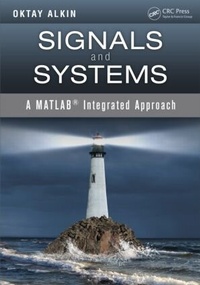
Signals and Systems
A MATLAB (R) Integrated Approach
1st Edition
Published on 18. March 2014
Book
Hardback
1122 pages
978-1-4665-9853-9 (ISBN)
Description
Drawing on the author's 25+ years of teaching experience, Signals and Systems: A MATLAB (R) Integrated Approach presents a novel and comprehensive approach to understanding signals and systems theory. Many texts use MATLAB (R) as a computational tool, but Alkin's text employs MATLAB both computationally and pedagogically to provide interactive, visual reinforcement of the fundamentals, including the characteristics of signals, operations used on signals, time and frequency domain analyses of systems, continuous-time and discrete-time signals and systems, and more.
In addition to 350 traditional end-of-chapter problems and 287 solved examples, the book includes hands-on MATLAB modules consisting of:
101 solved MATLAB examples, working in tandem with the contents of the text itself
98 MATLAB homework problems (coordinated with the 350 traditional end-of-chapter problems)
93 GUI-based MATLAB demo programs that animate key figures and bring core concepts to life
23 MATLAB projects, more involved than the homework problems (used by instructors in building assignments)
11 sections of standalone MATLAB exercises that increase MATLAB proficiency and enforce good coding practices
Each module or application is linked to a specific segment of the text to ensure seamless integration between learning and doing. A solutions manual, all relevant MATLAB code, figures, presentation slides, and other ancillary materials are available on an author-supported website or with qualifying course adoption.
By involving students directly in the process of visualization, Signals and Systems: A MATLAB (R) Integrated Approach affords a more interactive-thus more effective-solution for a one- or two-semester course on signals and systems at the junior or senior level.
In addition to 350 traditional end-of-chapter problems and 287 solved examples, the book includes hands-on MATLAB modules consisting of:
101 solved MATLAB examples, working in tandem with the contents of the text itself
98 MATLAB homework problems (coordinated with the 350 traditional end-of-chapter problems)
93 GUI-based MATLAB demo programs that animate key figures and bring core concepts to life
23 MATLAB projects, more involved than the homework problems (used by instructors in building assignments)
11 sections of standalone MATLAB exercises that increase MATLAB proficiency and enforce good coding practices
Each module or application is linked to a specific segment of the text to ensure seamless integration between learning and doing. A solutions manual, all relevant MATLAB code, figures, presentation slides, and other ancillary materials are available on an author-supported website or with qualifying course adoption.
By involving students directly in the process of visualization, Signals and Systems: A MATLAB (R) Integrated Approach affords a more interactive-thus more effective-solution for a one- or two-semester course on signals and systems at the junior or senior level.
Reviews / Votes
"... very comprehensive, covering basic to advanced topics with MATLAB (R)-based examples throughout. Engineering students will particularly find the book very useful to understand the signals and systems theories and practices that underpin modern communication systems."-Dr. Rishad Shafik, School of Electronics and Computer Science, University of Southampton, UK
"The main strength of the proposed book is the emphasis on involving readers Matlab examples and use of Matlab as an integrated teaching tool. It is probably the first book in this area that provides such a good usage of Matlab for class instructions."
-Dr. Tadeusz A Wysocki, University of Nebraska - Lincoln
"All students are lost among the equations after a while, when they first take a signals and systems course. ... For its MATLAB integrated approach, I would adopt the book."
-OEzguel SALOR, Dept. of Electrical and Electronics Engineering, Gazi University
"... I must confess I was greatly impressed. The treatment appears to be very comprehensive and the book should fill many gaps in the market."
-William Coffey, Trinity College Dublin
More details
Language
English
Place of publication
Bosa Roca
United States
Publishing group
Taylor & Francis Inc
Target group
College/higher education
Professional and scholarly
Juniors and seniors studying electrical engineering, computer engineering, electronics engineering, mechanical engineering, signals and systems, linear systems and signals, or signal and system analysis, as well as companies that teach courses on signals and systems, linear systems, or signal processing in-house for their engineers.
Illustrations
599 s/w Abbildungen, 2 s/w Tabellen
2 Tables, black and white; 599 Illustrations, black and white
Dimensions
Height: 254 mm
Width: 178 mm
Weight
2362 gr
ISBN-13
978-1-4665-9853-9 (9781466598539)
Copyright in bibliographic data and cover images is held by Nielsen Book Services Limited or by the publishers or by their respective licensors: all rights reserved.
Schweitzer Classification
Other editions
New editions
Book
03/2025
2nd Edition
CRC Press
€221.90
Shipment within 10-20 days
Additional editions
Book
05/2017
1st Edition
CRC Press
€133.69
Article exhausted; check for reprint
Person
Oktay Alkin earned a bachelor's degree in electrical engineering from Istanbul Technical University, Turkey, and a master's degree and Ph.D from University of Alabama, Tuscaloosa, USA. Since 1986, he has been a faculty member in the Department of Electrical and Computer Engineering at Southern Illinois University Edwardsville, USA, where he currently serves as the department chair. He has consulted for a variety of companies and organizations in the areas of signal and image processing and medical imaging, as well as authored numerous books and articles. His current research interests include medical imaging and applications of wireless sensor networks.
Content
Signal Representation and Modeling. Analyzing Continuous-Time Systems in the Time Domain. Analyzing Discrete-Time Systems in the Time Domain. Fourier Analysis for Continuous-Time Signals and Systems. Fourier Analysis for Discrete-Time Signals and Systems. Sampling and Reconstruction. Laplace Transform for Continuous-Time Signals and Systems. z-Transform for Discrete-Time Signals and Systems. State-Space Analysis of Systems. Analysis and Design of Filters. Amplitude Modulation. Appendices.