

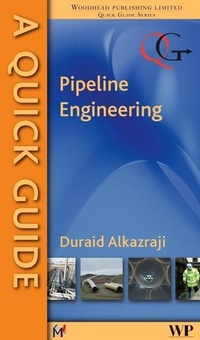
A Quick Guide to Pipeline Engineering
Published on 26. March 2008
Book
Paperback/Softback
176 pages
978-1-84569-490-6 (ISBN)
Description
Pipeline engineering requires an understanding of a wide range of topics. Operators must take into account numerous pipeline codes and standards, calculation approaches, and reference materials in order to make accurate and informed decisions.
A Quick Guide to Pipeline Engineering provides concise, easy-to-use, and accessible information on onshore and offshore pipeline engineering. Topics covered include: design; construction; testing; operation and maintenance; and decommissioning.
Basic principles are discussed and clear guidance on regulations is provided, in a way that will prove useful to both engineers and students.
A Quick Guide to Pipeline Engineering provides concise, easy-to-use, and accessible information on onshore and offshore pipeline engineering. Topics covered include: design; construction; testing; operation and maintenance; and decommissioning.
Basic principles are discussed and clear guidance on regulations is provided, in a way that will prove useful to both engineers and students.
More details
Language
English
Place of publication
Cambridge
United Kingdom
Publishing group
Elsevier Science & Technology
Target group
Professional and scholarly
Product notice
Paperback (trade)
Unsewn / adhesive bound
Dimensions
Height: 170 mm
Width: 101 mm
Thickness: 12 mm
Weight
187 gr
ISBN-13
978-1-84569-490-6 (9781845694906)
Copyright in bibliographic data and cover images is held by Nielsen Book Services Limited or by the publishers or by their respective licensors: all rights reserved.
Schweitzer Classification
Content
The Quick Guide Series
Invitation to New Authors
Preface
Summary
Chapter1: Principles of Pipeline Design
1.1 Effect on the environment
1.2 Routing
1.3 Approval and legal considerations
Chapter 2: Design Approach
2.1 Factors that influence the length of a pipeline
2.2 Choosing a wall thickness for the pipeline
2.3 Choosing an appropriate material grade for the pipeline
2.4 Toughness
2.2 Operational pressure
2.6 Temperature effects
2.7 Surge
2.8 Pipeline coating
2.9 Pipeline protection
Chapter 3: Pipeline Construction and Risk Assessment Techniques
3.1 Pipeline manufacturing methods
3.2 Land preparation, excavation and pipe stringing
3.3 Corrosion protection
3.4 Pipeline codes and standards
3.5 Risk assessment techniques
3.6 Quantitative risk assessment
3.7 Qualitative risk assessment
Chapter 4: Pressure Testing and Commissioning
4.1 Pressure testing
4.2 Commissioning
Chapter 5: Pipeline Operation
5.1 Magnetic inspection
5.2 Ultrasonic inspection
5.3 Geometric tools
5.4 In-service defects and corrosion mechanisms
Chapter 6: Pipeline Maintenance
6.1 Assessment of internal and external corrosion features
6.2 Assessing dents/profile distortions
6.3 Significance of manufacturing and construction defects
Chapter 7: Pipeline Condition Monitoring and Repair Methods
7.1 Pearson survey
7.2 CIPPS survey
7.3 DCVG survey
7.4 Repair techniques
Chapter 8: Pipeline Decommissioning and Industry Developments
8.1 Pipeline decommissioning
8.2 Pipeline industry developments
References
Index
Invitation to New Authors
Preface
Summary
Chapter1: Principles of Pipeline Design
1.1 Effect on the environment
1.2 Routing
1.3 Approval and legal considerations
Chapter 2: Design Approach
2.1 Factors that influence the length of a pipeline
2.2 Choosing a wall thickness for the pipeline
2.3 Choosing an appropriate material grade for the pipeline
2.4 Toughness
2.2 Operational pressure
2.6 Temperature effects
2.7 Surge
2.8 Pipeline coating
2.9 Pipeline protection
Chapter 3: Pipeline Construction and Risk Assessment Techniques
3.1 Pipeline manufacturing methods
3.2 Land preparation, excavation and pipe stringing
3.3 Corrosion protection
3.4 Pipeline codes and standards
3.5 Risk assessment techniques
3.6 Quantitative risk assessment
3.7 Qualitative risk assessment
Chapter 4: Pressure Testing and Commissioning
4.1 Pressure testing
4.2 Commissioning
Chapter 5: Pipeline Operation
5.1 Magnetic inspection
5.2 Ultrasonic inspection
5.3 Geometric tools
5.4 In-service defects and corrosion mechanisms
Chapter 6: Pipeline Maintenance
6.1 Assessment of internal and external corrosion features
6.2 Assessing dents/profile distortions
6.3 Significance of manufacturing and construction defects
Chapter 7: Pipeline Condition Monitoring and Repair Methods
7.1 Pearson survey
7.2 CIPPS survey
7.3 DCVG survey
7.4 Repair techniques
Chapter 8: Pipeline Decommissioning and Industry Developments
8.1 Pipeline decommissioning
8.2 Pipeline industry developments
References
Index