

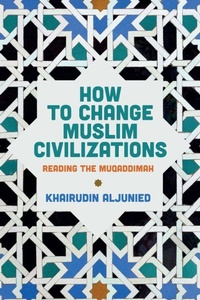
How to Change Muslim Civilizations
Reading the Muqaddimah
1st Edition
Will be published approx. on 6. November 2026
Book
Paperback/Softback
182 pages
978-1-5095-6161-2 (ISBN)
Description
For over a millennium, Muslim civilizations have had a profound impact on world history. Yet the global community of faith is now stifled by political instability, economic underdevelopment, everyday corruption, and rampant poverty. Can the troubling state of Muslim civilizations be changed? Who can bring about constructive reforms within the two billion-strong ummah? What necessary steps are needed to uplift Muslims from their predicaments?
In this book, Khairudin Aljunied explores the ideas of the renowned Muslim polymath, Ibn Khaldun, to shed new light on the challenges faced by Muslims today. Packed with compelling case studies and examples from around the world, this is a sobering critique of the forces causing decline in Muslim communities. Aljunied offers a fresh reading of the universal concepts found in the Muqaddimah, demonstrating how an age-old classic can provide penetrating insights into resolving civilizational problems. A work of intellectual history, autoethnography, and scholarly commentary on Islam in an era of global uncertainty, this is an essential text for scholars, policymakers, and activists seeking to understand and transform the trajectories of Muslim civilizations.
In this book, Khairudin Aljunied explores the ideas of the renowned Muslim polymath, Ibn Khaldun, to shed new light on the challenges faced by Muslims today. Packed with compelling case studies and examples from around the world, this is a sobering critique of the forces causing decline in Muslim communities. Aljunied offers a fresh reading of the universal concepts found in the Muqaddimah, demonstrating how an age-old classic can provide penetrating insights into resolving civilizational problems. A work of intellectual history, autoethnography, and scholarly commentary on Islam in an era of global uncertainty, this is an essential text for scholars, policymakers, and activists seeking to understand and transform the trajectories of Muslim civilizations.
Reviews / Votes
"Writing with the urgency of a scholar-activist and the sensitivities of a poet, Aljunied employs the universal concepts of Ibn Khaldun to shed light on current civilizational issues. Authentic, authoritative, and anguished, this book is a must-read for anyone seeking to understand Islam today."Akbar Ahmed, Distinguished Professor and Ibn Khaldun Chair of Islamic Studies, American University, and former Pakistan Ambassador to the UK and Ireland
"While many scholars and general readers are familiar with Ibn Khaldun, few have read his classic study on civilizational challenge and change as a history of the future, including our present dilemmas post-Gaza 2023. Aljunied places Southeast Asia within the broader landscape of Muslim civilizations and charts key concepts from Ibn Khaldun's classic that illuminate the need for asabiya (collective solidarity) to promote maslaha (the common good). This book seamlessly blends insights from the past with a hopeful vision for the future. Here is a manifesto for change, utilizing Ibn Khaldun's Muqaddima as a tool for rethinking contemporary issues - an essential read for all global citizens."
Bruce W. Lawrence, Nancy and Jeffrey Marcus Humanities Distinguished Professor Emeritus of Religion and Religious Studies, Duke University
More details
Language
English
Place of publication
Oxford
United Kingdom
Target group
Professional and scholarly
ISBN-13
978-1-5095-6161-2 (9781509561612)
Copyright in bibliographic data and cover images is held by Nielsen Book Services Limited or by the publishers or by their respective licensors: all rights reserved.
Schweitzer Classification
Other editions
Additional editions
Book
approx. 11/2026
1st Edition
Polity Press
€68.50
Not yet published