

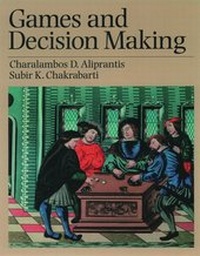
Games and Decision Making
Published on 1. July 1999
Book
Hardback
272 pages
978-0-19-512609-9 (ISBN)
Description
This is a self-contained introduction to basic issues and techniques of decision theory. From classical optimization to modern game theory, the authors show the increasing importance of mathematical knowledge for sustained competitive advantage in decision making. Students need only a basic understanding of elementary calculus and probability to use the book effectively. Through an imaginative selection of topics, the authors treat decision and game theory as part of one body of knowledge. They move from problems involving the individual decision maker to progressively more complex problems such as sequential rationality, auctions, and bargaining. By building each chapter on material presented earlier, the authors ensure that the text is clear and accessible to all.
More details
Language
English
Place of publication
New York
United States
Target group
College/higher education
Illustrations
num. fig.
numerous line figures
Dimensions
Height: 234 mm
Width: 190 mm
Weight
673 gr
ISBN-13
978-0-19-512609-9 (9780195126099)
Copyright in bibliographic data and cover images is held by Nielsen Book Services Limited or by the publishers or by their respective licensors: all rights reserved.
Schweitzer Classification
Other editions
New editions
Charalambos D. Aliprantis | Subir K. Chakrabarti
Games and Decision Making
Book
03/2012
2nd Edition
Oxford University Press Inc
€233.50
Shipment within 15-20 days
Content
1. Choices; 1.1 Functions; 1.2 The optimization problem; 1.3 First order conditions; 1.4 Optimizing uisng the Lagrange method; 1.5 Uncertainty and chance; 1.6 Decision making under uncertainty; 2. Decision and Games; 2.1 Two-person matrix games; 2.2 Strategic form games; 2.3 Applications; 2.4 Solving matrix games with mixed strategies; 3. Sequential Decisions; 3.1 Graphs and trees; 3.2 Single-person decisions; 3.3 Uncertainty and single-person decisions; 4. Sequential Games; 4.1 The structure of sequential games; 4.2 Sequential games with perfect information; 4.3 Sequential games with imperfect information; 5. Sequential Rationality; 5.1 The market for lemons; 5.2 Beliefs and strategies; 5.3 Consistency of beliefs; 5.4 Expected payoff; 5.5 Sequential equilibrium; 5.6 Applications: signaling games; 6. Auctions; 6.1 Auctions with complete information; 6.2 Individual private value auctions; 6.3 English auctions; 6.4 Common-value auctions; 7. Bargaining; 7.1 The Nash solution; 7.2 Monotonicity in bargaining; 7.3 The core of a bargaining game; 7.4 Allocation Rules: The Shapley Value; 7.5 Two-Person Sequential Bargaining; BIBLIOGRAPHY; INDEX