

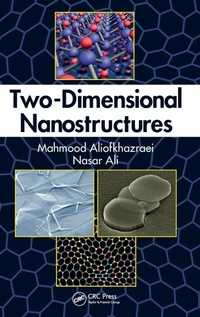
Two-Dimensional Nanostructures
1st Edition
Published on 2. May 2012
Book
Hardback
322 pages
978-1-4398-6665-8 (ISBN)
Description
After the 2010 Nobel Prize in Physics was awarded to Andre Geim and Konstantin Novoselov "for groundbreaking experiments regarding the two-dimensional material graphene," even more research and development efforts have been focused on two-dimensional nanostructures. Illustrating the importance of this area in future applications, Two-Dimensional Nanostructures covers the fabrication methods and properties of these materials.
The authors begin with discussions on the properties, size effect, applications, classification groups, and growth of nanostructures. They then describe various characterization and fabrication methods, such as spectrometry, low-energy electron diffraction, physical and chemical vapor deposition, and molecular beam epitaxy. The remainder of the text focuses on mechanical, chemical, and physical properties and fabrication methods, including a new mechanical method for fabricating graphene layers and a model for relating the features and structures of nanostructured thin films.
With companies already demonstrating the capabilities of graphene in a flexible touch-screen and a 150 GHz transistor, nanostructures are on their way to replacing silicon as the materials of choice in electronics and other areas. This book aids you in understanding the current chemical, mechanical, and physical processes for producing these "miracle materials."
The authors begin with discussions on the properties, size effect, applications, classification groups, and growth of nanostructures. They then describe various characterization and fabrication methods, such as spectrometry, low-energy electron diffraction, physical and chemical vapor deposition, and molecular beam epitaxy. The remainder of the text focuses on mechanical, chemical, and physical properties and fabrication methods, including a new mechanical method for fabricating graphene layers and a model for relating the features and structures of nanostructured thin films.
With companies already demonstrating the capabilities of graphene in a flexible touch-screen and a 150 GHz transistor, nanostructures are on their way to replacing silicon as the materials of choice in electronics and other areas. This book aids you in understanding the current chemical, mechanical, and physical processes for producing these "miracle materials."
Reviews / Votes
This is a book that combines presentation of state-of-the-art scientific techniques employing a highly pedagogical approach that makes it suitable for use in advanced classes in Chemistry and Materials Science. The first chapter includes a brief, but essential, introduction to all aspects of nanomaterials, with emphasis on size-dependent properties, which also makes it suitable as an introductory text for nanoscience. The following chapters focus on the hot topic of two-dimensional nanomaterials; most aspects of synthesis, characterization, physical and chemical properties are discussed. This is an excellent source of information for the hottest research topic of our decade.-Ioannis Remediakis, University of Crete, Greece
I like the approach followed by the book. First of all, key concepts in nanoscience are introduced from the very beginning, and then the main features that characterize the 2D nanomaterials are presented and thoroughly developed. ... The way that the book contents are organized makes it really appealing to anyone working in the field of nanoscience and nanotechnology.
-Eva Pellicer, Universitat Autonoma de Barcelona, Spain
Given the increase in research and technological applications of nanolayered 2-D materials recently, this book is being published at the right time. Although the focus is on graphene, the coverage is broader and covers other 2-D nanosystems as well. ... The presentation of concepts of synthesis and properties of nanostructures is at a simple level, easy to understand and appropriate for graduate students.
-Amit Misra, Los Alamos National Laboratory, New Mexico, USA
... a highly arranged and well-organized approach to study the low-dimensional structures ... This book can be recommended to both students and researchers working in the field of nanotechnologies. The relatively large number of figures and suitable physical explanation of low-dimensional effects make understanding the subject easier.
-Alex Axelevitch, Holon Institute of Technology, Israel
More details
Language
English
Place of publication
Bosa Roca
United States
Publishing group
Taylor & Francis Inc
Target group
College/higher education
Researchers in materials science, nanoscience/nanotech, chemistry, and physics.
Illustrations
134 s/w Abbildungen, 24 s/w Tabellen
24 Tables, black and white; 134 Illustrations, black and white
Dimensions
Height: 240 mm
Width: 161 mm
Thickness: 22 mm
Weight
649 gr
ISBN-13
978-1-4398-6665-8 (9781439866658)
Copyright in bibliographic data and cover images is held by Nielsen Book Services Limited or by the publishers or by their respective licensors: all rights reserved.
Schweitzer Classification
Other editions
Additional editions
Mahmood Aliofkhazraei | Nasar Ali
Two-Dimensional Nanostructures
Book
03/2017
1st Edition
CRC Press
€158.00
Shipment within 10-20 days
Mahmood Aliofkhazraei | Nasar Ali
Two-Dimensional Nanostructures
E-Book
05/2012
1st Edition
CRC Press
€152.99
Available for download
Mahmood Aliofkhazraei | Nasar Ali
Two-Dimensional Nanostructures
E-Book
05/2012
CRC Press
€152.99
Available for download
Persons
Mahmood Aliofkhazraei is a researcher in the corrosion and surface engineering group at the Tarbiat Modares University. Dr. Aliofkhazraei has received several honors, including the Khwarizmi award and the best young nanotechnologist award of Iran. He is a member of the National Association of Surface Sciences, Iranian Corrosion Association, and National Elite Foundation of Iran. His research focuses on nanotechnology and its use in surface and corrosion science.
Nasar Ali is the chairman of NANOSMAT and a director of CNC Coatings. Dr. Ali's research interests include chemical vapor deposition processes, polymer-based nanocomposites, nanotechnology, and vacuum coating.
Nasar Ali is the chairman of NANOSMAT and a director of CNC Coatings. Dr. Ali's research interests include chemical vapor deposition processes, polymer-based nanocomposites, nanotechnology, and vacuum coating.
Content
Synthesis, Processing and Application of Nanostructures. Classification of Two-Dimensional Nanostructures. Characterization and Fabrication Methods of Two-Dimensional Nanostructures. Mechanical Fabrication/Properties of Two-Dimensional Nanostructures. Chemical/Electrochemical Fabrication/Properties of Two-Dimensional Nanostructures. Physical and Other Fabrication/Properties of Two-Dimensional Nanostructures. Index.