

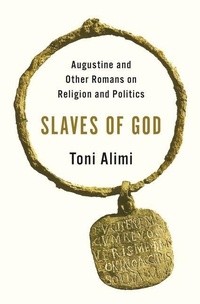
Slaves of God
Augustine and Other Romans on Religion and Politics
Will be published approx. on 8. December 2026
Book
Paperback/Softback
328 pages
978-0-691-24425-9 (ISBN)
Description
A provocative look at the central role of slavery in Augustine's religious, ethical, and political thought
Augustine believed that slavery is permissible, but to understand why, we must situate him in his late antique Roman intellectual context. Slaves of God provides a major reassessment of this monumental figure in the Western religious and political tradition, tracing the remarkably close connections between Augustine's understanding of slavery and his broader thought. Augustine is most often read through the lens of Greek philosophy and the theology of Christian writers such as Paul and Ambrose, yet his debt to Roman thought is seldom appreciated. Toni Alimi reminds us that the author of Confessions and City of God was also a Roman citizen and argues that some of the thinkers who most significantly shaped his intellectual development were Romans such as Cicero, Seneca, Lactantius, and Varro--Romans who had much to say about slavery and its relationship to civic life. Alimi shows how Augustine, a keen and influential student of these figures, related chattel slavery and slavery to God, and sheds light on Augustinianism's complicity in Christianity's long entanglement with slavery. An illuminating work of scholarship, Slaves of God reveals how slavery was integral to Augustine's views about law, rule, accountability, and citizenship, and breaks new ground on the topic of slavery in late antique and medieval political thought.More details
Other editions
Additional editions
E-Book
08/2024
1st Edition
Princeton University Press
€34.49
Available for download
Person
Toni Alimi is assistant professor in the Department of Religion and University Center for Human Values at Princeton University.