

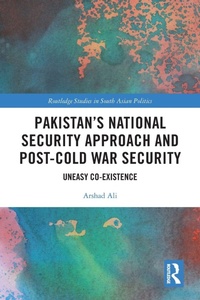
Pakistan's National Security Approach and Post-Cold War Security
Uneasy Co-existence
1st Edition
Published on 26. September 2022
Book
Paperback/Softback
232 pages
978-0-367-71475-8 (ISBN)
Description
This book analyzes the paradox that despite being a national security state, Pakistan has become even more insecure in the post-Cold War era. It provides an in-depth analysis of Pakistan's foreign and security policies and their implications for the overall state and society.
The book identifies the immediate security challenges to Pakistan and charts the distinctive evolution of Pakistan's national security state in which the military elite became the dominant actor in the political sphere of government during and after the Cold War period. By examining the national security state, militarization, democracy and security, proxy wars, and the hyper-military-industrial complex, the author illustrates how the vanguard role of the military created considerable structural, sociopolitical, economic, and security problems in Pakistan. Furthermore, the author argues that the mismatch between Pakistan's national security stance and the transformed security environment has been facilitated and sustained by the embedded interests of the country's military-industrial complex.
A critical evaluation of the role of the military in the political affairs of the government and how it has created structural problems for Pakistan, this book will be of interest to academics in the field of South Asian Politics and Security, South Asian Foreign and Security Policy, International Relations, Asian Security, and Cold War Studies.
The book identifies the immediate security challenges to Pakistan and charts the distinctive evolution of Pakistan's national security state in which the military elite became the dominant actor in the political sphere of government during and after the Cold War period. By examining the national security state, militarization, democracy and security, proxy wars, and the hyper-military-industrial complex, the author illustrates how the vanguard role of the military created considerable structural, sociopolitical, economic, and security problems in Pakistan. Furthermore, the author argues that the mismatch between Pakistan's national security stance and the transformed security environment has been facilitated and sustained by the embedded interests of the country's military-industrial complex.
A critical evaluation of the role of the military in the political affairs of the government and how it has created structural problems for Pakistan, this book will be of interest to academics in the field of South Asian Politics and Security, South Asian Foreign and Security Policy, International Relations, Asian Security, and Cold War Studies.
More details
Series
Language
English
Place of publication
London
United Kingdom
Publishing group
Taylor & Francis Ltd
Target group
College/higher education
Postgraduate
Illustrations
7 s/w Tabellen
7 Tables, black and white
Dimensions
Height: 234 mm
Width: 156 mm
Thickness: 13 mm
Weight
380 gr
ISBN-13
978-0-367-71475-8 (9780367714758)
Copyright in bibliographic data and cover images is held by Nielsen Book Services Limited or by the publishers or by their respective licensors: all rights reserved.
Schweitzer Classification
Other editions
Additional editions
Book
03/2021
1st Edition
Routledge
€193.50
Shipment within 15-20 days
E-Book
03/2021
1st Edition
Routledge
€58.99
Available for download
E-Book
03/2021
1st Edition
Routledge
€58.99
Available for download
Person
Arshad Ali is an Assistant Professor in the Department of Political Science and International Relations at the University of Management and Technology, Pakistan.
Content
Introduction 1. A Conceptual Overview of the National Security State 2. The Evolution of Pakistan's National Security State during the Cold War Era 3. Pakistan's Military-Centred National Security Approach and the Post-Cold War Era 4. The Long Shadow of Pakistan's Military-Centred National Security Approach: The Case of the Kashmir Dispute 1989-2001 5. Pakistan's Strategic Considerations and Regional Stability in South Asia: A Case of Pakistan's Participation in the Global War on Terror 6. Explaining Pakistan's Strategic Limitations: Structural Issues Facing Islamabad's National Security State Conclusion