

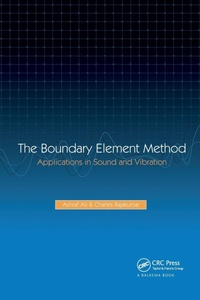
The Boundary Element Method
Applications in Sound and Vibration
1st Edition
Published on 30. June 2020
Book
Paperback/Softback
200 pages
978-0-367-44655-0 (ISBN)
Description
The Boundary Element Method, or BEM, is a powerful numerical analysis tool with particular advantages over other analytical methods. With research in this area increasing rapidly and more uses for the method appearing, this timely book provides a full chronological review of all techniques that have been proposed so far, covering not only the fundamentals of the BEM but also a wealth of information on related computational analysis techniques and formulations, and their applications in engineering, physics and mathematics. An indispensable handbook and source of inspiration for researchers and professionals in these fields, this book is also an ideal textbook for graduate engineering students.
More details
Language
English
Place of publication
London
United Kingdom
Publishing group
Taylor & Francis Ltd
Target group
College/higher education
Dimensions
Height: 234 mm
Width: 156 mm
Thickness: 11 mm
Weight
316 gr
ISBN-13
978-0-367-44655-0 (9780367446550)
Copyright in bibliographic data and cover images is held by Nielsen Book Services Limited or by the publishers or by their respective licensors: all rights reserved.
Schweitzer Classification
Other editions
Additional editions
Book
08/2004
1st Edition
A A Balkema Publishers
€193.13
Shipment within 15-20 days
E-Book
08/2004
CRC Press
€88.49
Available for download
E-Book
08/2004
CRC Press
€88.49
Available for download
Persons
Ali\, A.; Rajakumar\, C.
Content
1. Introduction 2. Boundary Element Method Fundamentals 3. Isoparametric Boundary Elements 4. Anisotropy, Axisymmetry and Zoning 5. Time-Harmonic Analysis in Acoustics and Elasticity 6. Dynamic Analysis: Acoustics and Elasticity 7. Basics of Eigenvalue Problem Formulation 8. Algebraic Eigenvalue Problem in Boundary Elements 9. Advanced Concepts in Boundary Element Algebraic Eigenproblem 10. Acoustic Fluid-Structure Interaction Problems 11. Solution Methods of Eigenvalue Problems 12. Discussion and Future Research