

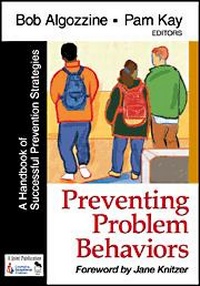
Preventing Problem Behaviors
A Handbook of Successful Prevention Strategies
1st Edition
Published on 11. September 2001
Book
Paperback/Softback
264 pages
978-0-7619-7776-6 (ISBN)
Description
`This book offers am array of suggested good practice with consistent thinking behind it and teachers and other education professional will find much that both interest and challenges in it. The book has much to teachers not only in the setting of challenging behaviours but also in the wider context of effective classroom practice aimed at preventing problems that become challenging' - Chris Lee, British Journal of Special Education
Today, most teachers will tell you that they spend an inordinate amount of time, energy, and effort managing problem behaviours - and that time spent managing behaviour seriously limits the amount of time they can spend teaching. Removing students who misbehave from the classroom only displaces the problem, and does nothing to address the school system's responsibility to educate them.
This book follows an OSEP-funded (Office of Special Education Programs) project titled Prevention Strategies That Work, which covered four years of implementing school-based prevention practices. The effective prevention (NOT intervention) programmes are based on the premise that early response to learning, behaviour, and emotional problems can lead to better outcomes for students. The three fundamental areas addressed are: improving individual behaviours, improving classroom and school-wide conditions, and improving family and community partnerships.
This is a strategy book, presenting practices to counter behavioural problems before they get out of hand. They have been tested, adapted, and proven effective in a variety of settings. Each chapter cites the research that supports the recommended practices.
Today, most teachers will tell you that they spend an inordinate amount of time, energy, and effort managing problem behaviours - and that time spent managing behaviour seriously limits the amount of time they can spend teaching. Removing students who misbehave from the classroom only displaces the problem, and does nothing to address the school system's responsibility to educate them.
This book follows an OSEP-funded (Office of Special Education Programs) project titled Prevention Strategies That Work, which covered four years of implementing school-based prevention practices. The effective prevention (NOT intervention) programmes are based on the premise that early response to learning, behaviour, and emotional problems can lead to better outcomes for students. The three fundamental areas addressed are: improving individual behaviours, improving classroom and school-wide conditions, and improving family and community partnerships.
This is a strategy book, presenting practices to counter behavioural problems before they get out of hand. They have been tested, adapted, and proven effective in a variety of settings. Each chapter cites the research that supports the recommended practices.
Reviews / Votes
"By combining the 'best of practices' designed to prevent school behavior problems, the authors provide more comprehensive and a wider range of source material than is typically available." -- Mary Damer, Author "I'm using Preventing Problem Behaviors for a graduate seminar on youth with behavioral disorders this semester. The book has been very well received by my students. Prior to preparing for the course I had only skimmed through the chapters. [the] book contains a wealth of useful information and a bias toward looking at children's and families' strengths." -- Peter Leone, Gemstone Fellow and Professor "This book offers an array of suggested good practices with consistent thinking behind it and teachers and other education professional will find much that both interests and challenges in it. The book has much to offer teachers not only in the setting of challenging behaviors but also in the wider context of effective classroom practice aimed at preventing problems that become challenging" -- Chris Lee, British Journal of Special EducationMore details
Language
English
Place of publication
Thousand Oaks
United States
Publishing group
SAGE Publications Inc
Target group
Professional and scholarly
Dimensions
Height: 254 mm
Width: 178 mm
Weight
557 gr
ISBN-13
978-0-7619-7776-6 (9780761977766)
Copyright in bibliographic data and cover images is held by Nielsen Book Services Limited or by the publishers or by their respective licensors: all rights reserved.
Schweitzer Classification
Other editions
New editions
Bob Algozzine | Ann P. Daunic | Stephen W. Smith
Preventing Problem Behaviors
Schoolwide Programs and Classroom Practices
Book
05/2010
2nd Edition
Corwin Press Inc
€62.08
Shipment within 10-20 days
Persons
Bob Algozzine is a professor in the Department of Educational Leadership at the University of North Carolina and project codirector of the U.S. Department of Education-supported Behavior and Reading Improvement Center. With 25 years of research experience and extensive firsthand knowledge of teaching students classified as seriously emotionally disturbed, Algozzine is a uniquely qualified staff developer, conference speaker, and teacher of behavior management and effective teaching courses. He is active in special education practice as a partner and collaborator with professionals in the Charlotte-Mecklenburg schools in North Carolina and as an editor of several journals focused on special education. Algozzine has written more than 250 manuscripts on special education topics, including many books and textbooks on how to manage emotional and social behavior problems.
Content
Foreword - Jane Knitzer
Acknowledgments
About the Authors
1. Promising Practices for Preventing Problem Behaviors - Bob Algozzine and Pam Kay
2. Preventing Problems by Improving Behavior - Debra M. Kamps
3. Preventing Learning Problems Using Total Quality Principles - Bob Audette, Bob Algozzine, Mary Beth Marr, Edward D. Ellis, Jr., and Richard White
4. Preventing Problems Through Social Skills Instruction - Debra M. Kamps and Pam Kay
5. Preventing Problem Behaviors Using Schoolwide Discipline - Bob Algozzine and Richard White
6. Building Effective Parent-Teacher Partnerships - Pam Kay, Martha Fitzgerald, and Stephanie McConaughy
7. Building Linkages to Learning Through Community Partnerships - Peter E. Leone, Robert J. Evert, and Karen A. Friedman
8. Using Conflict Resolution and Peer Mediation to Support Positive Behavior - Stephen W. Smith and Ann P. Daunic
9. Making Connections That Keep Students Coming to School - Mary F. Sinclair, Christine M. Hurley, David L. Evelo, Sandra L. Christenson, and Martha L. Thurlow
10. Measuring the Success of Prevention Programs - Stephanie H. McConaughy and Peter E. Leone
11. Building Effective Prevention Practices - Bob Algozzine
Index
Acknowledgments
About the Authors
1. Promising Practices for Preventing Problem Behaviors - Bob Algozzine and Pam Kay
2. Preventing Problems by Improving Behavior - Debra M. Kamps
3. Preventing Learning Problems Using Total Quality Principles - Bob Audette, Bob Algozzine, Mary Beth Marr, Edward D. Ellis, Jr., and Richard White
4. Preventing Problems Through Social Skills Instruction - Debra M. Kamps and Pam Kay
5. Preventing Problem Behaviors Using Schoolwide Discipline - Bob Algozzine and Richard White
6. Building Effective Parent-Teacher Partnerships - Pam Kay, Martha Fitzgerald, and Stephanie McConaughy
7. Building Linkages to Learning Through Community Partnerships - Peter E. Leone, Robert J. Evert, and Karen A. Friedman
8. Using Conflict Resolution and Peer Mediation to Support Positive Behavior - Stephen W. Smith and Ann P. Daunic
9. Making Connections That Keep Students Coming to School - Mary F. Sinclair, Christine M. Hurley, David L. Evelo, Sandra L. Christenson, and Martha L. Thurlow
10. Measuring the Success of Prevention Programs - Stephanie H. McConaughy and Peter E. Leone
11. Building Effective Prevention Practices - Bob Algozzine
Index