

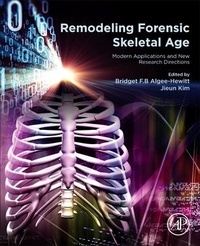
Remodeling Forensic Skeletal Age
Modern Applications and New Research Directions
Published on 28. April 2021
Book
Hardback
260 pages
978-0-12-824370-1 (ISBN)
Description
Remodeling Forensic Skeletal Age: Modern Applications and New Research Directions presents a comprehensive understanding of the analytical frameworks and conceptual approaches surrounding forensic age estimation and the current state of the field. The book also includes a series of recommendations of best practice through chapter-examples that offer theory and guidance for data acquisition, technique and/or model development, and the assessment of impact of the adopted approaches. Written by leading, international experts, the book's contributors provide an introduction, conceptual understanding and taxonomy of statistical frameworks and computational approaches, including the Bayesian paradigm and machine learning techniques for age estimation.
More details
Language
English
Place of publication
San Diego
United States
Publishing group
Elsevier Science Publishing Co Inc
Target group
Professional and scholarly
Product notice
sewn/stitched
Cloth over boards
Illustrations
Approx. 150 illustrations (75 in full color)
Dimensions
Height: 235 mm
Width: 191 mm
Weight
540 gr
ISBN-13
978-0-12-824370-1 (9780128243701)
Copyright in bibliographic data and cover images is held by Nielsen Book Services Limited or by the publishers or by their respective licensors: all rights reserved.
Schweitzer Classification
Other editions
Additional editions
Bridget F. B. Algee-Hewitt | Jieun Kim
Remodeling Forensic Skeletal Age
Modern Applications and New Research Directions
E-Book
04/2021
Academic Press
€131.00
Available for download
Persons
Bridget F.B. Algee-Hewitt is a biological anthropologist who studies skeletal and genetic trait variation in modern humans. Her research combines data analytic and hands-on laboratory approaches to the estimation of the personal identity parameters - like sex, ancestry, stature, and age - that are essential components of the biological profile used in forensic identification of unknown human remains and for the paleodemographic reconstruction of past population histories in bioarchaeology. Concerns for social justice, human rights, and issues of group disparities underlie much of her work. As a practicing forensic anthropologist and geneticist, she provides forensic casework consultation to the medico-legal community. Jieun is a biological anthropologist whose specialty lies in human skeletal biology and its application to forensic anthropology and bioarchaeology. Her doctoral dissertation investigated the extent of population variation (if it ever exits) in skeletal aging process using Southeast and East Asian populations and sought to develop a more inclusive age-at-death estimation method that is broadly applicable to Asians. To complete her fieldwork abroad, she was awarded the Wenner-Gren Foundation Doctoral Dissertation Fieldwork Grant, the W. M. Bass Endowment and W. Leitner Award offered by the Forensic Anthropology Center, UTK, and the W. K. McClure Scholarship for the Study of World Affairs, UTK. She has been working with skeletal remains in Korea, Japan, Thailand and the U.S., and as a part of the National Institute of Justice postdoctoral research, is currently building 3D laser scan data on those populations to extend the applicability of the fully computation age estimation methods to more diverse populations.
Content
A - Longstanding problems of "the population?
1. Using data from the US Korean War Dead and the Terry Collection to demonstrate problems of the common "overlap methods?
Lyle W. Konigsberg
2. Testing for differences in senescence using score data to understand the effects of reference sample choices
Susan R. Frankenberg
B - Aging across the ages
3. Subadult age estimation variables: Exploring their varying roles across ontogeny
K.E. Stull, L.K. Corron, and M.H. Price
4. Aging the elderly: Does the skull tell us something about age at death?
Flavia Teixeira and Eugenia Cunha
5. Population variation in diaphyseal growth and age estimation of juvenile skeletal remains
H.F.V. Cardoso, L. Spake, L. Ri?os, and J. Albanese
6. Great expectations: The rise, fall, and resurrection of adult skeletal age estimation
George R. Milner, Jesper L. Boldsen, Stephen D. Ousley, Sara M. Getz, Svenja Weise, and Peter Tarp
C - Computational methods come of age
7. A volumetric approach to age estimation informed by voxel selection: Application to the spheno-occipital synchondrosis
Nicolene Lottering, Mark D. Barry, Laura S. Gregory, Donna M. MacGregor, and Clair L. Alston-Knox
8. The consecutive inference of ancestry and age from shape measures of the pubic symphysis
Bridget FB Algee-Hewitt and Jieun Kim
D - Classic indicators rejuvenated
9. The fallacy of forensic age estimation from morphometric quantifications of the pubic symphysis
Fred L. Bookstein and Guillermo Bravo Morante
10. An application of the Bayesian San-Milla?n-Rissech acetabular aging method to an African American sample: Preliminary results
Marta San-Millan
1. Using data from the US Korean War Dead and the Terry Collection to demonstrate problems of the common "overlap methods?
Lyle W. Konigsberg
2. Testing for differences in senescence using score data to understand the effects of reference sample choices
Susan R. Frankenberg
B - Aging across the ages
3. Subadult age estimation variables: Exploring their varying roles across ontogeny
K.E. Stull, L.K. Corron, and M.H. Price
4. Aging the elderly: Does the skull tell us something about age at death?
Flavia Teixeira and Eugenia Cunha
5. Population variation in diaphyseal growth and age estimation of juvenile skeletal remains
H.F.V. Cardoso, L. Spake, L. Ri?os, and J. Albanese
6. Great expectations: The rise, fall, and resurrection of adult skeletal age estimation
George R. Milner, Jesper L. Boldsen, Stephen D. Ousley, Sara M. Getz, Svenja Weise, and Peter Tarp
C - Computational methods come of age
7. A volumetric approach to age estimation informed by voxel selection: Application to the spheno-occipital synchondrosis
Nicolene Lottering, Mark D. Barry, Laura S. Gregory, Donna M. MacGregor, and Clair L. Alston-Knox
8. The consecutive inference of ancestry and age from shape measures of the pubic symphysis
Bridget FB Algee-Hewitt and Jieun Kim
D - Classic indicators rejuvenated
9. The fallacy of forensic age estimation from morphometric quantifications of the pubic symphysis
Fred L. Bookstein and Guillermo Bravo Morante
10. An application of the Bayesian San-Milla?n-Rissech acetabular aging method to an African American sample: Preliminary results
Marta San-Millan