

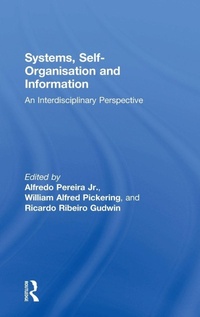
Systems, Self-Organisation and Information
An Interdisciplinary Perspective
1st Edition
Published on 10. October 2018
Book
Hardback
238 pages
978-1-138-60992-1 (ISBN)
Description
Complex system studies are a growing area of central importance to a wide range of disciplines, ranging from physics to politics and beyond. Adopting this interdisciplinary approach, Systems, Self-Organisation and Information presents and discusses a range of ground-breaking research in complex systems theory.
Building upon foundational concepts, the volume introduces a theory of Self-Organization, providing definitions of concepts including system, structure, organization, functionality, and boundary. Biophysical and cognitive approaches to Self-Organization are also covered, discussing the complex dynamics of living beings and the brain, and self-organized adaptation and learning in computational systems. The convergence of Peircean philosophy with the study of Self-Organization also provides an original pathway of research, which contributes to a dialogue between pragmatism, semeiotics, complexity theory, and self-organizing systems.
As one of the few interdisciplinary works on systems theory, relating Self-Organization and Information Theory, Systems, Self-Organisation and Information is an invaluable resource for researchers and postgraduate students interested in complex systems theory from related disciplines including philosophy, physics, and engineering.
Building upon foundational concepts, the volume introduces a theory of Self-Organization, providing definitions of concepts including system, structure, organization, functionality, and boundary. Biophysical and cognitive approaches to Self-Organization are also covered, discussing the complex dynamics of living beings and the brain, and self-organized adaptation and learning in computational systems. The convergence of Peircean philosophy with the study of Self-Organization also provides an original pathway of research, which contributes to a dialogue between pragmatism, semeiotics, complexity theory, and self-organizing systems.
As one of the few interdisciplinary works on systems theory, relating Self-Organization and Information Theory, Systems, Self-Organisation and Information is an invaluable resource for researchers and postgraduate students interested in complex systems theory from related disciplines including philosophy, physics, and engineering.
More details
Language
English
Place of publication
London
United Kingdom
Publishing group
Taylor & Francis Ltd
Target group
College/higher education
Illustrations
5 s/w Tabellen
5 Tables, black and white
Dimensions
Height: 240 mm
Width: 161 mm
Thickness: 18 mm
Weight
543 gr
ISBN-13
978-1-138-60992-1 (9781138609921)
Copyright in bibliographic data and cover images is held by Nielsen Book Services Limited or by the publishers or by their respective licensors: all rights reserved.
Schweitzer Classification
Other editions
Additional editions
Pereira Junior Alfredo | William Pickering | Ricardo Gudwin
Systems, Self-Organisation and Information
An Interdisciplinary Perspective
Book
10/2018
1st Edition
Routledge
€69.20
Shipment within 10-20 days
Pereira Junior Alfredo | William Pickering | Ricardo Gudwin
Systems, Self-Organisation and Information
An Interdisciplinary Perspective
E-Book
10/2018
1st Edition
Routledge
€63.49
Available for download
Pereira Junior Alfredo | William Pickering | Ricardo Gudwin
Systems, Self-Organisation and Information
An Interdisciplinary Perspective
E-Book
10/2018
1st Edition
Routledge
€63.49
Available for download
Persons
Alfredo Pereira Jr. is Professor at Universidade Estadual Paulista Julio de Mesquita Filho, Brazil.
William Alfred Pickering holds a doctorate in Linguistics, and is currently a freelance translator.
Ricardo Ribeiro Gudwin is an Associate Professor at the University of Campinas, Brazil.
William Alfred Pickering holds a doctorate in Linguistics, and is currently a freelance translator.
Ricardo Ribeiro Gudwin is an Associate Professor at the University of Campinas, Brazil.
Content
Table of Contents
Introduction
Alfredo Pereira Jr., William A. Pickering, and Ricardo Gudwin
Part I - Foundational Studies
1. The Idea of Self-Organization
Michel Debrun
2. The Dynamics of Primary Self-Organization
Michel Debrun
3. Basic Concepts of Systemics
Ettore Bresciani Filho and Itala M. Loffredo D'Ottaviano
4. The Role of Information in Self-Organization
Alfredo Pereira Jr. and Maria Eunice Quilic Gonzalez
5. On the Self-Organizing of Reality-Totality as Living Knowledge
Ricardo Pereira Tassinari
Part II - Biophysical and Cognitive Approaches
6. Vital Flow: the Self-Organization Stage
Romeu Cardoso Guimaraes
7. Implication and Information: A Quantitative-Informational Analysis of Material Implication
Marcos Antonio Alves and Itala M. Loffredo D'Ottaviano
8. Self-Organization in Computational Systems
Ricardo Ribeiro Gudwin
Part III - Practical Issues
9. Self-Organization and Action: A Systemic Approach to Common Action
Mariana Claudia Broens
10. Complexity and Informational Privacy: A Study in the Systemic Perspective
Joao Antonio de Moraes and Maria Eunice Quilici Gonzalez
11. An Understanding of Solidarity Economy in the Light of Self-Organization Theory
Renata Cristina Geromel Meneghetti
12. Multilingualism and Social Self-Organization in Brazil
Claudia Wanderley
Part IV - Semiotic Studies
13. Prolegomena to a Semeiotic Theory of Self-Organization
Vinicius Romanini
14. Habit Formation and Self-Organization: A Peircean Approach
Ivo A. Ibri
15. Origin of the Cosmos and Self-Organization in the Work of Charles Sanders Peirce
Lauro Frederico Barbosa da Silveira
16. Diagrammatic Logic as a Method for the Study of Cosmovisions
Enidio Ilario
Introduction
Alfredo Pereira Jr., William A. Pickering, and Ricardo Gudwin
Part I - Foundational Studies
1. The Idea of Self-Organization
Michel Debrun
2. The Dynamics of Primary Self-Organization
Michel Debrun
3. Basic Concepts of Systemics
Ettore Bresciani Filho and Itala M. Loffredo D'Ottaviano
4. The Role of Information in Self-Organization
Alfredo Pereira Jr. and Maria Eunice Quilic Gonzalez
5. On the Self-Organizing of Reality-Totality as Living Knowledge
Ricardo Pereira Tassinari
Part II - Biophysical and Cognitive Approaches
6. Vital Flow: the Self-Organization Stage
Romeu Cardoso Guimaraes
7. Implication and Information: A Quantitative-Informational Analysis of Material Implication
Marcos Antonio Alves and Itala M. Loffredo D'Ottaviano
8. Self-Organization in Computational Systems
Ricardo Ribeiro Gudwin
Part III - Practical Issues
9. Self-Organization and Action: A Systemic Approach to Common Action
Mariana Claudia Broens
10. Complexity and Informational Privacy: A Study in the Systemic Perspective
Joao Antonio de Moraes and Maria Eunice Quilici Gonzalez
11. An Understanding of Solidarity Economy in the Light of Self-Organization Theory
Renata Cristina Geromel Meneghetti
12. Multilingualism and Social Self-Organization in Brazil
Claudia Wanderley
Part IV - Semiotic Studies
13. Prolegomena to a Semeiotic Theory of Self-Organization
Vinicius Romanini
14. Habit Formation and Self-Organization: A Peircean Approach
Ivo A. Ibri
15. Origin of the Cosmos and Self-Organization in the Work of Charles Sanders Peirce
Lauro Frederico Barbosa da Silveira
16. Diagrammatic Logic as a Method for the Study of Cosmovisions
Enidio Ilario