

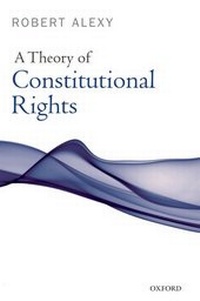
A Theory of Constitutional Rights
Published on 10. December 2009
Book
Paperback/Softback
516 pages
978-0-19-958423-9 (ISBN)
Description
In any country where there is a Bill of Rights, constitutional rights reasoning is an important part of the legal process. As more and more countries adopt Human Rights legislation and accede to international human rights agreements, and as the European Union introduces its own Bill of Rights, judges struggle to implement these rights consistently and sometimes the reasoning behind them is lost. Examining the practice in other jurisdictions can be a valuable guide. Robert Alexy's classic work reconstructs the reasoning behind the jurisprudence of the German Basic Law and in doing so provides a theory of general application to all jurisdictions where judges wrestle with rights adjudication.
In considering the features of constitutional rights reasoning, the author moves from the doctrine of proportionality, procedural rights and the structure and scope of constitutional rights, to general rights of liberty and equality and the problem of horizontal effect. A postscript written for the English edition considers critiques of the Theory since it first appeared in 1985, focusing in particular on the discretion left to legislatures and in an extended introduction the translator argues that the theory may be used to clarify the nature of legal reasoning in the context of rights under the British Constitution.
This book will be of central interest to all legal and constitutional theorists and human rights scholars.
In considering the features of constitutional rights reasoning, the author moves from the doctrine of proportionality, procedural rights and the structure and scope of constitutional rights, to general rights of liberty and equality and the problem of horizontal effect. A postscript written for the English edition considers critiques of the Theory since it first appeared in 1985, focusing in particular on the discretion left to legislatures and in an extended introduction the translator argues that the theory may be used to clarify the nature of legal reasoning in the context of rights under the British Constitution.
This book will be of central interest to all legal and constitutional theorists and human rights scholars.
Reviews / Votes
Review from previous edition 'This is unquestionably a major classic of German constitutional theory' * Neil MacCormick * 'His theory is now becoming the leading theory of constitutional rights' * Nils Jansen * This work provides one of the most penetrating, analytically refined, and influential general accounts of constitutional rights available. American realists will recognize the structure of rights it proposes as functional and pragmatic. Comparative constitutional jurists will recognize it as a reconstruction of what is, perhaps, the dominant understanding of constitutional rights in the world. It would be a mistake for constitutional scholars of any tradition not to engage this book seriously. * Mattias Kumm * Juian Rivers deserves credit not only for a text which does full justice to Alexy's renowned lucidity, but also for an introduction which argues persuasively for the relevance of Alexy's understanding of constitutional rights. * Legal Studies * ... a valuable contribution to our appreciation of the wider context in which both the German Federal Constitutional Court (FCC) and US Supreme Court operate. * European Public Law * ... provide(s) us with a stimulating theoretical account of the method of adjudication employed by the judges of the FCC, as well as some insight into the workings and background assumptions of German constitutional law. * European Public Law * ... reveal(s) numerous and fruitful points of contact between American and German constitutional law on the one hand, and the emerging case-law under the HRA on the other. * European Public Law * ... provides a series of challenging arguments that draw together fine theoretical developments with a clear analysis of the German case law. Undoubtedly, it constitutes a building block of every serious discussion on constitutional rights and everyone who is interested in these issues should compare his views with Alexy's. His subtle analytical distinctions would shed much light over utterly obscure issues such as horizontality, proportionality, scope, and limits of rights. Moreover, a British audience puzzled by the role of a new Bill of Rights would find much relief from a comparative insight on questions of rights. The strength of this book is that it provides a sound framework for initiating a discussion on constitutional rights. * International and Comparative Law Quarterly *More details
Language
English
Place of publication
Oxford
United Kingdom
Target group
College/higher education
Professional and scholarly
Academics and practitioners and scholars in the fields of human rights and constitutional law. Legal and political philosophers. Scholars and practitioners of comparative law.
Dimensions
Height: 23 mm
Width: 154 mm
Thickness: 30 mm
Weight
776 gr
ISBN-13
978-0-19-958423-9 (9780199584239)
Copyright in bibliographic data and cover images is held by Nielsen Book Services Limited or by the publishers or by their respective licensors: all rights reserved.
Schweitzer Classification
Other editions
Additional editions
Book
08/2002
2nd Edition
Oxford University Press
€252.60
Shipment within 15-20 days
Persons
Robert Alexy has been Professor of Public Law and Legal Philosophy at Christian Albrechts University, Kiel, since 1986. He was President of the German Section of the International Association for Philosophy of Law and Social Philosophy (IVR) from 1994-1998. Other books published by OUP include A Theory of Constitutional Rights and the Argument From Injustice.
Content
PREFACE ; A Theory of Constitutional Rights and the British Constitution ; 1. The Content and Purpose of a Theory of Constitutional Rights ; 2. The Concept of a Constitutional Rights Norm ; 3. The Structure of Constitutional Rights Norms ; 4. Constitutional Rights as Subjective Rights ; 5. Constitutional Rights and Legal Status ; 6. The Limits of Constitutional Rights ; 7. The General Right to Liberty ; 8. The General Right to Equality ; 9. Rights to Positive State Action (Entitlements in the Wide Sense) ; 10. Constitutional Rights and Constitutional Rights Norms in the Legal System ; Postscript