

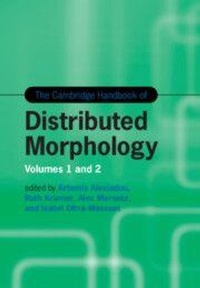
The Cambridge Handbook of Distributed Morphology 2 Volume Set Hardback
Will be published approx. on 31. December 2026
Book
Hardback
1376 pages
978-1-009-20614-3 (ISBN)
Description
With contributions from a team of renowned scholars, this two-volume Handbook is a comprehensive guide to the Distributed Morphology (DM) framework. Filling a crucial gap in the domain of morphology, it covers DM's historical context, its foundational principles, and a wide range of phenomena. The first volume is divided into three parts, covering the basics of DM and comparing it with alternative models, the core components of DM, and the key issues for the syntax-morphology interface. The second volume is also split into three parts, with parts I and II focusing on morphology post-syntax, exploring its phonological and semantic aspects, and part III extending DM's reach well beyond core language components. Each chapter focuses on different theoretical issues, as well as empirical phenomena across a variety of languages. This Handbook is an essential resource for anyone who wants to understand the depth and scope of Distributed Morphology research.
More details
Content
Volume I: Introduction to the handbook Artemis Alexiadou, Ruth Kramer, Alec Marantz and Isabel Oltra-Massuet; Part I. Distributed Morphology: Basics and Competing Theories: 1. Introduction to distributed morphology Ruth Kramer, Alec Marantz, Artemis Alexiadou and Isabel Oltra-Massuet; 2. Nanosyntax: some key features Pavel Caha; 3. The exoskeletal model Terje Lohndal; 4. Distributed morphology and paradigm function morphology Lindley Winchester; Part II. Core Components: 5 Morphotactics: an overview of positional constraints and repairs Karlos Arregi and Andrew Nevins; 6. Morphological variation in distributed morphology Antonio Fábregas; 7. Impoverishment Stefan Keine and Gereon Müller; 8. Morphological productivity Shiloh Drake; 9. Blocking Itamar Kastner; 10. Abstract morphemes and local contexts David Embick; 11. Adjacency and linearization in distributed morphology Richard Compton and Tom Leu; 12. Phases/cyclicity Anton Ingason; Part III. Morphology as Syntax:13. Case and agreement in distributed morphology Florian Schäfer and Elena Anagnostopoulou; 14. Argument structure in distributed morphology Artemis Alexiadou and Isabel Oltra-Massuet; 15. Movement Vera Gribanova and Boris Harizanov; 16. Nominal inflection in distributed morphology: a case study of Ingush Mark Norris; 17. Derivational morphology Martha McGinnis and Jim Wood; 18. Compounding Jeffrey Punske; 19. Verbal inflection in distributed morphology Bronwyn Bjorkman; Volume II: Introduction to the handbook Artemis Alexiadou, Ruth Kramer, Alec Marantz and Isabel Oltra-Massuet; 1. Introduction to distributed morphology: morphology after syntax and beyond Artemis Alexiadou, Ruth Kramer, Alec Marantz and Isabel Oltra-Massuet; Part I. Morphology after Syntax: Morphophonology: 2. Allomorphy and vocabulary insertion Maria Gouskova and Jonathan David Bobaljik; 3. Non-concatenative morphology Itamar Kastner and Matthew Tucker; 4. Multiple exponence Daniel Siddiqi and Isabelle Boyer; 5. Syncretism in distributed morphology Ruth Kramer; 6. Suppletion Beata Moskal; 7. Markedness in distributed morphology Philipp Weisser; 8. Phonological strata Heather Newell; 9. Suprasegmental phenomena Marjorie Pak; Part II. Morphology after Syntax: Morpho-semantics: 10. Contextual allosemy Alec Marantz and Neil Myler; 11. The Syntax-semantics interface in distributed morphology Marijke De Belder; 12. Feature semantics Daniel Harbour; 13. The interpretation of roots Elena Anagnostopoulou and Roumyana Pancheva; 14. Reprint of the no-agents idioms hypothesis Heidi Harley and Megan Stone; Part III. Distributed Morphology from a Wider Perspective: 15. Distributed morphology and minimalism Peter W Smith; 16. Distributed morphology and acquisition Jennifer Austin and Liliana Sánchez; 17. Distributed morphology and bilingualism: code-switching and mixed languages Luis López; 18. Distributed morphology and psycholinguistics Christopher M. Hammerly and Roland Pfau; 19. Distributed morphology and neurolinguistics Linnaea Stockall and Laura Gwilliams; 20. Distributed morphology and computational linguistics Thomas Graf; 21. Distributed morphology and historical linguistics Andrea Calabrese and Laura Grestenberger; 22. Distributed morphology and anthropology Jason D. Haugen.