

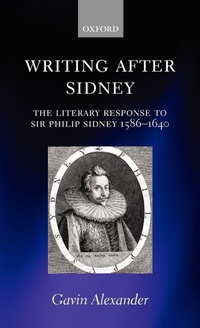
Writing after Sidney
The Literary Response to Sir Philip Sidney 1586-1640
Published on 7. December 2006
Book
Hardback
424 pages
978-0-19-928547-1 (ISBN)
Description
Writing After Sidney examines the literary response to Sir Philip Sidney (1554-86), author of the Arcadia, Astrophil and Stella, and The Defence of Poesy, and the most immediately influential writer of the Elizabethan period. It does so by looking closely both at Sidney and at four writers who had an important stake in his afterlife: his sister Mary Sidney, his brother Robert Sidney, his best friend Fulke Greville, and his niece Mary Wroth. At the same time as these authors wrote their own works in response to Sidney they presented his life and writings to the world, and were shaped by other writers as his literary and political heirs. Readings of these five central authors are embedded in a more general study of the literary and cultural scene in the years after Sidney's death, examining the work of such writers as Spenser, Jonson, Daniel, Drayton, and Herbert. The study uses a wide range of manuscript and printed sources, and key use is made of perspectives from Renaissance literary theory, especially Renaissance rhetoric. The book aims to come to a better understanding of the nature of Sidney's impact on the literature of the fifty or so years after his death in 1586; it also aims to improve our understanding both of Sidney and of the other writers discussed by developing a more nuanced approach to the questions of imitation and example so central to Renaissance literature. It thereby adds to the general store of our understanding of how writing of the English Renaissance offered examples to later readers and writers, and of how it encountered and responded to such examples itself.
Reviews / Votes
This is a compendious yet focused book... the work of an extraordinarily well-rounded scholar-critic, steeped in knowledge of Sidney and his followers * Tom MacFaul, Notes and Queries * This comprehensive and subtle study is a near-definitive account of this process, and adumbrates a fascinating new model of literary influence. * Tom MacFaul, Notes and Queries * ...fine book...a work of assiduous scholarship which is a pleasure to read. * Helen Hackett, TLS * extraordinary erudition, an impressive command of the manuscript tradition, densely packed and rhetorically informed readings...is a book that every scholar of English Renaissance literature should read. * Robert E. Stillman, Seventeeth-Century News * an encyclopaedic study of Sidney's work and Sidney's influence, a sweeping, comprehensive gathering of Sidney's affectedness and his effectiveness, a work that combines judicious interpretation of personal and literary history alongside detailed sensitive readings that are often fresh, always revelatory, and sometimes dazzling...a compelling and indispensible study * Arthur F. Kinney, Review of English Studies, Volume 58, Number 237 * Readers will find Writing after Sidney extremely useful because of its interconnections among so many writers in the period; they will also find some brilliant literary analysis. * William C. Johnson, Sixteenth Century Journal * [A] searching and detailed study... Gavin Alexander has succeeded admirably in shedding new light on how and why Sidney figured so large in the literary consciousness of his generation. * The Cambridge Quarterly, Volume 36, Number 4 *More details
Language
English
Place of publication
Oxford
United Kingdom
Target group
College/higher education
Professional and scholarly
Illustrations
3 halftones
Dimensions
Height: 222 mm
Width: 145 mm
Thickness: 28 mm
Weight
729 gr
ISBN-13
978-0-19-928547-1 (9780199285471)
Copyright in bibliographic data and cover images is held by Nielsen Book Services Limited or by the publishers or by their respective licensors: all rights reserved.
Schweitzer Classification
Other editions
Additional editions
Book
10/2010
Oxford University Press
€74.28
Shipment within 15-20 days
E-Book
10/2010
OUP eBook
€32.99
Available for download
Person
Gavin Alexander was educated at Leeds Grammar School and Gonville and Caius College, Cambridge, where he was subsequently a Research Fellow. He is currently a Lecturer in the Faculty of English, University of Cambridge, and Fellow, Librarian, and Director of Studies in English at Christ's College. He has published on various literary and musical topics, and is the editor of Sidney's The Defence of Poesy and Selected Renaissance Literary Criticism (Penguin, 2004).
Content
Introduction ; 1. Philip Sidney: Dialogue and Incompletion ; 2. Elegies and Legacies ; 3. Mary Sidney, Countess of Pembroke: The Last Word ; 4. Families and Friends ; 5. Robert Sidney: Finding and Making ; 6. Lyric After Sidney ; 7. Fulke Greville: Life After Sidney ; 8. Versions of Arcadia ; 9. Mary Wroth: The Constant Art ; Postscript ; Bibliography