

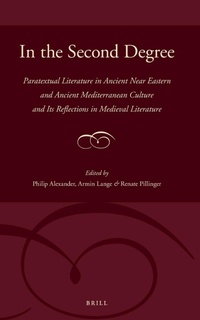
In the Second Degree
Paratextual Literature in Ancient Near Eastern and Ancient Mediterranean Culture and Its Reflections in Medieval Literature
Published on 29. October 2010
Book
Hardback
300 pages
978-90-04-18773-3 (ISBN)
Description
To better understand the phenomenon of Literature in the Second Degree - in Jewish and Biblical studies often characterized as parabiblical or Rewritten Bible - the current volume applies the theories of Gerard Genette to ancient and medieval literature from various cultures. Literature in the Second Degree realigns earlier (authoritative) texts to the dynamics of developing cultures and their changing cultural memories. In the case of authoritative base texts, Literature in the Second Degree reaffirms their authority by way of interpretative actualization. In the case of non-authoritative base texts it replaces them to effect cultural forgetting. Far from being just literary forgery (pseudepigraphy), Literature in the Second Degree has an important function in the development of the ancient and medieval cultures.
More details
Language
English
Place of publication
Leiden
Netherlands
Product notice
sewn/stitched
Cloth over boards
Dimensions
Height: 234 mm
Width: 155 mm
Thickness: 18 mm
Weight
594 gr
ISBN-13
978-90-04-18773-3 (9789004187733)
Copyright in bibliographic data and cover images is held by Nielsen Book Services Limited or by the publishers or by their respective licensors: all rights reserved.
Schweitzer Classification
Persons
Philip S. Alexander (PhD 1973, University of Oxford) is Professor of Post-Biblical Jewish Literature at the University of Manchester, Co-Director of its Center for Jewish Studies, and a member of the international team editiong the Dead Sea Scrolls. He as published extensively on Rabbinic Judaism and the Dead Sea Scrolls including The Mystical Texts (T & T Clark International, 2005).
Armin Lange (PhD 1994, University of Muenster) is Professr for Second Temple Judaism as the University of Vienna and a member of the International Team editing the Dead Sea Scrolls. He has published extensively on the Hebrew Bible, Second Temple Judaism, and the Dead Sea Scrolls including Handbuch der Textfunde vom Toten Meer, vol. 1: Die Handschriften biblischer Buecher von Qumran und den anderen Fundorten (Mohr Siebeck, 2009).
Renate J. Pillinger (PhD 1976, University of Vienna) is Professor of Early Christian Archeology at the University of Vienna. She has directed several exavations and published extensively on the history of Early Christian art including Studien zur roemischen Zwischengoldglaesern (Austrian Acadamy of Sciences, 1984).
Armin Lange (PhD 1994, University of Muenster) is Professr for Second Temple Judaism as the University of Vienna and a member of the International Team editing the Dead Sea Scrolls. He has published extensively on the Hebrew Bible, Second Temple Judaism, and the Dead Sea Scrolls including Handbuch der Textfunde vom Toten Meer, vol. 1: Die Handschriften biblischer Buecher von Qumran und den anderen Fundorten (Mohr Siebeck, 2009).
Renate J. Pillinger (PhD 1976, University of Vienna) is Professor of Early Christian Archeology at the University of Vienna. She has directed several exavations and published extensively on the history of Early Christian art including Studien zur roemischen Zwischengoldglaesern (Austrian Acadamy of Sciences, 1984).
Content
Abbreviations
Preface
Introduction
In the Second Degree: Ancient Jewish Paratextual Literature in the Context of Graeco-Roman and Ancient Near Eastern Literature
Armin Lange
I. Ancient Judaism Hypertextuality and the -Parabiblical|| Dead Sea Scrolls
George J. Brooke
The Book of Jubilees as Paratextual Literature
Jaques T. A. G. M. van Ruiten
II. Graeco-Roman World Trojan Palimpsests: The Relation of Greek Tragedy to the Homeric Epics
Annemarie AmbuehlThe Homeric Epics as Palimpsests
Georg Danek
III. Ancient Egypt and the Ancient Near East From Ritual to Text to Intertext: A New Look on
the Dreams in Ludlul Bel Nemeqi
Beate Pongratz-Leisten
Priestly Texts, Recensions, Rewritings and Paratexts in the Late Egyptian Period
Sydney H. Aufrere
IV. Late Ancient and Medieval Paratextual Literature Rabbinic Paratexts: The Case of Midrash Lamentations Rabba
Philip S. Alexander
Some Considerations on Enoch/Metatron in the Jewish Mystical Tradition
Felicia Waldman
Three Latin Paratexts from Late Antiquity and the Early Middle Ages (-Sulpicia,|| -Seneca||--Paulus,|| Carmen navale)
Kurt Smolak
Paratextual Literature in Early Christian Art (Acta Pauli et Theclae)
Renate J. Pillinger
Paratextual Literature in Action: Historical Apocalypses with the Names of Daniel and Isaiah in Byzantine and Old Bulgarian Tradition (11th-13th Centuries)
Anissava Miltenova
Preface
Introduction
In the Second Degree: Ancient Jewish Paratextual Literature in the Context of Graeco-Roman and Ancient Near Eastern Literature
Armin Lange
I. Ancient Judaism Hypertextuality and the -Parabiblical|| Dead Sea Scrolls
George J. Brooke
The Book of Jubilees as Paratextual Literature
Jaques T. A. G. M. van Ruiten
II. Graeco-Roman World Trojan Palimpsests: The Relation of Greek Tragedy to the Homeric Epics
Annemarie AmbuehlThe Homeric Epics as Palimpsests
Georg Danek
III. Ancient Egypt and the Ancient Near East From Ritual to Text to Intertext: A New Look on
the Dreams in Ludlul Bel Nemeqi
Beate Pongratz-Leisten
Priestly Texts, Recensions, Rewritings and Paratexts in the Late Egyptian Period
Sydney H. Aufrere
IV. Late Ancient and Medieval Paratextual Literature Rabbinic Paratexts: The Case of Midrash Lamentations Rabba
Philip S. Alexander
Some Considerations on Enoch/Metatron in the Jewish Mystical Tradition
Felicia Waldman
Three Latin Paratexts from Late Antiquity and the Early Middle Ages (-Sulpicia,|| -Seneca||--Paulus,|| Carmen navale)
Kurt Smolak
Paratextual Literature in Early Christian Art (Acta Pauli et Theclae)
Renate J. Pillinger
Paratextual Literature in Action: Historical Apocalypses with the Names of Daniel and Isaiah in Byzantine and Old Bulgarian Tradition (11th-13th Centuries)
Anissava Miltenova