


Rethinking Progress
Movements, Forces, and Ideas at the End of the Twentieth Century
1st Edition
Published on 23. August 1990
Book
Hardback
280 pages
978-0-04-445753-4 (ISBN)
Description
Rethinking Progress provides a challenging reevaluation of one of the crucial ideas of Western civilization; the notion of progress. Progress often seems to have become self-defeating, producing ecological deserts, overpopulated cities, exhausted resources, decaying cultures, and widespread feelings of alienation. The contributors, from all over the world, present their diversified perspectives on the fate of progress.
More details
Language
English
Place of publication
London
United Kingdom
Publishing group
Taylor & Francis Ltd
Target group
Professional and scholarly
Dimensions
Height: 240 mm
Width: 161 mm
Thickness: 20 mm
Weight
593 gr
ISBN-13
978-0-04-445753-4 (9780044457534)
Copyright in bibliographic data and cover images is held by Nielsen Book Services Limited or by the publishers or by their respective licensors: all rights reserved.
Schweitzer Classification
Other editions
Additional editions

Jeffrey C. Alexander | Piotr Sztompka
Rethinking Progress
Movements, Forces, and Ideas at the End of the Twentieth Century
Book
01/2016
1st Edition
Routledge
€72.40
Shipment within 10-20 days
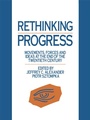
Jeffrey C. Alexander | Piotr Sztompka
Rethinking Progress
Movements, Forces, and Ideas at the End of the Twentieth Century
E-Book
09/2002
1st Edition
Routledge
€65.99
Available for download
Jeffrey C. Alexander | Piotr Sztompka
Rethinking Progress
Movements, Forces, and Ideas at the End of the Twentieth Century
E-Book
09/2002
1st Edition
Routledge
€65.99
Available for download
Persons
Jeffrey C. Alexander, Piotr Sztompka
Content
Introduction, Jeffrey C. Alexander, Piotr Sztompka; Part 1 Beyond progress and modernity; Chapter 1 Between progress and apocalypse: social theory and the dream of reason in the twentieth century, Jeffrey C. Alexander; Chapter 2 Problems of crisis and normalcy in the contemporary world, Robert Holton; Chapter 3 The decadence of modernity: the delusions of progress and the search for historical consciousness, Carlo Mongardini; Chapter 4 The cultural code of modernity and the problem of nature: a critique of the naturalistic notion of progress, Klaus Eder; Part 2 Rethinking the agents of progress; Chapter 5 Intellectuals and progress: the origins, decline, and revival of a critical group, Ron Eyerman; Chapter 6 Progress in the distribution of power: gender relations and women's movements as a source of change, Dietrich Rueschemeyer, Marilyn Rueschemeyer; Chapter 7 The end of western trade unionism?: social progress after the age of progressivism, David Kettler, Volker Meja; Part 3 Rethinking the mechanisms of progress; Chapter 8 Secularization and sacralization, Kenneth Thompson; Chapter 9 The democratization of differentiation: on the creativity of collective action, Hans Joas; Chapter 10 The relative autonomy of elites: the absorption of protest and social progress in western democracies, Eva Etzioni-Halevy; Part 4 New concepts of progress; Chapter 11 Models of directional change and human values: the theory of progress as an applied social science, Stepan Nowak; Chapter 12 Agency and progress: the idea of progress and changing theories of change, Piotr Sztompka; Index;