

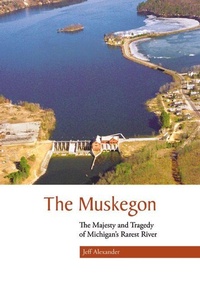
The Muskegon
The Majesty and Tragedy of Michigan's Rarest River
Published on 29. August 2006
Book
Paperback/Softback
238 pages
978-0-87013-786-0 (ISBN)
Description
Muskegon is a derivation of a Native American word meaning "river with marshes." Jeff Alexander examines the creation, uses of, devastation, and restoration of Michigan's historic and beautiful Muskegon River.
Four of the five Great Lakes touch Michigan's shores; the state's shoreline spans more than 4,500 miles, not to mention more than 11,000 inland lakes and a multitude of rivers. The Muskegon River, the state's second longest river, runs 227 miles and has the most diverse features of any of Michigan's many rivers. The Muskegon rises from the center of the state, widens, and moves westward, passing through the Pere Marquette and AuSable State Forests. The river ultimately flows toward Lake Michigan, where it opens into Muskegon Lake, a 12 square-mile, broad harbor located between the Muskegon River and Lake Michigan.
Formed several thousand years ago, when the glaciers that created the Great Lakes receded, and later inhabited by Ottawa and Potawatomi Indians, the Muskegon River was used by French fur trappers in the 1600s. Rich in white pine, the area was developed during the turn-of-the-century lumber boom, and at one time Muskegon Lake boasted more than 47 sawmills. The Muskegon was ravaged following settlement by Europeans, when rivers and streams were used to transport logs to the newly developing cities. Dams on rivers and larger streams provided power for sawmills and grain milling, and later provided energy for generating electricity as technology advanced.
There is now an ambitious effort to restore and protect this mighty river's natural features in the face of encroaching urbanization and land development that threatens to turn this majestic waterway into a mirror image of the Grand River, Michigan's longest river and one of its most polluted.
Four of the five Great Lakes touch Michigan's shores; the state's shoreline spans more than 4,500 miles, not to mention more than 11,000 inland lakes and a multitude of rivers. The Muskegon River, the state's second longest river, runs 227 miles and has the most diverse features of any of Michigan's many rivers. The Muskegon rises from the center of the state, widens, and moves westward, passing through the Pere Marquette and AuSable State Forests. The river ultimately flows toward Lake Michigan, where it opens into Muskegon Lake, a 12 square-mile, broad harbor located between the Muskegon River and Lake Michigan.
Formed several thousand years ago, when the glaciers that created the Great Lakes receded, and later inhabited by Ottawa and Potawatomi Indians, the Muskegon River was used by French fur trappers in the 1600s. Rich in white pine, the area was developed during the turn-of-the-century lumber boom, and at one time Muskegon Lake boasted more than 47 sawmills. The Muskegon was ravaged following settlement by Europeans, when rivers and streams were used to transport logs to the newly developing cities. Dams on rivers and larger streams provided power for sawmills and grain milling, and later provided energy for generating electricity as technology advanced.
There is now an ambitious effort to restore and protect this mighty river's natural features in the face of encroaching urbanization and land development that threatens to turn this majestic waterway into a mirror image of the Grand River, Michigan's longest river and one of its most polluted.
More details
Language
English
Place of publication
East Lansing, MI
United States
Product notice
Paperback (trade)
Unsewn / adhesive bound
Dimensions
Height: 238 mm
Width: 161 mm
Thickness: 15 mm
Weight
349 gr
ISBN-13
978-0-87013-786-0 (9780870137860)
Copyright in bibliographic data and cover images is held by Nielsen Book Services Limited or by the publishers or by their respective licensors: all rights reserved.
Schweitzer Classification
Person
Ieff Alexander has been an award-winning environmental journalist for more than 25 years and currently writes for The Muskegon Chronicle.
Content
Contents
Acknowledgments
Timeline of Muskegon River History
Prologue: Fatal Attraction
Introduction
Natural Wonder
A Working River
The Berlin Wall
Small Wonders
Alien Invasion
Bottleneck
Paradise Found
Pollution Revolution
Sacred Cows
A Tangled Web
Hungry Water
Fatal Attraction II
Liquid Gold Rush
Epilogue: Connecting with the River
Notes
Index
Acknowledgments
Timeline of Muskegon River History
Prologue: Fatal Attraction
Introduction
Natural Wonder
A Working River
The Berlin Wall
Small Wonders
Alien Invasion
Bottleneck
Paradise Found
Pollution Revolution
Sacred Cows
A Tangled Web
Hungry Water
Fatal Attraction II
Liquid Gold Rush
Epilogue: Connecting with the River
Notes
Index