

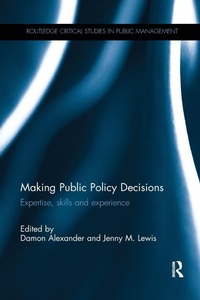
Making Public Policy Decisions
Expertise, skills and experience
1st Edition
Published on 11. April 2017
Book
Paperback/Softback
206 pages
978-1-138-74376-2 (ISBN)
Description
To understand public policy decisions, it is imperative to understand the capacities of the individual actors who are making them, how they think and feel about their role, and what drives and motivates them. However, the current literature takes little account of this, preferring instead to frame the decisions as the outcomes of a rational search for value-maximising alternatives or the result of systematic and well-ordered institutional and organisational processes.
Yet understanding how personal and emotional factors interact with broader institutional and organisational influences to shape the deliberations and behaviour of politicians and bureaucrats is paramount if we are to construct a more useful, nuanced and dynamic picture of government decision-making. This book draws on a variety of approaches to examine individuals working in contemporary government, from freshly-trained policy officers to former cabinet ministers and prime ministers. It provides important new insights into how those in government navigate their way through complex issues and decisions based on developed expertise that fuses formal, rational techniques with other learned behaviours, memories, emotions and practiced forms of judgment at an individual level.
This innovative collection from leading academics across Australia, Europe, the United Kingdom and North America will be of great interest to researchers, educators, advanced students and practitioners working in the fields of political science, public management and administration, and public policy.
Yet understanding how personal and emotional factors interact with broader institutional and organisational influences to shape the deliberations and behaviour of politicians and bureaucrats is paramount if we are to construct a more useful, nuanced and dynamic picture of government decision-making. This book draws on a variety of approaches to examine individuals working in contemporary government, from freshly-trained policy officers to former cabinet ministers and prime ministers. It provides important new insights into how those in government navigate their way through complex issues and decisions based on developed expertise that fuses formal, rational techniques with other learned behaviours, memories, emotions and practiced forms of judgment at an individual level.
This innovative collection from leading academics across Australia, Europe, the United Kingdom and North America will be of great interest to researchers, educators, advanced students and practitioners working in the fields of political science, public management and administration, and public policy.
Reviews / Votes
'For too long, the study of public policy-making has ignored the role of individual managers, politicians or community activists. This book brings them back into the frame. Importantly, it avoids the tendency to reduce everything to a question of super-heroic leadership skills and personal charisma. Instead, it takes the debate forward by analysing the ways in which the expertise and skill of individuals interact with their institutional settings and in the context of particular kinds of policy problems. This points towards a new agenda for research into the ways in which public policy is constructed, negotiated and realised.' - Chris Skelcher, Professor, University of Birmingham, UK'Each chapter in this excellent collection helps clarify the situation with respect to a relevant set of actors; providing a careful assessment of their motivations and inter-relationships as a decision-making process unfolds. As a result, taken as a whole, the volume moves our understanding of this key phase of public policy-making a considerable ways forward.' - Michael Howlett, Professor, Simon Fraser University, Canada and National University of Singapore, Singapore
More details
Series
Language
English
Place of publication
London
United Kingdom
Publishing group
Taylor & Francis Ltd
Target group
College/higher education
Illustrations
7 s/w Abbildungen, 7 s/w Zeichnungen, 11 s/w Tabellen
11 Tables, black and white; 7 Line drawings, black and white; 7 Illustrations, black and white
Dimensions
Height: 234 mm
Width: 156 mm
Thickness: 12 mm
Weight
327 gr
ISBN-13
978-1-138-74376-2 (9781138743762)
Copyright in bibliographic data and cover images is held by Nielsen Book Services Limited or by the publishers or by their respective licensors: all rights reserved.
Schweitzer Classification
Other editions
Additional editions
Book
12/2014
1st Edition
Routledge
€243.10
Shipment within 10-20 days
E-Book
12/2014
1st Edition
Routledge
€55.49
Available for download
E-Book
12/2014
1st Edition
Routledge
€55.49
Available for download
Persons
Dr Damon Alexander is a Senior Research Fellow in the School of Social and Political Sciences, University of Melbourne. His research covers public policy decision making; innovation; political/policy networks; and local government reform. His previous book, Networks, Innovation and Public Policy, was published in 2009.
Professor Jenny M. Lewis is Professor of Public Policy in the School of Social and Political Sciences at the University of Melbourne, and an Australian Research Council Future Fellow for 2013-16. Jenny is a public policy expert, with particular interests in governance, policy influence, and the policy process. Her most recent book, Academic Governance: Disciplines and Policy, was published by Routledge in 2013.
Professor Jenny M. Lewis is Professor of Public Policy in the School of Social and Political Sciences at the University of Melbourne, and an Australian Research Council Future Fellow for 2013-16. Jenny is a public policy expert, with particular interests in governance, policy influence, and the policy process. Her most recent book, Academic Governance: Disciplines and Policy, was published by Routledge in 2013.
Content
1. Making Policy Decisions 2: Not Only What, But How: The Role of expertise in developing public sector leadership 3. How Governments Think: Skills, expertise, and experience in public policy making 4. A Matter of Personality? Stability and change in EU leaders' beliefs during the Euro-crisis 5. The Impact of Expertise on Crisis Management: Real-time evidence on response decisions by a public health agency during the 2009 H1N1 pandemic 6. Performing a Collaborative Self: Emotions, expertise and ethics in network decisions 7. Decision-Making at the Frontline: Exploring coping with moral conflicts during public service delivery 8. Policy Entrepreneurs, Creative Teamwork, and Policy Change 9. Prime Ministers' Chiefs of Staff: Coping with wild treachery and weirdness 10. Leadership of Reforming Governments: The role of political tandems