

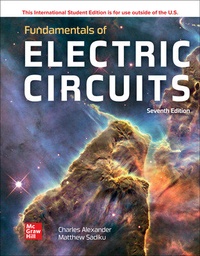
ISE Fundamentals of Electric Circuits
7th Edition
Published on 28. February 2020
Book
Paperback/Softback
1984 pages
978-1-260-57079-3 (ISBN)
Description
Fundamentals of Electric Circuits continues in the spirit of its successful previous editions, with the objective of presenting circuit analysis in a manner that is clearer, more interesting, and easier to understand than other, more traditional texts. A balance of theory, worked & extended examples, practice problems, and real-world applications, combined with over 580 new or changed homework problems complete this edition.
Robust media offerings renders this text to be the most comprehensive and student-friendly approach to linear circuit analysis. The seventh edition retains the "Design a Problem" feature which helps students develop their design skills by having the student develop the question, as well as the solution. There are over 100 "Design a Problem" exercises integrated into problem sets in the book.
McGraw-Hill's Connect, is also available with Fundamentals of Electric Circuits. Connect provides an ebook experience for students and enables professors to assign and assess reading, homework, quizzes, and tests easily and automatically grades and records the scores of the student's work. Problems are randomized to prevent sharing of answers an may also have a "multi-step solution" which helps move the students' learning along if they experience difficulty.
Robust media offerings renders this text to be the most comprehensive and student-friendly approach to linear circuit analysis. The seventh edition retains the "Design a Problem" feature which helps students develop their design skills by having the student develop the question, as well as the solution. There are over 100 "Design a Problem" exercises integrated into problem sets in the book.
McGraw-Hill's Connect, is also available with Fundamentals of Electric Circuits. Connect provides an ebook experience for students and enables professors to assign and assess reading, homework, quizzes, and tests easily and automatically grades and records the scores of the student's work. Problems are randomized to prevent sharing of answers an may also have a "multi-step solution" which helps move the students' learning along if they experience difficulty.
More details
Edition
7th edition
Language
English
Place of publication
OH
United States
Target group
College/higher education
US School Grade: From College Freshman to College Graduate Student
Illustrations
2131 Illustrations
Dimensions
Height: 257 mm
Width: 185 mm
Thickness: 38 mm
Weight
1588 gr
ISBN-13
978-1-260-57079-3 (9781260570793)
Copyright in bibliographic data and cover images is held by Nielsen Book Services Limited or by the publishers or by their respective licensors: all rights reserved.
Schweitzer Classification
Persons
Dr. Charles K. Alexander is a Professor of Electrical and Computer Engineering at Cleveland State University, Cleveland, Ohio. He is also the Director of the Center for Research in Electronics and Aerospace Technology (CREATE). From 2002 until 2006 he was Dean of the Fenn College of Engineering. He has held the position of Dean of Engineering at Cleveland State University, California State University, Northridge, and Temple University (acting Dean for six years). He has held the position of Department Chair at Temple University and Tennessee Technological University as well as the position of Stocker Visiting Professor (an Endowed Chair) at Ohio University. He has held faculty status at all of the aforementioned Universities.
Matthew N. O. Sadiku received his PhD from Tennessee Technological University, Cookeville. From 1984 to 1988, he was Assistant Professor at Florida Atlantic University, where he did graduate work in Computer Science. From 1988 to 2000, he was at Temple University, Philadelphia, Pennsylvania, where he became a full Professor. From 2000 to 2002, he was with Lucent/Avaya, Holmdel, New Jersey, as a System Engineer and with Boeing Satellite Systems as a Senior Scientist. He is currently a professor at Prairie View A&M University.
Matthew N. O. Sadiku received his PhD from Tennessee Technological University, Cookeville. From 1984 to 1988, he was Assistant Professor at Florida Atlantic University, where he did graduate work in Computer Science. From 1988 to 2000, he was at Temple University, Philadelphia, Pennsylvania, where he became a full Professor. From 2000 to 2002, he was with Lucent/Avaya, Holmdel, New Jersey, as a System Engineer and with Boeing Satellite Systems as a Senior Scientist. He is currently a professor at Prairie View A&M University.
Content
Part One - DC Circuits
1) Basic Concepts
2) Basic Laws
3) Methods of Analysis
4) Circuit Theorems
5) Operational Amplifiers
6) Capacitors and Inductors
7) First-Order Circuits
8) Second-Order Circuits
Part Two - AC Circuits
9) Sinusoids and Phasors
10) Sinusoidal Steady-State Analysis
11) AC Power Analysis
12) Three-Phase Circuits
13) Magnetically Coupled Circuits
14) Frequency Response
Part Three - Advanced Circuit Analysis
15) Introduction to the Laplace Transform
16) Applications of the Laplace Transform
17) The Fourier Series
18) Fourier Transform
19) Two-Port Networks
1) Basic Concepts
2) Basic Laws
3) Methods of Analysis
4) Circuit Theorems
5) Operational Amplifiers
6) Capacitors and Inductors
7) First-Order Circuits
8) Second-Order Circuits
Part Two - AC Circuits
9) Sinusoids and Phasors
10) Sinusoidal Steady-State Analysis
11) AC Power Analysis
12) Three-Phase Circuits
13) Magnetically Coupled Circuits
14) Frequency Response
Part Three - Advanced Circuit Analysis
15) Introduction to the Laplace Transform
16) Applications of the Laplace Transform
17) The Fourier Series
18) Fourier Transform
19) Two-Port Networks