

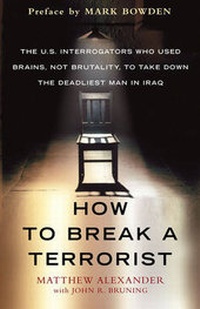
How to Break a Terrorist
The U.S. Interrogators Who Used Brains, Not Brutality, to Take Down the Deadliest Man in Iraq
Published on 2. December 2008
Book
Hardback
304 pages
978-1-4165-7315-9 (ISBN)
Description
In the wake of the torture scandals at Abu Ghraib and Guantanamo, the government has rushed to Iraq a new breed of interrogator. Matthew Alexander, a former criminal investigator and head of a crack interrogation team, tells the story of how he and his team used psychological warfare to track down Abu Musab Zarqawi, the leader of Al Qaeda in Iraq.
The interrogator's job is simple: get the right information in a timely fashion. Finding Abu Musab Zarqawi had long been the US military's top priority--even trumping the search for Osama Bin Laden. No brutality was spared in trying to squeeze information from detainees. But when the Military brought in Matthew the exertions of Special Forces had yielded exactly nothing.
So Matthew and his team decided to sit down and get to know their opponents. Who were these monsters so impervious to violence? Who were they fighting for? What were they trying to protect? The intelligence coup that enabled the June 7, 2006 air strike on Zarqawi's rural safe house northeast of Baghdad was the result of a painstaking and dramatic manhunt, but it was not the result of what Matthew calls "force on force" interactions.
First featured in an Atlanticcover story by Mark Bowden, this is more of a true-crime or psychological suspense story than a war memoir.
The interrogator's job is simple: get the right information in a timely fashion. Finding Abu Musab Zarqawi had long been the US military's top priority--even trumping the search for Osama Bin Laden. No brutality was spared in trying to squeeze information from detainees. But when the Military brought in Matthew the exertions of Special Forces had yielded exactly nothing.
So Matthew and his team decided to sit down and get to know their opponents. Who were these monsters so impervious to violence? Who were they fighting for? What were they trying to protect? The intelligence coup that enabled the June 7, 2006 air strike on Zarqawi's rural safe house northeast of Baghdad was the result of a painstaking and dramatic manhunt, but it was not the result of what Matthew calls "force on force" interactions.
First featured in an Atlanticcover story by Mark Bowden, this is more of a true-crime or psychological suspense story than a war memoir.
Reviews / Votes
"[T]his is an excellent account of a high-profile victory in the often-hidden intelligence war that is at the heart of the U.S. effort in Iraq.... It is generally agreed that the Global War on Terrorism is first and foremost an intelligence war. Alexander's story offers us an absorbing behind-the=scenes look at the secret intelligence war within a war." -- www.military.comMore details
Language
English
Place of publication
New York
United States
Publishing group
Simon & Schuster
Illustrations
index; 8pp b+w photos; 4 illust t-o
Dimensions
Height: 214 mm
Width: 140 mm
Thickness: 30 mm
Weight
431 gr
ISBN-13
978-1-4165-7315-9 (9781416573159)
Copyright in bibliographic data and cover images is held by Nielsen Book Services Limited or by the publishers or by their respective licensors: all rights reserved.
Schweitzer Classification
Other editions
Additional editions
Matthew Alexander | John Bruning
How to Break a Terrorist
The U.S. Interrogators Who Used Brains, Not Brutality, to Take Down the Deadliest Man in Iraq
E-Book
12/2008
Free Press
€17.79
Available for download
Persons
Matthew Alexander spent fourteen years in the U.S. Air Force and is now part of the U.S. Air Force Reserves. He has personally conducted more than 300 interrogations in Iraq and supervised more than 1,000. Matthews was awarded the Bronze Star Medal for his achievement in Iraq, has two advanced degrees, and speaks three languages. When he's not chasing the world's most wanted, he goes surfing.
John R. Bruning is a prolific military and aviation historian who is the author and collaborator of many bestselling books.
John R. Bruning is a prolific military and aviation historian who is the author and collaborator of many bestselling books.