

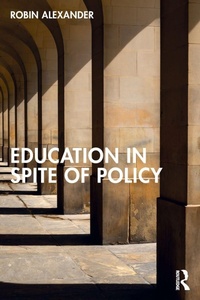
Education in Spite of Policy
1st Edition
Published on 31. December 2021
Book
Paperback/Softback
400 pages
978-1-138-04987-1 (ISBN)
Description
A national system of education cannot function without policy. But the path to practice is seldom smooth, especially when ideology overrules evidence or when ministers seek to micromanage what is best left to teachers. And once the media join the fray the mixture becomes downright combustible.
Drawing on his long experience as teacher, researcher, government adviser, campaigner and international consultant, and on over 600 published sources, Robin Alexander expertly illustrates and illuminates these processes. This selection from his recent writing, some hitherto unpublished, opens windows onto cases and issues that concern every teacher.
Part 1 tackles system-level reform. It revisits the Cambridge Primary Review, an evidence-rich enquiry into the condition and future of primary education in England, which challenged the UK government's policies on curriculum, testing, standards and more besides. Here the reform narratives and strategies of successive governments are confronted and dissected.
Part 2 follows the development of England's current National Curriculum, exposing its narrow vision and questionable use of evidence and offering a more generous aims-driven alternative. This section also investigates the expertise and leadership needed if children are to experience a curriculum of the highest quality in all its aspects.
Part 3 reaches the heart of the matter: securing the place in effective pedagogy of well-founded classroom talk, a mission repeatedly frustrated by political intervention. The centrepiece is dialogic teaching, a proven tool for advancing students' speaking, thinking, learning and arguing, and an essential response to the corrosion of democracy and the nihilism of 'post-truth'.
Part 4 goes global. It investigates governments' PISA-fuelled flirtations with what they think can be adapted or copied from education elsewhere, examines the benefits and pitfalls of international comparison, and ends with the ultimate policy initiative: the United Nations mission to ensure 'inclusive and equitable quality education' for all the world's children.
Education in Spite of Policy is for all those teachers, students, school leaders and researchers who value the conversation of policy, evidence and practice, and who wish to explore the parts of education that policy cannot reach.
Drawing on his long experience as teacher, researcher, government adviser, campaigner and international consultant, and on over 600 published sources, Robin Alexander expertly illustrates and illuminates these processes. This selection from his recent writing, some hitherto unpublished, opens windows onto cases and issues that concern every teacher.
Part 1 tackles system-level reform. It revisits the Cambridge Primary Review, an evidence-rich enquiry into the condition and future of primary education in England, which challenged the UK government's policies on curriculum, testing, standards and more besides. Here the reform narratives and strategies of successive governments are confronted and dissected.
Part 2 follows the development of England's current National Curriculum, exposing its narrow vision and questionable use of evidence and offering a more generous aims-driven alternative. This section also investigates the expertise and leadership needed if children are to experience a curriculum of the highest quality in all its aspects.
Part 3 reaches the heart of the matter: securing the place in effective pedagogy of well-founded classroom talk, a mission repeatedly frustrated by political intervention. The centrepiece is dialogic teaching, a proven tool for advancing students' speaking, thinking, learning and arguing, and an essential response to the corrosion of democracy and the nihilism of 'post-truth'.
Part 4 goes global. It investigates governments' PISA-fuelled flirtations with what they think can be adapted or copied from education elsewhere, examines the benefits and pitfalls of international comparison, and ends with the ultimate policy initiative: the United Nations mission to ensure 'inclusive and equitable quality education' for all the world's children.
Education in Spite of Policy is for all those teachers, students, school leaders and researchers who value the conversation of policy, evidence and practice, and who wish to explore the parts of education that policy cannot reach.
Reviews / Votes
"I found it inspirational because, along with the disappointments and frustrations, there is another feature which shines through every page: the author's passionate concern for the world's children and their education. It is, above all, the record of a man who has devoted his life, whatever the difficulties, to making a difference." - Derek Gillard, ForumMore details
Language
English
Place of publication
London
United Kingdom
Publishing group
Taylor & Francis Ltd
Target group
Professional and scholarly
Professional
Illustrations
4 s/w Abbildungen, 4 s/w Zeichnungen, 4 s/w Tabellen
4 Tables, black and white; 4 Line drawings, black and white; 4 Illustrations, black and white
Dimensions
Height: 234 mm
Width: 156 mm
Thickness: 23 mm
Weight
623 gr
ISBN-13
978-1-138-04987-1 (9781138049871)
Copyright in bibliographic data and cover images is held by Nielsen Book Services Limited or by the publishers or by their respective licensors: all rights reserved.
Schweitzer Classification
Other editions
Additional editions
Book
12/2021
1st Edition
Routledge
€208.80
Shipment within 10-20 days
E-Book
12/2021
1st Edition
Routledge
€52.49
Available for download
E-Book
12/2021
1st Edition
Routledge
€52.49
Available for download
Person
Robin Alexander is Fellow of Wolfson College at the University of Cambridge, Professor of Education Emeritus at the University of Warwick, and Fellow of the British Academy. His five-nation Culture and Pedagogy (2001) won the Outstanding Book Award of the American Educational Research Association, while Children, their World, their Education (2010), and his work as director of the Cambridge Primary Review, won the SES Book Awards First Prize and the BERA/Sage Public Impact and Engagement Award. His most recent book, A Dialogic Teaching Companion (2020), is a summation of many years of work on the quality of talk in teaching and learning.
Content
Introduction
PART 1 - ABOVE THE PARAPET
A tale of two reviews
Health of a nation
Success, amnesia and collateral damage
Triumph of the eristic
What works and what matters
Evidence, mediation and narrative
PART 2 - CURRICULUM CONVOLUTIONS
Reform, retrench or recycle?
Epistemic imbroglio
Entitlement, freedom and minimalism
Neither national nor a curriculum
Beyond the reach of art
True grit
Curriculum capacity and leadership
PART 3 - SPEAKING BUT NOT LISTENING
Promise and politics of talk
Evaluating dialogic teaching
The unquestioned answer
Dialogic pedagogy in a post-truth world
PART 4 - EDUCATION FOR ALL
Towards a comparative pedagogy
World beating or world sustaining?
Moral panic and miracle cures
In pursuit of quality
Bibliography
PART 1 - ABOVE THE PARAPET
A tale of two reviews
Health of a nation
Success, amnesia and collateral damage
Triumph of the eristic
What works and what matters
Evidence, mediation and narrative
PART 2 - CURRICULUM CONVOLUTIONS
Reform, retrench or recycle?
Epistemic imbroglio
Entitlement, freedom and minimalism
Neither national nor a curriculum
Beyond the reach of art
True grit
Curriculum capacity and leadership
PART 3 - SPEAKING BUT NOT LISTENING
Promise and politics of talk
Evaluating dialogic teaching
The unquestioned answer
Dialogic pedagogy in a post-truth world
PART 4 - EDUCATION FOR ALL
Towards a comparative pedagogy
World beating or world sustaining?
Moral panic and miracle cures
In pursuit of quality
Bibliography