

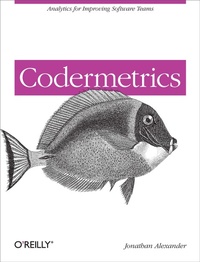
Codermetrics
Analytics for Improving Software Teams
1st Edition
Will be published approx. on 27. September 2011
Book
260 pages
978-1-4493-0515-4 (ISBN)
Description
How can you help your software team improve? This concise book introduces codermetrics, a clear and objective way to identify, analyze, and discuss the successes and failures of software engineers-not as part of a performance review, but as a way to make the team a more cohesive and productive unit.
Experienced team builder Jonathan Alexander explains how codermetrics helps teams understand exactly what occurred during a project, and enables each coder to focus on specific improvements. Alexander presents a variety of simple and complex codermetrics, and teaches you how to create your own.
* Learn how codermetrics changes long-held assumptions and improves team dynamics
* Get recommendations for integrating codermetrics into existing processes
* Ask the right questions to determine the type of data you need to collect
* Use metrics to measure individual coder skills and a team's effectiveness over time
* Identify the contributions each coder makes to the team
* Analyze the response to your software and its features-and verify that you're meeting team and organizational goals
* Build better teams, using codermetrics to make personnel adjustments and additions
More details
Other editions
Additional editions
E-Book
08/2011
1st Edition
O'Reilly
€35.99
Available for download
E-Book
08/2011
1st Edition
O'Reilly
€32.99
Available for download
Person
Jonathan Alexander has over 25 years of experience in software development. He is currently VP of Engineering at Vocalocity, a leader in cloud-based business telecommunications. Previously he built and managed software teams at vmSight, Epiphany, and Radnet. He studied computer science at UCLA, and began his career writing software for author Michael Crichton.
Content
Preface;
Organization of This Book;
Safari® Books Online;
How to Contact Us;
Acknowledgments;
Concepts;
Chapter 1: Introduction;
Chapter 2: Measuring What Coders Do;
2.1 The Purpose of Metrics;
2.2 Timeout for an Example: The Magic Triangle (Partially) Debunked;
2.3 Patterns, Anomalies, and Outliers;
2.4 Understanding the Limits;
2.5 Timeout for an Example: An Unexpected Factor in Success;
2.6 Useful Data;
2.7 Timeout for an Example: Metrics and the Skeptic;
Chapter 3: The Right Data;
3.1 Questions That Metrics Can Help Answer;
3.2 Timeout for an Example: An MVP Season;
3.3 The Data for Metrics;
3.4 Timeout for An Example: A Tale of Two Teams;
Metrics;
Chapter 4: Skill Metrics;
4.1 Input Data;
4.2 Offensive Metrics;
4.3 Defensive Metrics;
4.4 Precision Metrics;
4.5 Skill Metric Scorecards;
4.6 Observations on Coder Types;
Chapter 5: Response Metrics;
5.1 Input Data;
5.2 Win Metrics;
5.3 Loss Metrics;
5.4 Momentum Metrics;
5.5 Response Metric Scorecards;
5.6 Observations on Project Types;
Chapter 6: Value Metrics;
6.1 Input Data;
6.2 Contribution Metrics;
6.3 Rating Metrics;
6.4 Value Metric Scorecards;
6.5 Observations on Team Stages;
Processes;
Chapter 7: Metrics in Use;
7.1 Getting Started;
7.2 Timeout for an Example: The Seven Percent Rule;
7.3 Utilizing Metrics in the Development Process;
7.4 Timeout for an Example: The Turn-Around;
7.5 Using Metrics in Performance Reviews;
7.6 Taking Metrics Further;
7.7 Timeout for an Example: The Same But Different;
Chapter 8: Building Software Teams;
8.1 Goals and Profiles;
8.2 Roles;
8.3 Timeout for an Example: Two All-Nighters;
8.4 Personnel;
8.5 Timeout for an Example: No Such Thing As a Perfect Team;
Chapter 9: Conclusion;
Codermetrics Quick Reference;
Bibliography;
Colophon;