

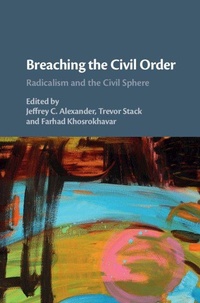
Breaching the Civil Order
Radicalism and the Civil Sphere
Published on 12. December 2019
Book
Hardback
678 pages
978-1-108-42723-4 (ISBN)
Description
It is not only a paradox but something of an intellectual scandal that, in an era so shaken by radical actions and ideologies, social science has had nothing theoretically new to say about radicalism since the middle of the last century. Breaching the Civil Order fills this void. It argues that, rather than seeing radicalism in substantive terms - as violent or militant, communist or fascist - radicalism should be seen more broadly as any organized effort to breach the civil order. The theory is brilliantly made flesh in a series of case studies by leading European and American social scientists, from the destruction of property in the London race riots to the public militancy of Black Lives Matter in the US, the performative violence of the Irish IRA and the Mexican Zapatistas to the democratic upheavals of the Arab Spring, and from Islamic terrorism in France to Germany's right-wing populist Pegida.
Reviews / Votes
'This book brings together a fascinating range of contemporary case studies around a central provocative theme: what makes collective actors breach the civil order? And what happens when they do? I particularly appreciate the attention to the nature of the 'civil sphere' and its translation into real world 'flesh and blood' examples of radical action. The intelligent analytical framing of the case studies by the editors makes this a valuable and stimulating contribution to scholarship on contemporary politics and society.' Cristina Flesher Fominaya, Loughborough University 'Civil sphere theory (CST) is one of the most important and exciting advances to reshape the study of politics and society in the last fifteen years. Decisively refuting the notion that radical politics have no place in the framework of CST, this groundbreaking volume by more than a dozen leading theorists places radicalism front and center. Pushing us to rethink what we thought we already understood, it offers fresh insights into political radicalism and its complex and varying relationship to civil solidarity. At the same time, its creative reexamination of radicalism serves to revise, develop, and expand CST in promising new directions. Breaching the Civil Order is required reading for everyone who wishes to grasp social solidarity by the root. Chad Alan Goldberg, University of Wisconsin, MadisonMore details
Language
English
Place of publication
Cambridge
United Kingdom
Target group
Professional and scholarly
Illustrations
Worked examples or Exercises; 8 Line drawings, black and white
Dimensions
Height: 235 mm
Width: 157 mm
Thickness: 22 mm
Weight
647 gr
ISBN-13
978-1-108-42723-4 (9781108427234)
Copyright in bibliographic data and cover images is held by Nielsen Book Services Limited or by the publishers or by their respective licensors: all rights reserved.
Schweitzer Classification
Other editions
Additional editions
E-Book
12/2019
Cambridge University Press
€73.99
Available for download
Persons
Content
Introduction Jeffrey C. Alexander and Trevor Stack; 1. Wedging open established civil spheres: a comparative approach to their emancipatory potential Trevor Stack; 2. Radical protest in a university campus: performances of civil transition in Colombia Carlo Tognato; 3. Antiracism movements and the US civil sphere: the case of Black Lives Matter Stephen F. Ostertag; 4. The civil sphere and its variants in light of the Arab revolutions and jihadism in Europe Farhad Khosrokhavar; 5. Restaging a vital center within radicalized civil societies: the media, performativity, and the Charlie Hebdo attack Maria Luengo and Karoline Andrea Ihlebaek; 6. Anti-immigrant movements and the self-poisoning of the civil sphere: the case of Germany Volker M. Heins and Christine Unrau; 7. The civil sphere and the Irish Republican movement, 1970-1998 Anne Kane; 8. 'We all came together that day': the 2011 English riots as an enactment of solidarity Yasushi Tanaka-Gutiez; 9. Disobedience in civil regeneration: radical transformations in the civil sphere Maeve Cooke; Commentary Liv Egholm; Conclusion Peter Kivisto and Giuseppe Sciortino.