

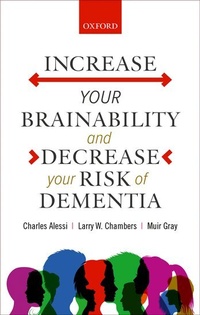
Increase your Brainability-and Reduce your Risk of Dementia
Published on 27. May 2021
Book
Paperback/Softback
176 pages
978-0-19-886034-1 (ISBN)
Description
Dreaded by many people as an inevitable part of normal aging, Dementia has displaced Cancer as the most feared health problem. Cancer continues to be a serious condition, but it is often curable, and almost always treatable. In contrast, the fear of dementia is complicated by the fear of ageing, and by muddled thinking about its relationship with Alzheimer's disease.
Yet, there is no reason to be disheartened. Ever-evolving scientific evidence means that we can be increasingly optimistic about the future, and on-going research shows that the problems we dread- dementia, disability and dependency- can be controlled. By taking steps to limit damage to the brain caused by stress, sleep problems, and inactivity throughout our lives, it is more than possible to substantially reduce your risk of dementia. Equally, a loss of physical fitness (which starts long before old age) is preventable.
Based on research from the Optimal Ageing Programme, and full of practical, evidence-based advice on managing the major risk factors underpinning dementia, this book will inspire readers to fight back against the modern environment and negative societal attitudes. Through simple but effective lifestyle changes that anyone can make, everyone can take positive action to increase their brainability.
It is never too late to change your life, reduce your risk, and live better for longer.
Yet, there is no reason to be disheartened. Ever-evolving scientific evidence means that we can be increasingly optimistic about the future, and on-going research shows that the problems we dread- dementia, disability and dependency- can be controlled. By taking steps to limit damage to the brain caused by stress, sleep problems, and inactivity throughout our lives, it is more than possible to substantially reduce your risk of dementia. Equally, a loss of physical fitness (which starts long before old age) is preventable.
Based on research from the Optimal Ageing Programme, and full of practical, evidence-based advice on managing the major risk factors underpinning dementia, this book will inspire readers to fight back against the modern environment and negative societal attitudes. Through simple but effective lifestyle changes that anyone can make, everyone can take positive action to increase their brainability.
It is never too late to change your life, reduce your risk, and live better for longer.
Reviews / Votes
This is a great book for anyone wanting to take a step back and look at the proactive possibilities of dealing with the threat of dementia. The clinical details are dealt with simply and in a way that makes it easy for anyone to understand. The authors do an excellent job of bringing fresh ideas and fresh research to help people transition from fearing brain disease to improving brain health. * Wendy Boren, MU Sinclair School of Nursing) *More details
Language
English
Place of publication
Oxford
United Kingdom
Dimensions
Height: 217 mm
Width: 140 mm
Thickness: 10 mm
Weight
254 gr
ISBN-13
978-0-19-886034-1 (9780198860341)
Copyright in bibliographic data and cover images is held by Nielsen Book Services Limited or by the publishers or by their respective licensors: all rights reserved.
Schweitzer Classification
Other editions
Additional editions
Charles Alessi | Larry W. Chambers | Muir Gray
Increase your Brainability-and Reduce your Risk of Dementia
E-Book
05/2021
1st Edition
OUP eBook
€12.49
Available for download
Charles Alessi | Larry W. Chambers | Muir Gray
Increase your Brainability-and Reduce your Risk of Dementia
E-Book
05/2021
1st Edition
OUP eBook
€12.49
Available for download
Persons
Dr. Charles Alessi is a globally recognized and trusted leader in health care. He is the global chief clinical officer of HIMSS, a mission driven, not for profit global membership organisation. He is a physician in London, with more than 35 years of experience in all aspects of clinical practice in the UK National Health Service. Most recently, he served as the Chairman of the National Association of Primary Care, part of the NHS confederation, where he was at the heart of the recent health and social care reforms. He is also the Senior Advisor to Public Health England, a position leading thought leadership around productive healthy ageing including dementia, targeting risk reduction. Furthermore, he fulfils key roles in PHE around digital interventions, particularly those that involve behavioral change. Other responsibilites include air quality and antibiotic prescribing. He leads thought leadership around productive healthy aging.
Former Scientific Advisor to the Alzheimer Society of Canada, Professor Chambers' research career has contributed to our understanding of many issues for people living with dementia. As a leader of the Canadian Study on Health and Aging, this was the first nation-wide Canadian population study of dementia prevalence, incidence and caregiver issues by following the health trajectory of 10,000 older adult Canadians for 10 years. Professor Chambers co-led with the award-winning community wide program to prevent cardiovascular disease, a major cause of dementia. The Cardiovascular Health Awareness Program has received awards from the British Medical Journal, Canadian Institutes for Health Research, American Heart Association and the Canadian Medical Association Journal. Professor Chambers' work on evaluating the effectiveness of community screening for the signs of dementia has received international recognition.
Muir Gray entered the Public Health Service in Oxford in 1972 after qualifying in medicine in Glasgow and is a consultant in public health. He has been working with both NHS England and Public Health England with the aim of increasing value for both populations and individuals and published How To Get Better Value Healthcare in 2007. The means of doing this through Systems and Personalisation is now called Population Healthcare, the aim of which is to maximise value and equity by focusing not on institutions, specialties or technologies, but on populations defined by a common symptom such as breathlessness, condition such as type 1 or Type 2 Diabetes or by a common characteristic, such as multiple morbidity. Recently he has returned to his first public health mission - preventing the changes we assume are due to ageing and disease by getting the right attitude and fighting back against an environment that makes us inactive.
Former Scientific Advisor to the Alzheimer Society of Canada, Professor Chambers' research career has contributed to our understanding of many issues for people living with dementia. As a leader of the Canadian Study on Health and Aging, this was the first nation-wide Canadian population study of dementia prevalence, incidence and caregiver issues by following the health trajectory of 10,000 older adult Canadians for 10 years. Professor Chambers co-led with the award-winning community wide program to prevent cardiovascular disease, a major cause of dementia. The Cardiovascular Health Awareness Program has received awards from the British Medical Journal, Canadian Institutes for Health Research, American Heart Association and the Canadian Medical Association Journal. Professor Chambers' work on evaluating the effectiveness of community screening for the signs of dementia has received international recognition.
Muir Gray entered the Public Health Service in Oxford in 1972 after qualifying in medicine in Glasgow and is a consultant in public health. He has been working with both NHS England and Public Health England with the aim of increasing value for both populations and individuals and published How To Get Better Value Healthcare in 2007. The means of doing this through Systems and Personalisation is now called Population Healthcare, the aim of which is to maximise value and equity by focusing not on institutions, specialties or technologies, but on populations defined by a common symptom such as breathlessness, condition such as type 1 or Type 2 Diabetes or by a common characteristic, such as multiple morbidity. Recently he has returned to his first public health mission - preventing the changes we assume are due to ageing and disease by getting the right attitude and fighting back against an environment that makes us inactive.
Author
Global Chief Clinical Officer, HIMSS Senior AdvisorGlobal Chief Clinical Officer, HIMSS Senior Advisor, Public Health England
Professor EmeritusProfessor Emeritus, Department of Health Methods, Evidence and Impact, Faculty of Health Sciences, McMaster University, Hamilton, Canada
DirectorDirector, Optimal Ageing Programme, Oxford, UK
Content
Author Biographies 1 Living Longer Better 2 Understanding the Potential for Protecting and Improving Brainability 3 Keep Your Brain Tissue Healthy 4 Maintain and Increase Blood Supply to the Brain 5 Increase Your Ability to Interact with People and Ideas 6 The Future of Brainability Index